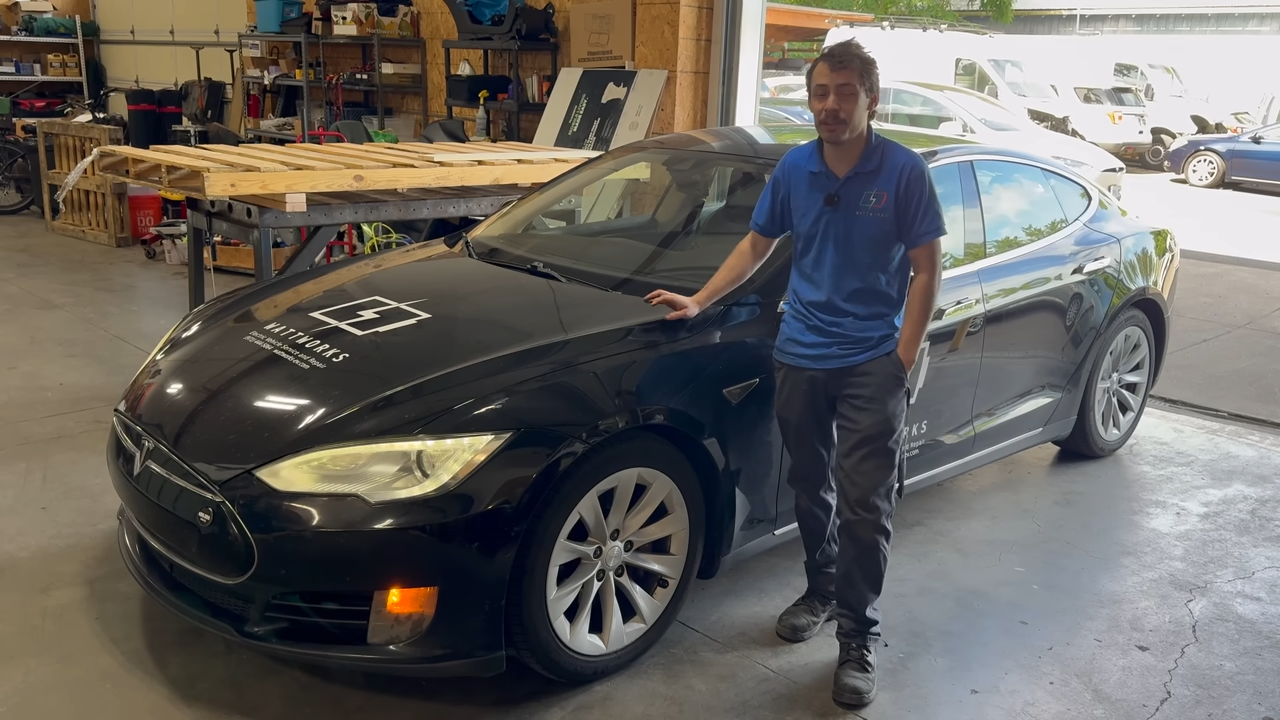
A Tesla Model S with more than 470,000 miles on the odometer received a major upgrade when its owner replaced its aging battery with a newer 100 kWh pack. The installation itself was relatively straightforward, but getting the car’s software to accept the new hardware proved considerably more difficult.
Alex, the mechanic behind the Out of Spec Renew YouTube channel, documented the project in a video published June 16, 2025. His Model S 70D had already received one battery replacement at approximately 250,000 miles, making this its third battery pack.
For the latest upgrade, Alex sourced a replacement battery manufactured in January 2022. The 100 kWh pack had been installed in another Tesla before that vehicle was wrecked and sent to a dismantling yard.
The larger battery promised more driving range and improved performance, potentially making the high-mileage electric sedan considerably more useful for daily driving and road trips.
Swapping the Battery
Embedded media follows; please allow a moment to load.
Alex began by inspecting the salvaged battery, checking its connectors, and performing a pressure test to verify that the enclosure was properly sealed.
After confirming the pack held pressure, he disconnected the car’s electrical systems and removed the original battery using a vehicle lift and support table.
The older Model S architecture made the physical replacement relatively simple. Tesla originally designed these vehicles with battery swapping in mind, incorporating a connection system known as Rapid Mate.
The system allows the battery’s electrical and coolant connections to engage when the pack is installed.
Alex replaced the newer battery’s connector ring with an older compatible version and installed different shear plates. He then carefully positioned the replacement pack beneath the vehicle.
Software Problems
Although the battery physically fit, the car initially refused to operate normally.
Alex encountered multiple software errors while attempting to pair the replacement battery with the vehicle. The process included failed battery management routines, software reinstallation, and configuration mismatches.
Eventually, the car recognized its new battery and displayed the updated 100D designation. However, another problem arose: a drive inverter configuration mismatch that severely limited the vehicle’s power output.
During an initial test drive, Alex demonstrated that the car accelerated slowly despite applying full throttle.
The following morning, he determined that the vehicle’s performance configuration was incorrect. After changing the setting to match the car’s non-performance drivetrain and reinstalling the software, the remaining problem disappeared.
A Successful Upgrade
With the software problems resolved, Alex took the modified Tesla onto the road for another test drive.
The difference was immediately noticeable. When he accelerated, the car delivered substantially more power than before.
“Definitely way more power than it had before, for sure,” Alex said.
The larger battery also offered the prospect of significantly improved road-trip capability. Alex planned a follow-up comparison measuring how far the upgraded vehicle could travel after a 15-minute charging session.
He hoped the new battery would deliver nearly twice the distance of the previous pack, although that improvement had not been verified in the video.
One remaining consideration involved the vehicle’s suspension. Because the replacement pack was heavier, Alex said he might install stiffer springs to compensate for the additional weight.
By the end of the project, the 470,000-mile Tesla was operating without the battery or drivetrain alerts that had complicated the installation.