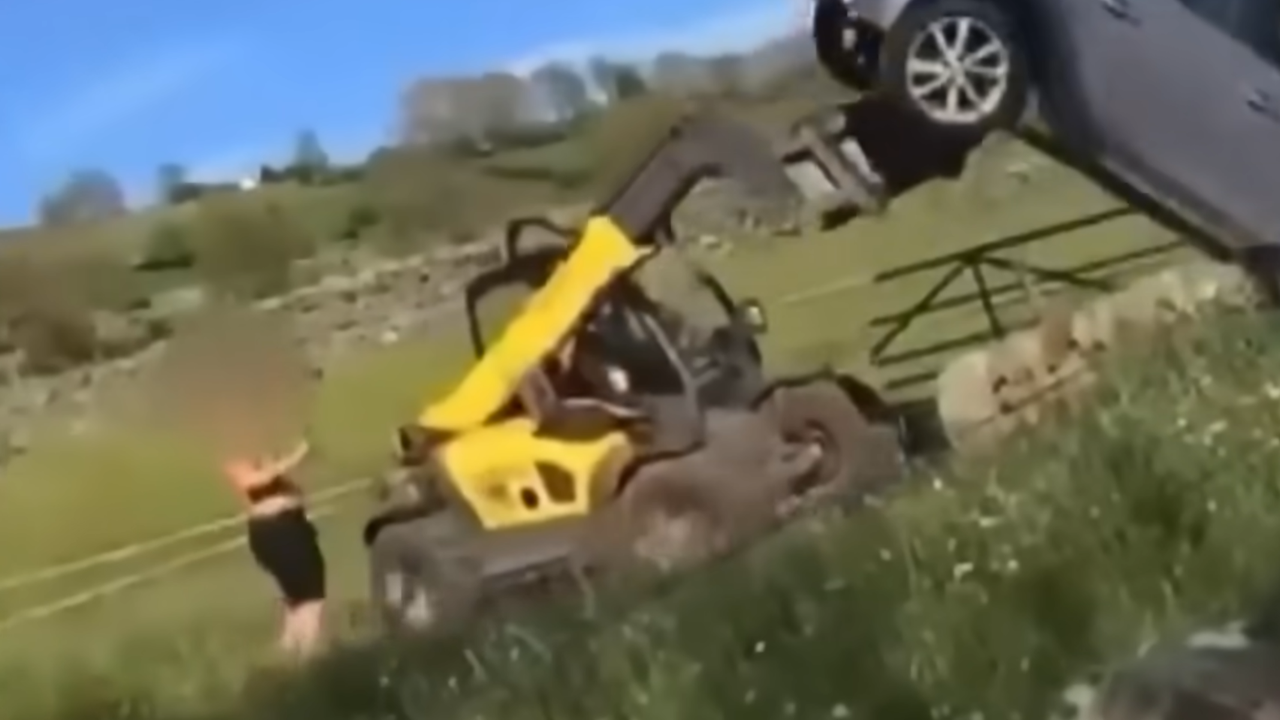
If you have spent any time on the internet, chances are you have seen this one. A tractor with forks casually scoops up a parked car, tips it right over, and shoves it out of the way like it weighs nothing. The clip has been floating around for years now, popping back up on social media every few months as if it just happened yesterday. It is one of those videos that never really goes away, and honestly, it is easy to see why.
The footage comes from Newbiggin-in-Teesdale, a small farming community in County Durham, England. It shows a farmer using a telehandler, essentially a beefed-up forklift on wheels, to lift a Vauxhall Corsa that was blocking the lane leading to his property. He tips it onto its side, then pushes it out toward the road. The whole thing looks almost too smooth to be real, but it happened, and there is a court case to prove it.
The man behind the wheel was Robert Hooper, a 57-year-old fourth-generation hill farmer. According to The Guardian’s reporting at the time, Hooper used the telehandler to lift the car from a lane outside his farm, flip it, and push it onto its side on the road, with mobile phone footage of the incident later played in court. This was not simply a dispute over a parking spot. There was a confrontation behind it, and it eventually landed Hooper before a jury.
So what actually happened, and more importantly, what happened to the farmer after the video made him internet famous? Let’s get into it.
How the Confrontation Started
The BBC covered the trial extensively at the time, and, based on that court reporting, the trouble began when Elliott Johnson’s Vauxhall Corsa blocked the lane leading to Hooper’s farm on what was described as a busy working day. Johnson told the court he was arranging recovery for the car because it had suffered a double puncture.
His friend, 21-year-old Charlie Burns, had been visiting the nearby Low Force waterfall and came across Johnson after spending the day there. According to the BBC’s report from the first day of trial, Burns denied being drunk, saying he had consumed six or seven bottles of Corona lager.
Hooper told the jury he asked the pair to move the car, but claimed Burns punched him after the confrontation escalated. He testified that he warned them, “If you don’t move it, I will,” before returning with the telehandler. During the incident, Burns was later knocked to the ground by the machine’s lifting forks.
That is a lot to unpack, and it is exactly why this case ended up going all the way to Durham Crown Court instead of getting sorted out on the side of the road. When you throw in a busted lip, a blocked farm lane, and a very expensive-looking forklift maneuver, you have got yourself a real legal headache.
Why the Farmer Ended Up in Court
The confrontation did not end when the telehandler set the Corsa back down. Prosecutors charged Hooper with dangerous driving and criminal damage, arguing that using heavy farm equipment to lift, flip, and push the car into the roadway crossed the line from protecting his property into criminal conduct.
Prosecutors were careful to tell the jury they were not portraying Hooper as some thug. Instead, they argued that his actions that day were “utterly irrational” and that he had acted out of anger rather than necessity.
There was also the question many people probably had after seeing the video: why not just call police? Hooper testified that his farm had suffered eight break-ins and that he had not had the best response from police in the past, saying officers might take an hour to arrive.
The Courtroom Defense Nobody Saw Coming
At trial, Hooper’s defense leaned heavily on the old English legal principle that a man’s home is his castle. He argued that his castle began at his front gate and that he felt threatened by two younger men, whom he did not know, nor did he know what they were capable of.
His defense lawyer even quoted Mike Tyson during closing arguments, pointing out that “everyone has a plan until they get punched in the mouth”. That is not a line you hear every day in a criminal trial, but it apparently landed with the jury.
Before deliberations, the judge instructed the jury on the law governing self-defense and the protection of one’s property.
The Verdict and What Happened to Robert Hooper
So did the farmer face consequences? Not the ones you might expect. After a four-day trial, a jury cleared Hooper of both dangerous driving and criminal damage, and supporters cheered for him outside the courthouse. His partner read a statement afterward describing the ordeal as eight months of hell, while thanking the local community for their support throughout the process.
Local farmers who showed up to back him were not shy about their opinions either, with several telling reporters he was a hardworking, decent man who should not have had to go through the ordeal at all.
As for the Corsa, it certainly wasn’t the same afterward. Whatever resale value it had before meeting a telehandler, it probably wasn’t helped by being flipped onto its side.