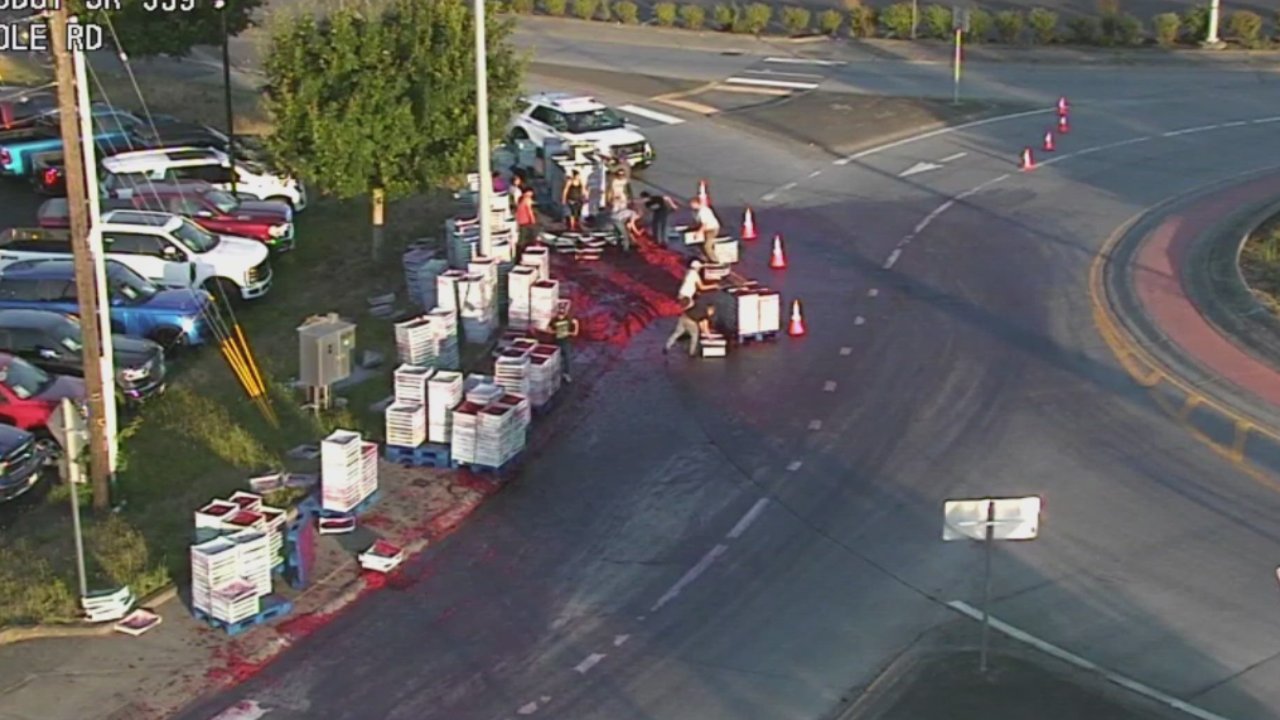
There are traffic jams, and then there are traffic jams. Most involve fender-benders, construction cones, or someone trying to make an impossible left turn. But in Lynden, Washington, a small agricultural town in Whatcom County near the Canadian border, drivers recently found themselves sitting behind something considerably stickier: roughly 100 trays of fresh raspberries, scattered across a roundabout on Guide Meridian Road at Pole Road.
The fruit belonged to Enfield Farms, and by the time the mess was sorted out, an entire lane had been blocked for nearly two hours while locals pitched in to help with the cleanup. The road itself was stained bright red. Local farmers estimated the loss somewhere between $15,000 and $20,000. That is not a small number for a truckload of perishable fruit that nobody is going to be eating.
The Washington State Patrol did not find this particularly charming. The truck driver was cited for failing to secure the load. It is a citation that covers the legal side of things, though it does nothing to bring back the raspberries.
What makes this more than a one-off oddity is the context. People living and working near the intersection told local media that this was at least the third similar spill at the same location over the span of just three weeks. A red-stained roundabout is one thing. A pattern is another.
The Roundabout Is Not the Problem, Exactly
Roundabouts tend to attract a particular kind of frustration from drivers who did not grow up using them. Some approach too fast, others brake too sharply, and a few seem to treat yield signs as optional. Kemaar James, who works near the intersection, pointed out that people frequently come through running well above a sensible speed, and that the stop-and-go nature of roundabout traffic causes drivers to accelerate hard on the exit. If a load is not fully secured, that’s when things shift.
That mechanical reality is straightforward enough: centrifugal force during the curve, followed by a burst of acceleration on the way out. If the cargo is not strapped down properly, physics takes over. At that point, it does not matter whether the cargo is raspberries, lumber, or anything else.
A $20,000 Lesson in Load Securement
One person who witnessed the incident put the loss in human terms: the growing season, the picking, the labor, all the coordination it takes to get a harvest from a field onto a truck, and then to watch it end up on the asphalt. The emotional weight of that is not hard to understand.
Load securement is not a complicated concept, but it is one that gets skipped when schedules are tight or assumptions are made about how far the truck is actually going. Short trips can produce the same consequences as long ones if the road includes tight curves or abrupt traffic changes. A roundabout qualifies on both counts.
Federal Motor Carrier Safety Administration regulations require that cargo be secured against shifting or falling, and violations carry real fines on top of any citation from state patrol. The citation issued here reflects that framework, but the financial loss to the farm was the more immediate consequence.
When the Same Intersection Keeps Making Headlines
This was not even the first time a berry truck had lost control at this specific intersection. At some point, a location that appears repeatedly in incident reports stops being a coincidence and starts being a data point. Whether that points to driver behavior, road design, signage, or just the volume of agricultural transport moving through a rural route during harvest season is worth examining.
Whatcom County is serious farming country. Trucks carrying produce are a regular part of the road mix, especially during summer. That means roundabouts in the area need to work for loaded commercial vehicles, and drivers operating those vehicles need to treat load securement as a non-negotiable step before departure, not an afterthought.
The raspberries are gone. The stain on the road, reportedly, is not.