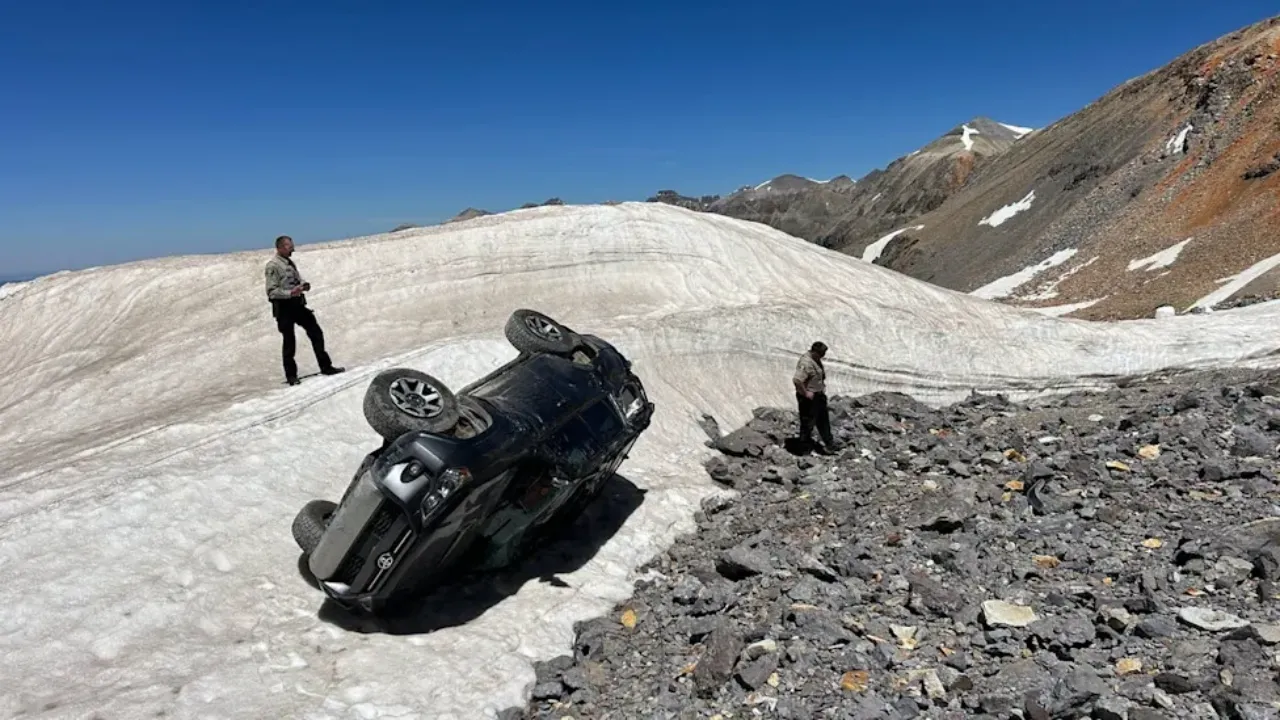
A 58-year-old man from Phoenix is counting his blessings after his SUV rolled multiple times down a steep switchback near the top of one of Colorado’s most punishing high-altitude roads. The incident unfolded the morning of June 18 near the summit of Imogene Pass, a 13,114-foot crossing in the San Juan Mountains that connects Ouray and Telluride and ranks as the second-highest drivable pass in the entire state. It is not a road that forgives mistakes.
What makes the story notable isn’t just the crash itself but the sequence of events that followed. Despite rolling multiple times down a rocky mountain switchback, the driver pulled himself free from the wreckage, hiked approximately 150 feet back up the incline to the road, and was found standing there by first responders. Walking away from a rollover on terrain like that isn’t something you plan for. It just happens to work out, or it doesn’t.
The man had started his journey on the Ouray County side, which was open for the season. The problem, as officials later clarified, is that the San Miguel County side had not yet opened due to ice. There were no signs at the summit indicating that the pass was closed on the other end, a gap in communication that the driver had no way of knowing about until his SUV hit a frozen patch on the switchback and the road ran out beneath him.
A multi-agency response was underway by 9:30 a.m., with Telluride Fire and EMS navigating the rugged terrain to reach the patient by 10 a.m. Two bystanders with wilderness first-aid training stayed with the driver until help arrived. He was transported to Telluride Regional Medical Center with non-life-threatening injuries. Search and rescue crews were staged but never needed.
What Imogene Pass Actually Demands From a Driver
Imogene Pass is not a scenic byway. It’s an unpaved, 4WD-required route with steep grades, narrow shelf roads, sharp drop-offs, and a summit that sits well above treeline. High clearance, low-range gearing, and skid plates are the standard recommendations.
Cell service is essentially nonexistent along the route. Guidebooks rate it anywhere from moderate to difficult depending on conditions, and conditions can shift dramatically with elevation. Even in summer, ice and snow near the 13,000-foot summit are not unusual.
A Signage Gap That Authorities Moved to Fix Immediately
After the crash, Ouray County officials placed warning signs at the top of the pass to alert drivers that the San Miguel County side was still closed, and they also updated information on the county’s website.
The San Miguel County Sheriff’s Office confirmed the San Miguel side had not yet opened for the season, but there had been no indication of that closure at the summit where drivers would cross over from Ouray. It’s the kind of administrative detail that seems minor until someone’s vehicle is 150 feet down a mountain.
The Response That Worked
San Miguel County Sheriff Dan Covault pointed to the multi-agency coordination as a model of how mountain rescues are supposed to work. He noted that passes at this altitude can turn dangerous quickly even for experienced off-roaders, and that rapid teamwork between agencies is what keeps outcomes like this one in the survivable column.
Telluride Fire District Chief John Bennett echoed that, crediting crew training for the speed and efficiency of reaching the patient in that terrain.
Lessons Learned
This is the sort of incident that serves as a practical reminder for anyone planning mountain road travel: open on one side does not mean open on both sides. Imogene Pass typically doesn’t clear snow until early July, and this crash happened in mid-June.
Checking conditions with each county’s sheriff’s office or road department before crossing any high-altitude pass, rather than relying solely on trailhead signage, is the kind of due diligence that can make a real difference. The driver in this case walked away. That outcome was never guaranteed.