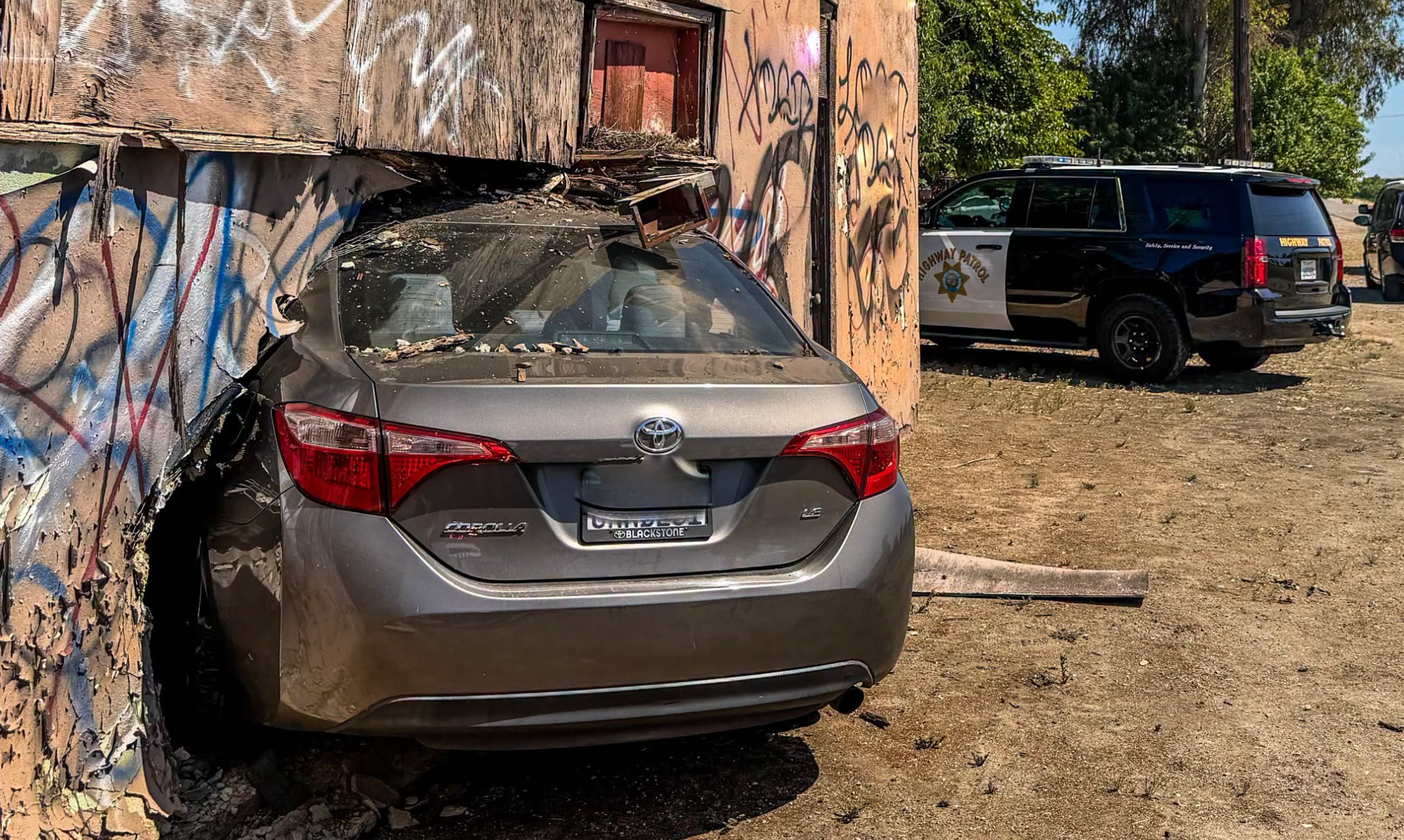
A wrong-of-way call at a Central Valley intersection last Friday produced the kind of outcome that makes you put the phone down and pay attention. A Toyota Corolla cut across the path of a Honda Odyssey near Reedley, California, and the chain of events that followed ended with the Corolla embedded in a building that, fortunately, had no one inside it. Both drivers walked away with minor injuries. The seatbelts did their job. The building did not fare as well.
The collision happened around 3 p.m. at the intersection of Manning and Englehart Avenues, a surface-road crossing in the San Joaquin Valley that has seen its share of bad days. The Corolla pulled directly into the Odyssey’s right of way, and the minivan’s mass did what physics tends to do in those situations. The Corolla had nowhere to go but sideways, fast, and straight into a nearby structure.
No one was inside the building at the time of the crash, and CHP reported only complaints of pain injuries from both drivers. That combination of an empty building and buckled occupants is about as good as a wreck like this gets. It could have been considerably worse on both counts, and anyone who has covered traffic incidents long enough knows that.
The California Highway Patrol documented the scene and shared it publicly, noting that seatbelts and a measure of luck kept the injury toll from climbing. The agency used the incident as a reminder that intersections demand real attention, not a rolling glance and a hope. That is not a novel message, but collisions like this one make it worth repeating without editorial flourish.
What Happens When a Compact Car Meets a Minivan
The physics here are not complicated. A Toyota Corolla weighs somewhere around 3,000 pounds depending on trim and year. A Honda Odyssey sits closer to 4,500. When a vehicle of that size T-bones a compact at intersection speed, the smaller car absorbs the bulk of the kinetic energy and often gets redirected rather than stopped.
In this case, the Corolla traveled far enough after impact to reach and breach a building wall. CHP described it, aptly, as the car going in like a missile.
The Intersection Has a History
Manning and Englehart is not a freeway interchange or a high-speed arterial. It is the kind of intersection found all over California’s agricultural flatlands: wide, open, and deceptively easy to misjudge. That visibility can work against drivers who assume a clear view means a clear path.
The same intersection saw a fatal two-car crash years earlier, when a Chevrolet Impala failed to stop and struck a Ford F-150, killing two occupants of the Impala. Familiarity with a road tends to breed the kind of inattention that turns routine crossings into crash reports.
Seatbelts Kept This From Being a Different Story
This is the detail that deserves the most attention. At the speeds involved in a mid-block building breach, unbelted occupants face a separate and more violent collision of their own inside the car. CHP credited seatbelt use with helping prevent more serious injuries.
That credit is well placed. Seatbelts in a redirected impact are not a comfort item; they are the mechanism keeping a driver from becoming a projectile inside their own vehicle.
Why CHP Posted It Publicly
Law enforcement agencies have increasingly used social media to circulate crash images and accounts, not as a scare tactic but as an efficient way to reach drivers in the local area where a collision occurred.
The Reedley CHP post was direct and brief: the Corolla pulled out, the Odyssey connected, the Corolla went into a building, and seatbelts made a measurable difference. No embellishment needed.
A compact sedan through a wall is its own argument for watching the intersection before committing to it.