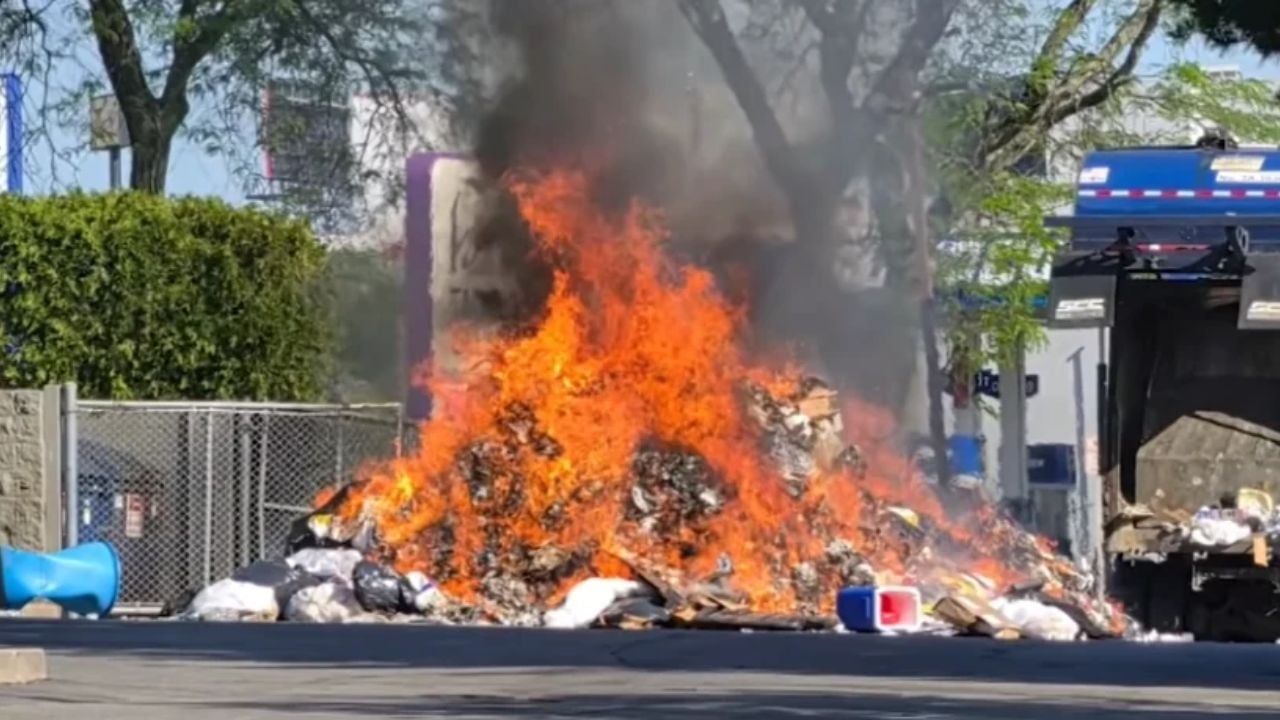
A Westchester County garbage truck driver made a fast call when smoke started billowing from his load, and while the truck survived, the Taco Bell parking lot had a rough morning.
Around 8:30 a.m. on a recent weekday, a driver with Suburban Carting noticed fire coming out of the top of his garbage truck while on his route. Rather than wait and hope for the best, he did exactly what you’d want a driver hauling a rolling pile of combustibles to do: he got off the road, found the nearest open lot, and dumped his entire load onto the pavement before the truck itself could catch.
The nearest open lot happened to be a Taco Bell on Stevenson Boulevard in New Rochelle. No one asked the restaurant’s permission, but then again, nobody ever plans a trash fire.
The driver popped the rear, offloaded the burning heap, and pulled the truck clear before the fire could spread to the vehicle. By the time witnesses described the scene, the pile was fully involved, sending up a visible smoke column that could be seen from Palmer Avenue.
The truck, however, was intact and operational, which is either great fleet management or dumb luck, depending on your perspective. Suburban Carting operations manager Timothy Loftess credited the driver’s quick judgment for keeping a bad situation from getting significantly worse.
Fire crews responded and extinguished the blaze. The cause remained under investigation at time of reporting, but Loftess and the local fire chief both pointed to a now-familiar culprit category: a “hot load,” meaning trash that arrived at the truck carrying an active fire hazard.
Workers spent the remainder of the day cleaning the parking lot, and while the Taco Bell had a less-than-ideal morning, the New Rochelle fire department confirmed what everyone really needed to know: no tacos were harmed.
This Wasn’t a Freak Occurrence
Loftess told News 12 this was the third hot load incident Suburban Carting had dealt with since last summer alone. Three fires in under a year from improperly discarded materials is not a streak of bad luck.
It’s a pattern, and it suggests the problem is showing up regularly enough that haulers are now building mental playbooks for what to do when smoke appears mid-route.
What Counts as a Hot Load
The term sounds dramatic, but it describes something surprisingly common: trash that contains items still capable of igniting or already smoldering by the time it gets compacted into a truck. Lithium-ion batteries are among the most widely cited culprits, and for good reason.
A damaged or partially charged lithium cell can enter thermal runaway, a self-sustaining chemical reaction that generates its own heat and is notoriously difficult to extinguish with water alone. Other known offenders include partially used propane canisters, aerosol cans, and liquid flammables that have no business going into a residential bin.
The compaction process inside a garbage truck creates pressure and friction that can trigger ignition in materials that seemed inert at the curb.
Why Garbage Truck Fires Are a Growing Problem
This Westchester incident is part of a broader national trend that waste management companies have been flagging for years. As lithium-ion batteries have become standard in everything from e-bikes to power tools to vaping devices, they’ve also become one of the leading causes of fires in garbage trucks and at materials recovery facilities across the country.
The National Waste and Recycling Association has repeatedly called for better consumer education on proper battery disposal, as many people either don’t know or don’t bother to find out that these items require separate handling. Some municipalities have set up specific drop-off programs for batteries and hazardous materials, but participation rates remain inconsistent.
What Residents Should Actually Do
Both Loftess and the local fire chief used the incident as a direct public message: pay attention to what you’re putting in the bin. Lithium batteries from phones, laptops, and power tools should go to designated collection sites, not the trash.
Propane tanks, even “empty” ones, should be returned to exchange programs or taken to a hazardous waste facility. Aerosol cans that are not fully empty are flammable under pressure. Paint, solvents, and other liquid chemicals are also on the no-list. Most counties publish disposal guidelines online, and many hardware retailers and big-box stores accept batteries and fluorescent bulbs at no charge.
Taking five minutes to look up the right drop-off point is considerably less disruptive than watching a garbage truck dump a burning pile of trash into a fast food parking lot on a Tuesday morning.