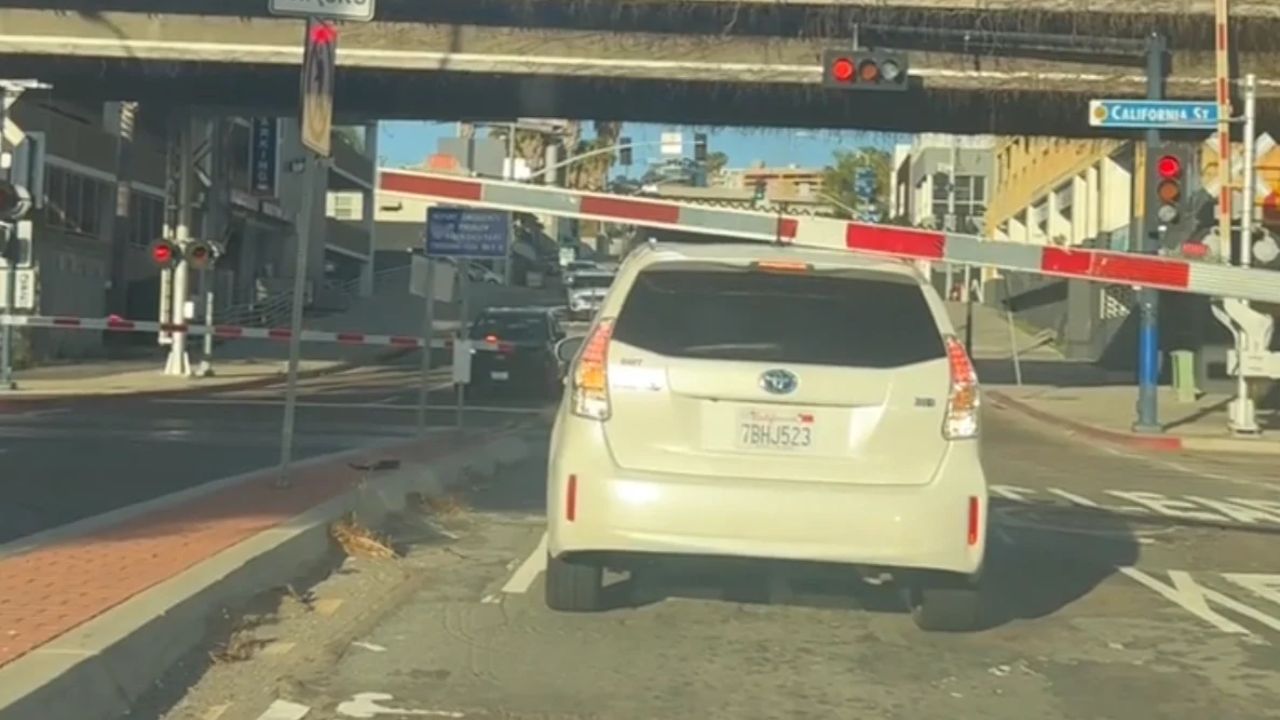
A TikTok video making the rounds this week captures the kind of moment that makes experienced drivers grip their steering wheels in secondhand anxiety. Shot from inside a vehicle waiting at a railroad crossing somewhere in the US, the clip shows a car ahead of the camera with a lowered crossing gate resting directly on its roof. That alone would have most people slamming it into reverse without a second thought. Instead, the car does the opposite.
The footage, posted by TikTok user Kenny Ledesma, shows the vehicle creeping forward, not backward, toward the active tracks as a train bears down on the crossing. Passengers in Ledesma’s car can be heard audibly alarmed, questioning in real time what exactly the driver ahead thinks they’re doing. The answer, apparently, is nothing that could be described as a well-reasoned plan. The train clears the crossing without making contact, and everyone walks away intact, but the near-miss was close enough to leave a car full of witnesses with their hearts somewhere near their throats.
Videos like this tend to rack up comments fast, and this one was no exception. One viewer summed up the collective reaction pretty succinctly: “You left them SO much space to back up too? omg…” It’s a fair point. The clip makes clear there was room to reverse and plenty of time to do it. Whether the driver panicked, froze, misjudged the situation, or made some other inexplicable call in the moment is hard to say. What’s easy to say is that the outcome could have been catastrophically different.
The video isn’t just good for raised blood pressure and comment section outrage. It’s a useful reminder that railroad crossings remain one of the more consistently dangerous intersections between everyday driving and heavy infrastructure, and that driver behavior is almost always the variable that determines whether a crossing goes fine or goes very wrong.
The Numbers Behind Railroad Crossing Dangers
@kenny.ledesmathis was an emotional rollercoaster LOL♬ original sound – Kenny Ledesma
It’s worth putting this kind of video in context, because the statistics on railroad crossing accidents aren’t something most drivers think about on a typical commute. According to Federal Railroad Administration data, there were 2,272 highway-rail grade crossing collisions in 2025 alone, resulting in 285 fatalities and 765 injuries across the country.
The human tendency to underestimate a train’s speed and distance plays a big role in many of those incidents. Trains are deceptively fast and, due to their mass, take an enormous distance to stop once brakes are applied. A freight train moving at highway speed can require a mile or more to come to a complete stop. That’s not a typo. Federal Railroad Administration data also indicates that in crossing accidents, roughly 94% of the time the incident is attributed to risky driver behavior, including disobeying signals, driving around lowered gates, or ignoring warning lights.
California, despite ranking fourth in the total number of rail crossings nationwide, leads the country in fatalities at those intersections, with 391 deaths recorded over the past decade. That’s a sobering figure for a state with a reputation for car culture and a lot of confident drivers.
What the Gate on the Roof Should Have Told This Driver
Crossing gates are not suggestions. They’re active warning systems that lower when a train is detected approaching, and they are designed with enough lead time built in to allow a vehicle to clear the tracks or stop safely. When a gate comes down on top of a car, it typically means the vehicle was too far forward when the system activated, a situation that calls for one response: reverse and get clear.
The instinct to keep moving forward in a stressful situation is something traffic safety researchers have documented. Panic can override logical decision-making, and a driver who suddenly finds a gate on their roof may genuinely not know what to do. But the correct answer is unambiguous. Moving toward an active track while a signal is down is exactly the scenario these systems are built to prevent.
Modern crossing gates are designed to break away if struck by a vehicle, so that a car already on the tracks can exit without the gate pinning it down. That detail tends to get lost in public awareness. The gate is meant to stop you before you get there, not trap you once you do.
A Close Call That Speaks to a Broader Problem
There’s a reason railroad safety organizations run ongoing public awareness campaigns year after year. In 2024, fatalities at highway-rail crossings increased 7% compared to the prior year, even as overall rail-related deaths edged slightly downward. The problem isn’t getting solved on its own, and it isn’t going to get solved by infrastructure improvements alone.
While freight rail operators have pushed overall train accident rates to historic lows, with a 14% year-over-year improvement in 2025, grade crossing incidents have remained essentially flat, showing only modest progress despite broader safety gains across the industry. That gap tells its own story. The tracks are being maintained better, the trains are being operated more safely, but what happens at the crossing is still largely up to the driver.
Why This Video Keeps Getting Shared
Videos of close calls at railroad crossings have been a fixture of social media for years, and the formula is consistent: something goes badly wrong, everyone reacts in real time, the outcome is narrowly avoided, and the internet piles on with comments ranging from disbelief to dark humor. What makes this particular clip stand out is the simplicity of the mistake. There’s no complex traffic situation, no obscured sightline, no ambiguous signal. There’s a gate sitting on a car’s roof and a train visibly approaching. The solution was right there.
That’s also what makes it genuinely instructive rather than just another piece of viral content. Driving confidently doesn’t mean driving correctly, and experience behind the wheel is no guarantee of sound judgment in an unfamiliar or stressful moment. The driver in this video may be a perfectly competent motorist on an ordinary day. At a railroad crossing with a gate on their roof and a train coming, they made a call that nearly turned a bad situation into something far worse.
Ledesma and his passengers got to drive away and post the video. That’s the version of this story worth watching.