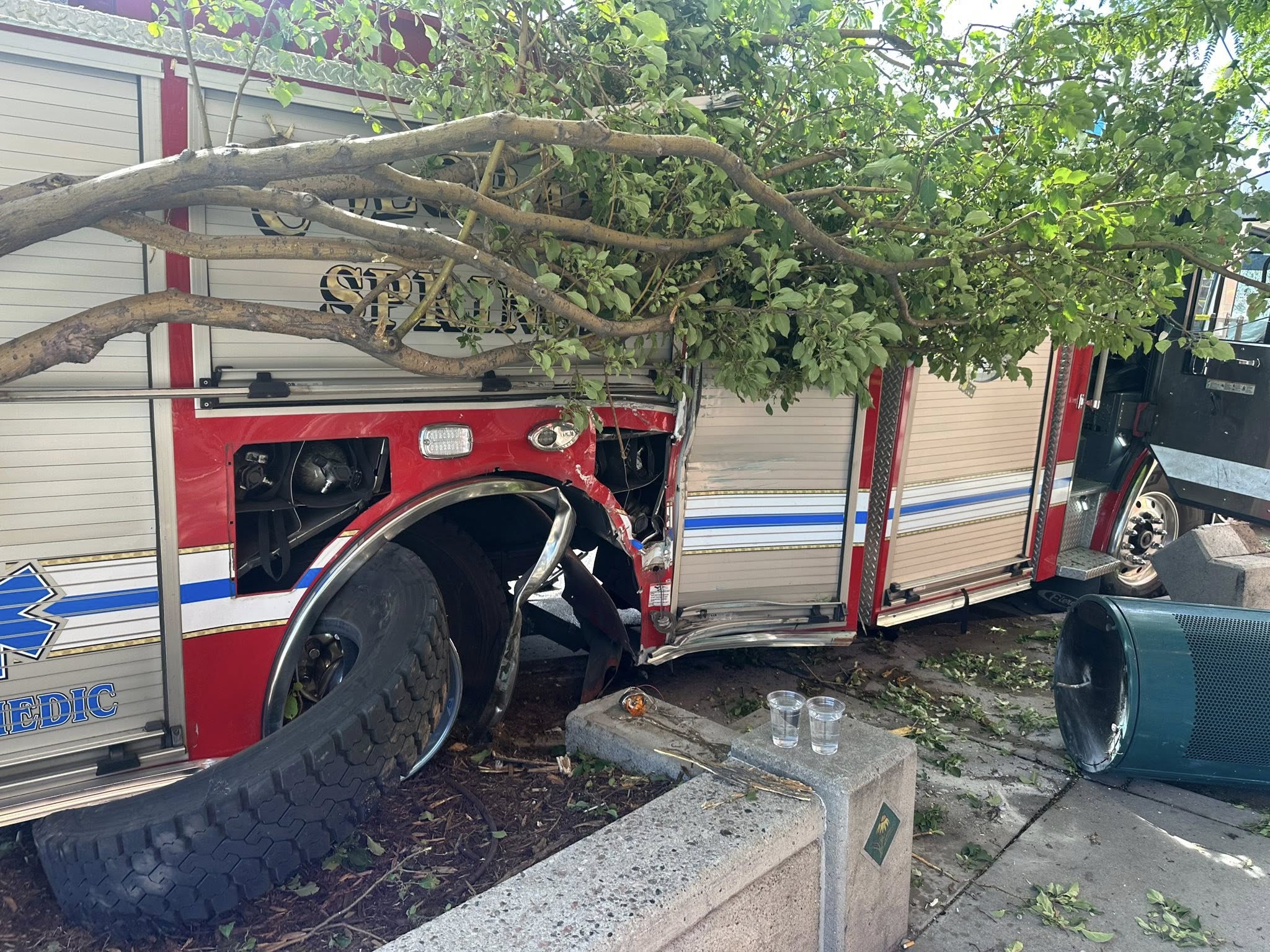
A Colorado Springs fire engine was destroyed and nine people were hospitalized Saturday morning after the crew was blindsided by a passenger bus while racing to a medical emergency. The crew didn’t make it to their call. Instead, they became one.
Shortly before 10 a.m. on June 13, Engine 3 of the Colorado Springs Fire Department was southbound on Tejon Street with lights and sirens running, responding to a reported overdose. A Bustang bus, Colorado’s state-operated interregional express service, was heading west on Bijou Street at the same time. The front passenger side of the bus connected with the driver’s side of the fire engine, and the impact didn’t stop there.
Two additional vehicles were struck as a result, one parked and one occupied, though the two people in the occupied vehicle walked away uninjured.
All four firefighters aboard Engine 3 were taken to local hospitals. Seven people were on the Bustang, including the driver, and five of them required hospital transport. In total, nine people were hospitalized in a crash that began, from the fire department’s perspective, as just another run to a scene.
The Colorado Springs Fire Department confirmed the crash would not affect response times, but the optics of a fire crew being knocked out of commission mid-emergency response are hard to ignore.
Engine 3 was declared a total loss, and the department will rely on a significantly older reserve engine while a replacement is sourced. The Colorado Springs Police Department’s Major Crash Team is leading the investigation, and as of Saturday afternoon, no fault had been assigned to either party.
A Busy Downtown Intersection and a Tough Physics Problem
The intersection of Tejon and Bijou in downtown Colorado Springs is not a quiet back road. It sits adjacent to Acacia Park and sees steady traffic through the heart of the city. When a fire engine running code meets cross-traffic at a busy urban intersection, the question of right-of-way becomes a high-stakes calculation. Drivers are legally required to yield to emergency vehicles with active lights and sirens, but reaction time, obstructed sightlines, and simple inattention can collapse that margin in a second.
That appears to be what happened here. The angles tell part of the story: the front passenger corner of the bus struck the driver’s side of the engine, suggesting the bus was well into the intersection before the impact occurred. CSPD noted that no fault has yet been determined, and the crash remains under active investigation. Whether the bus driver failed to yield, had limited visibility, or simply didn’t hear the sirens in time is a question for the Major Crash Team.
What the Bustang Is, and Why It Matters
Readers outside Colorado may be unfamiliar with the Bustang, which is not a charter coach or a local city bus. The Colorado Department of Transportation launched Bustang in 2015 as its own intercity bus service, funded with state money and operated by an independent company, Ace Express Coaches. It connects major population centers, employment hubs, and local transit systems along the I-25 and I-70 corridors.
In short, it’s a full-size motorcoach carrying real passengers between real cities, not a municipal shuttle.
The bus driver required extrication from the vehicle, which tells you something about the force involved. Twenty-one CSFD personnel ultimately responded to a scene that began as a medical call and turned into a multi-vehicle, multi-patient crash requiring patient care, driver extrication, and firefighter treatment simultaneously.
The Engine Is Gone. The Risk Never Is.
Engine 3 is a total loss. That’s not a rounding error in the fire department’s budget. Fire apparatus is enormously expensive, with modern pumper engines typically ranging from $500,000 to over $700,000 depending on configuration and specifications. Replacing one isn’t a quick order. In the interim, the department confirmed it will pull an older reserve engine into service, a vehicle that by definition has more wear, more age, and fewer of the updated safety and operational features of a frontline rig.
The Colorado Springs Fire Department acknowledged the grim calculus its crews accept every shift. As the department put it in their statement, firefighters respond to emergencies every day knowing the risks that come with it. That awareness doesn’t make a T-bone collision in the middle of a downtown intersection any easier for the four crew members who ended up as patients themselves before the morning was over.
What Happens Next
The CSPD Major Crash Team investigation will determine the sequence of events and assign fault if warranted. That process takes time, and the department has been careful not to get ahead of it. For now, the injured firefighters and bus occupants are the priority.
This type of crash is not unprecedented, but it remains relatively rare. Emergency vehicle intersection collisions are a documented concern in fire service safety research, and departments across the country have debated everything from intersection control preemption systems to slower approach speeds at cross streets as mitigation strategies.
Whether this incident prompts any policy review in Colorado Springs remains to be seen, but the conversation will likely happen whether the department initiates it or not.
What is certain is that Engine 3 is not coming back, nine people have hospital bills they didn’t plan for this Saturday morning, and a crew that left the station to help someone else ended up needing help themselves.