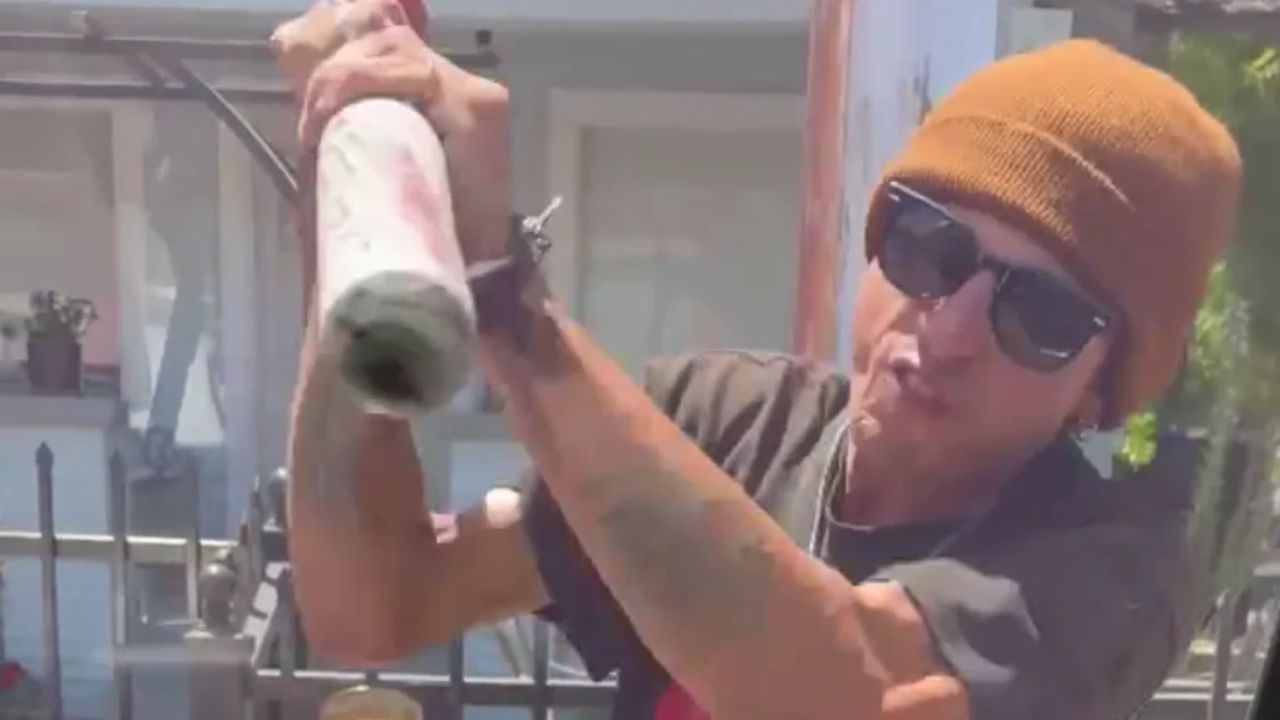
There are bad days, and then there’s the kind of day where a stranger takes a metal baseball bat to your car window because you had the audacity to ask him to stop spray-painting someone else’s property. A driver in Fresno, California found himself on the wrong end of that exact scenario recently, after witnessing a man tagging a business in the city’s Tower District and doing what any reasonable person might do: asking him to knock it off. The response was not a sheepish retreat. It was a swing.
The incident was captured on video and shared to Facebook by Fresno City Council District 3 representative Miguel Arias, who urged anyone with information to help identify the suspect. The footage drew swift attention, in part because of how casually the whole thing unfolded. A man is caught in the act of defacing a building, someone rolls up and says something about it, and the tagger’s first instinct is apparently to reach for a bat. The sheer confidence of that reaction tells you something about how emboldened some people have become when it comes to this sort of activity.
The Tower District, for those unfamiliar, is one of Fresno’s more distinctive commercial corridors. Anchored by a 1930s art deco theater and populated with small businesses, restaurants, and local shops, it’s the kind of neighborhood where the physical environment actually matters to the people who live and work there. Graffiti tagging in areas like this isn’t just an aesthetic nuisance; it signals neglect, drives customers away, and costs property owners real money. Businesses that get tagged and don’t clean it up promptly can even face municipal fines in some cities.
As of this writing, the suspect had not been publicly identified. Arias’s office is asking anyone who recognizes the man in the video to send a direct message with information. No arrests have been announced, but given that the whole thing is on camera, the path to accountability seems reasonably clear provided someone in the community can put a name to the face.
A Bat, a Can of Spray Paint, and a Car Window That Never Asked for Any of This
The sequence of events is straightforward enough: the driver noticed someone tagging a business, spoke up, and the tagger responded by smashing the vehicle’s window with a metal baseball bat. What makes the incident stick with you isn’t the vandalism itself, which is unfortunately routine in urban areas across the country. It’s the escalation. Spray-painting a wall is one crime. Pulling out a bat and destroying a stranger’s car because they objected is a separate and more serious matter entirely.
Under California Penal Code §594, malicious property damage is charged based on dollar value. If the damage comes in under $400, it’s a misdemeanor carrying up to six months in jail. If it exceeds that threshold, it becomes a felony with up to three years in state prison. A smashed car window from a metal bat almost certainly clears the $400 bar, particularly given today’s repair costs. The suspect, in other words, may have turned a misdemeanor tagging situation into a felony vandalism charge with one swing.
Graffiti Vandalism Is a Bigger Problem Than Most People Realize
It’s easy to dismiss graffiti as a low-stakes nuisance, but the numbers tell a different story. Cities like Los Angeles and New York spend tens of millions of dollars annually on graffiti cleanup programs alone. Property owners who don’t act quickly enough on their own buildings can find themselves on the wrong side of local ordinances on top of it. Vandalism costs the United States billions of dollars each year in property damage, cleanup, and law enforcement resources. For a small business in a neighborhood like Tower District, a tagged storefront can be the difference between a welcoming entrance and one that sends customers driving past.
There’s also the well-documented “broken windows” effect, the theory backed by decades of urban research suggesting that visible signs of disorder, including graffiti, encourage more disorder. Neighborhoods that stay on top of vandalism tend to stay safer and more economically stable. Those that don’t can find themselves in a cycle that’s difficult and expensive to reverse.
California Has Seen Its Share of Vehicle Vandalism Tied to Street Confrontations
This incident isn’t occurring in a vacuum. California streets have seen a steady stream of cases where everyday confrontations spiral into property damage or worse. In a separate recent California road rage incident, a suspect who smashed a truck window was found to be under the influence and faced multiple charges including DUI, assault, and vandalism. The common thread in many of these cases is that someone feels challenged or called out in public and responds with disproportionate force, usually against the vehicle that represented the perceived threat.
For drivers, the uncomfortable takeaway is that intervening in a public vandalism situation carries real risk. Most people understand this instinctively, which is exactly why so many walk past and say nothing. The Fresno driver who spoke up probably wasn’t expecting a bat. Nobody ever is.
The Suspect Is Still Out There
Councilmember Arias made clear in his Facebook post that the community’s help is needed to identify the person seen in the video. Given that the footage exists and has been widely circulated, this is the kind of case where public recognition may do what traditional investigative work alone cannot. If you recognize the individual, authorities are asking for a direct message to the District 3 office.
What the driver lost was a car window. What the incident illustrates is something a bit larger: that the low-level disorder of graffiti tagging and the higher-stakes disorder of unprovoked assault are not always as far apart as we’d like to think. Sometimes they’re separated by nothing more than one person asking a perfectly reasonable question at the wrong moment.