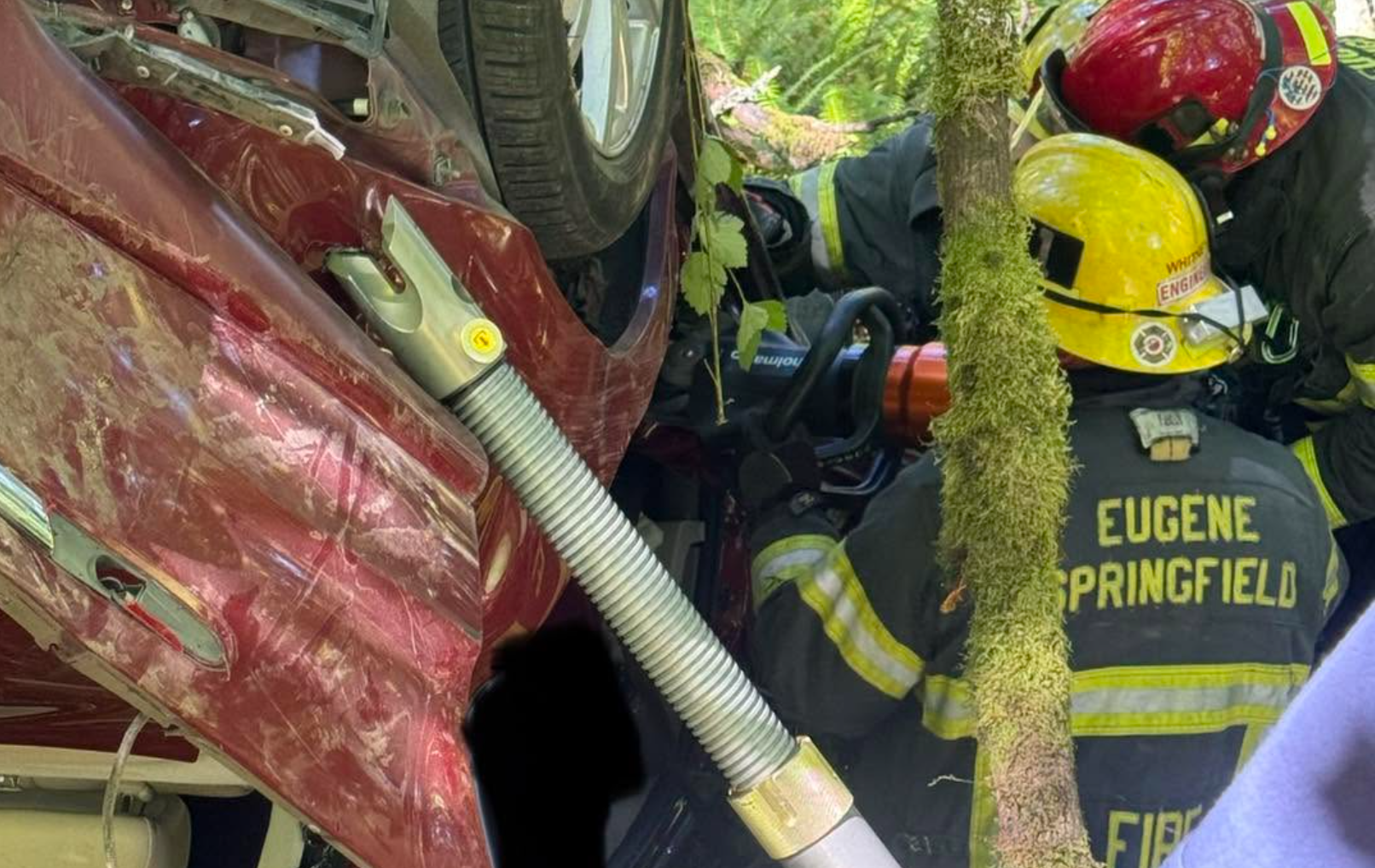
A smartwatch did what no bystander could have done last Thursday afternoon in South Eugene: it noticed a crash no one else did, reported it to 911, and set in motion a rescue operation complex enough to star in a fire department training manual. The driver, who ended up upside down on a rural hillside far off any normal road, walked away with non-life-threatening injuries, thanks in no small part to a wristwatch doing its job while its owner could not.
Just before 3 PM on June 11th, Eugene Springfield Fire received a dispatch call with an unusual origin story. There was no witness, no passing motorist, no neighbor with a view. The alert came from crash detection technology embedded in the driver’s watch, which automatically contacted 911 and relayed the situation: vehicle down, occupant incapacitated, location somewhere near 52nd Street and South Willamette. Dispatchers pieced together enough to get crews rolling.
Finding the vehicle was the first challenge. The crash was located at the end of a long rural driveway, well off the road, down a steep embankment, and resting on its roof. It was the kind of scene that, without automatic location sharing, could have gone undiscovered for hours. The first engine crew from the South Hills station made contact with the occupant, and what followed was a full-scale operation involving five fire crews, a medic unit, and two chief officers.
Here is the part that would raise even a skeptic’s eyebrows: the vehicle had also struck a large propane tank on its way down. The tank rolled down the hillside alongside the car and was leaking by the time crews arrived. Add in high-voltage power lines in the immediate area and a location flagged for elevated wildfire risk, and you have a situation that fire departments typically reserve for the hardest levels of command training scenarios. In this case, it was a real Thursday afternoon in Oregon.
When the Training Manual Becomes the Incident Report
Eugene Springfield Fire described the crash as having every element they use in promotional testing scenarios for command staff. The vehicle was difficult to locate and impossible to access quickly. It was on its roof on a steep embankment. A leaking propane tank was involved. Power lines overhead. Wildfire-risk terrain.
Any one of those complications demands a focused response; all of them at once demand coordination, prioritization, and calm. By all accounts, crews delivered on every count. The occupant was stabilized, extricated, carried out, and transported to an area hospital.
How Crash Detection Technology Works
The feature that started the whole chain of events is not new, but incidents like this one continue to demonstrate why it matters. Crash detection on Apple Watch uses advanced motion sensors, a gyroscope, and a high g-force accelerometer to recognize the signs of a serious collision. If the wearer is unresponsive for 10 seconds after the alert, the device automatically contacts emergency services and shares the user’s location. The technology was introduced in 2022 alongside the iPhone 14 and has been steadily adding to a growing list of rescues since.
In one widely reported case, a Wisconsin fire chief described a nearly identical scenario: a vehicle had flipped over in a farm field far from the road, the driver was unconscious, and no one knew the crash had occurred. The Apple Watch alert provided the precise location, and the fire chief later said the driver would likely have gone undetected for several hours without it. The Oregon incident adds another entry to that same category.
A Rescue Complex Enough to Train On
What stands out about the Eugene incident beyond the wearable tech angle is the sheer density of hazards crews had to manage simultaneously. Extrication on a slope with a leaking propane tank nearby is not a routine call by any definition, and doing it in terrain with both power line and wildfire exposure adds layers that require clear command structure and real-time prioritization. Fire departments routinely construct fictional versions of exactly this scenario to test senior staff. Eugene Springfield Fire worked through the real version before dinner.
The fact that crews also had to shuttle equipment down to the scene and physically carry the occupant back out gives a clearer picture of the physical and logistical demands involved. This was not a matter of pulling up, running a hose, and clearing the scene.
What This Means for Drivers in Rural Areas
For drivers who spend time on rural roads, steep driveways, or any terrain where a crash could go unwitnessed, this incident is a practical argument for keeping crash detection enabled and emergency contacts current. When a crash is detected and the user is unresponsive, the device autonomously connects with emergency responders and discloses the user’s location, and can also notify designated emergency contacts with the crash location. The system was designed specifically for situations where a vehicle operator may be disabled or unable to call for help.
The driver in South Eugene is expected to make a full recovery. The watch on their wrist, doing what its sensors were built to do, is a significant part of why that outcome was possible at all.