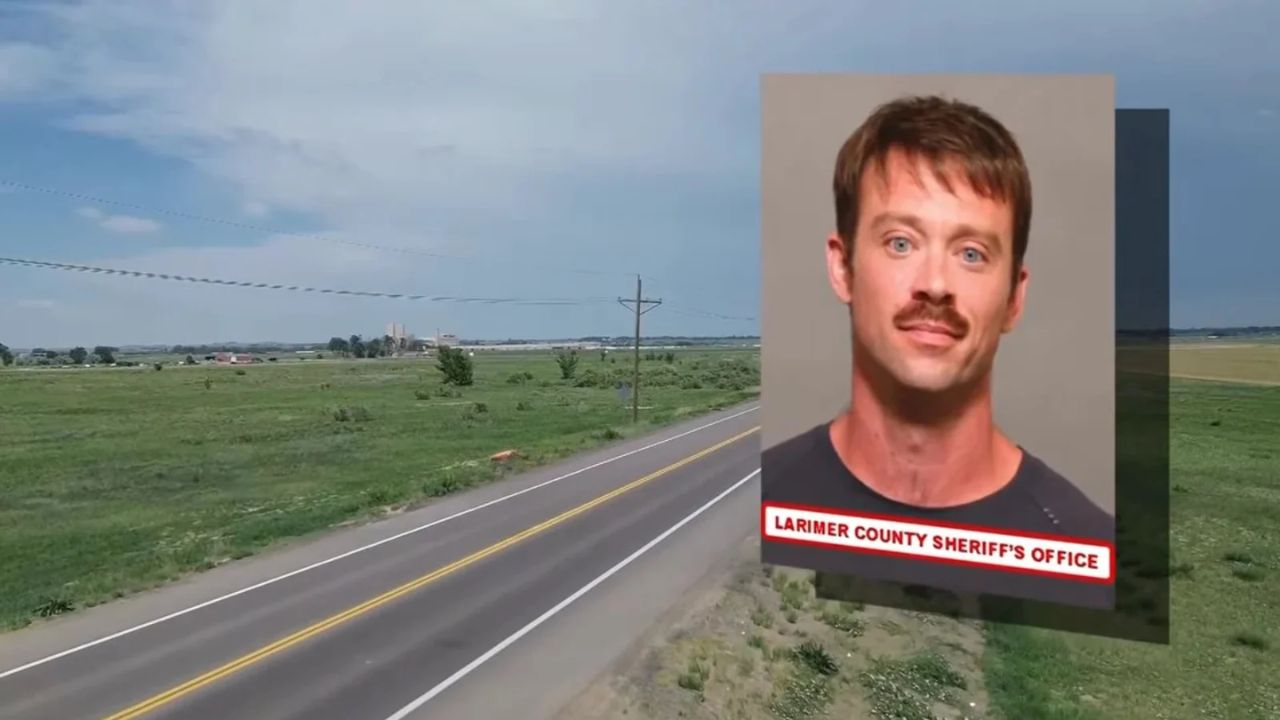
On the night of May 30, 2026, a Larimer County Sheriff’s Office deputy spotted a black Ford sedan traveling about 130 mph on northbound I-25 near Carpenter Road in northern Colorado. The speed limit there is 75 mph.
The stop quickly escalated into more than a simple speeding case. According to the sheriff’s office, as additional deputies moved into position, the driver exited I-25 at Mountain Vista while still traveling around 100 mph. He then turned off the vehicle’s headlights to evade detection and ran a red light near Country Club and Terry Lake.
When deputies finally stopped the Ford, they allegedly discovered what authorities described as a purpose-built evasion vehicle. The sedan was equipped with a signal jammer, a license plate cover, the ability to disable all vehicle lighting, and other hardware designed to avoid detection. The vehicle had been modified to resemble a police cruiser.
Deputies arrested the driver, Gregg Barclay, and the passenger, David Bandler. Authorities said Bandler was actively helping Barclay avoid police detection, and evidence found in the vehicle suggested the pair was also relaying information about law enforcement locations to warn others in the area.
Both men were taken into custody without further incident and later released from the Larimer County jail.
Authorities have not released clear public photos of the Ford or the modifications found inside it, leaving much of what is known about the vehicle to come from the sheriff’s office statements rather than photographs.
What Is a Cannonball Run, and Why Does It Require This Much Hardware?
For readers unfamiliar, the Cannonball Run is an unsanctioned coast-to-coast speed challenge with roots going back to the early 1970s, when automotive journalist Brock Yates turned it into a countercultural statement about open roads and personal freedom.
The traditional route runs from New York City’s Red Ball Garage to the Portofino Hotel in Redondo Beach, California, covering roughly 2,813 miles. The goal is to complete it faster than anyone else has.
As of August 2025, the overall record stands at 25 hours and 39 minutes, with an average speed of 112 mph. That record was set by Arne Toman, Douglas Tabbutt, and Dunadel Daryoush in May 2020.
Getting anywhere near those times requires more than a lead foot. Serious Cannonball builds typically feature extended fuel tanks to minimize stops, radar detectors, laser jammers, police scanner integration, and navigation systems designed to route around enforcement.
That is why the Colorado stop attracted attention beyond the speed alone. Deputies were not describing a normal fast car. They were describing a vehicle they believed was purpose-built for high-speed travel and detection avoidance.
The Driver Was Already Known to the Car Community
This particular arrest has an additional layer that separates it from a run-of-the-mill speeding case. Barclay is known within the Cannonball community and previously appeared on the YouTube channel VinWiki, where he discussed modifying a Ford Taurus SHO for a Cannonball-style run.
VinWiki is a popular automotive storytelling platform with a dedicated enthusiast following, so this was not a quiet admission to a small audience. Larimer County Sgt. Sam Roth noted that Barclay had discussed crossing the country in just over 30 hours on that video, and that the vehicle that stopped in Colorado appeared to be the same type of build as the one now sitting in the sheriff’s impound lot.
Authorities have not confirmed the exact model year of the Ford involved in the Colorado stop. However, the prior Taurus SHO connection is why several reports have linked this case to the Cannonball community.
For the car community, there is something almost darkly comedic about an enthusiast publicly discussing an evasion-focused endurance build, only to be arrested later after deputies say they found a similar vehicle equipped with illegal countermeasures. Sgt. Roth acknowledged he could not think of a prior instance where deputies had encountered a vehicle quite like this one.
130 MPH on a Highway Carrying 75,000 Vehicles a Day
I-25 through northern Colorado is not a remote stretch of empty asphalt. It carries an estimated 75,000 vehicles a day.
At 130 mph, a vehicle covers roughly 190 feet per second. The Larimer County Sheriff’s Office pointed out that the average driver takes roughly 1.5 seconds to react to a hazard, meaning the vehicle would have traveled nearly a football field before the driver even began to respond.
Cannonball runs have long occupied a complicated place in car culture. The mythology is compelling, and the mechanical ingenuity required for a competitive attempt is real. But the romanticized version of the run involves empty highways, meticulous planning, and risk management that participants often insist makes it safer than it sounds.
Doing 130 on a busy Colorado interstate after dark with a passenger allegedly running counter-surveillance is an entirely different proposition.
What Charges the Pair Are Facing
Upon closer inspection, deputies found the vehicle was extensively modified with systems designed to evade law enforcement detection, including radar detectors and jammers, a device to obscure the license plates, and a passenger binocular system for spotting law enforcement.
That combination of modifications pushed this beyond a simple speeding citation. Both Barclay and Bandler were booked into the Larimer County jail on charges related to the alleged illegal modifications and their conduct during the stop before being later released.
Whether this stop disrupted an actual Cannonball run attempt or was simply a high-speed shakedown of a freshly built car has not been confirmed. Given that I-25 runs north-south rather than coast to coast, it may have been the latter.
Either way, the car is impounded, the YouTube channel now has a follow-up story it probably did not plan for, and northern Colorado deputies have a pretty good answer to the question of whether they have ever seen anything like this before.
Correction: The original feature image showed the driver’s mugshot against a country road, but the road also featured an orange Jeep, which confused some readers.