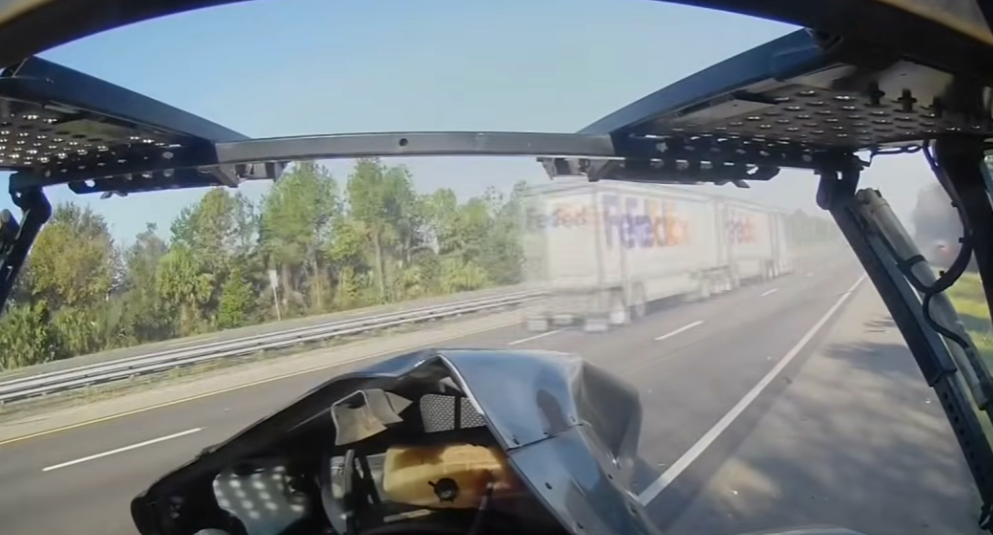
A Flagler County jury has put a price on what it looks like when a commercial truck driver’s negligence strips another man of his career, his health, and his sense of normalcy on the road. The verdict, handed down last week against TDC Transportation Inc. and the at-fault driver, totaled $8.64 million in favor of Jo’Relle Deleston, a former truck driver who has spent the last three and a half years rebuilding a life that changed in an instant on Interstate 95.
The crash happened on October 5, 2022, about a mile south of the Palm Coast exit in Flagler County. Dashcam footage captured the sequence clearly: a commercial truck drifted off the road, then corrected hard back into Deleston’s lane, slamming into him and sending his truck rolling multiple times. The kind of thing that takes less than two seconds to happen and considerably longer to recover from, if recovery is even the right word.
Deleston suffered a broken neck and multiple other injuries in the crash, and lost his driving job in the aftermath. His attorney, representing him through the firm Pajcic & Pajcic, argued that the jury’s verdict should serve notice to the industry that sloppy, reckless operation of commercial vehicles on Florida roads carries real consequences. Judging by the dollar amount, the jury agreed.
Good Samaritans who witnessed the crash stopped and crossed the highway to help Deleston before emergency services arrived. That detail alone says something about the severity of what unfolded on that stretch of I-95, and it was among the evidence presented during trial.
In the conference room where attorneys laid out the case, crash wreckage photos, X-rays, and medical scans covered the table. The dashcam footage was reportedly kept frozen just before the moment of impact, because watching it in full is enough to trigger PTSD responses in Deleston, who served six years in the Army before becoming a truck driver.
What the Jury Saw and What It Decided
The evidence presented to the Flagler County jury wasn’t subtle. Attorneys framed the crash as a straightforward case of a commercial driver failing at the most basic task of keeping his vehicle in the lane, with consequences that have proven permanent. The verdict of $8.64 million was issued against both the individual defendant and TDC Transportation Inc.
The inclusion of the trucking company in the verdict reflects a legal principle that tends to make industry observers pay attention: carriers bear responsibility for the behavior of the drivers they put on the road.
The attorney’s post-verdict statement was pointed: reckless trucking companies and the drivers they employ will be held accountable when they harm Florida residents. That’s less a legal opinion than a warning aimed directly at fleet operators who may treat safety compliance as a budget line item rather than an obligation.
Why I-95 Through Florida Is a Particularly Unforgiving Road
Anyone who has driven I-95 through central and northeast Florida knows it is not a relaxing stretch of highway. It functions as one of the state’s primary freight corridors, running alongside residential communities, beach towns, and tourist traffic in a way that produces a genuinely complicated mix of vehicles and driver behaviors at any given moment.
Florida consistently ranks among the top three states for fatal commercial truck crashes nationally, behind only Texas and California, with more than 3,000 deadly crashes per year statewide. I-95 along the Florida east coast is one of four corridors consistently flagged as a hot spot for serious-injury and fatal truck collisions by the Florida Highway Safety and Motor Vehicles agency.
The federal Large Truck Crash Causation Study identifies speeding and traveling too fast for conditions as the single most common driver-related factor in fatal large-truck crashes, alongside brake problems, driver fatigue, hours-of-service violations, and failure to check blind spots. In other words, the circumstances that put Deleston in a hospital with a broken neck are not rare. They are, statistically, routine.
The Human Side of the Verdict
Deleston has made clear that the money is not what this is about for him. He is focused on his wife and three sons, on getting through each day, and on adjusting to what he calls his “new norms.” He said that even being on the road now feels entirely different, describing driving as feeling like a job unto itself, requiring a constant level of alertness and caution that wasn’t part of how he moved through the world before October 2022.
That shift in relationship to the road is something any long-haul driver will recognize immediately. The profession demands a certain baseline comfort with highway speeds, tight quarters between rigs, and unpredictable traffic, and that comfort doesn’t return easily after a vehicle has rolled over you.
For a veteran who spent six years in the Army before transitioning to civilian trucking, Deleston’s account of trying to block it out and push forward sounds familiar in a way that goes beyond the crash itself.
What This Verdict Means for Trucking Accountability
Verdicts like this one get attention in the commercial trucking industry, and not just because of the dollar amount. Nationally, crashes involving large trucks rose roughly 12 percent between 2020 and 2023, a period that ended with more than 5,000 truck-related deaths across nearly 400,000 crashes.
The industry has been growing, freight demand has been high, and enforcement of hours-of-service and safety compliance rules has been a perennial challenge for federal regulators.
When a jury in a Florida county puts $8.64 million on the table against a carrier and its driver, it sends a clear market signal that civil liability is a very real cost of doing business irresponsibly. Fleet operators, insurers, and safety managers take notice of verdicts at this scale.
Whether that translates into meaningful changes in driver training, vehicle maintenance schedules, or dispatch practices remains to be seen, but the mechanism is at least functioning as designed. For Deleston, the verdict closes a legal chapter. The rest of the recovery is his own to navigate.