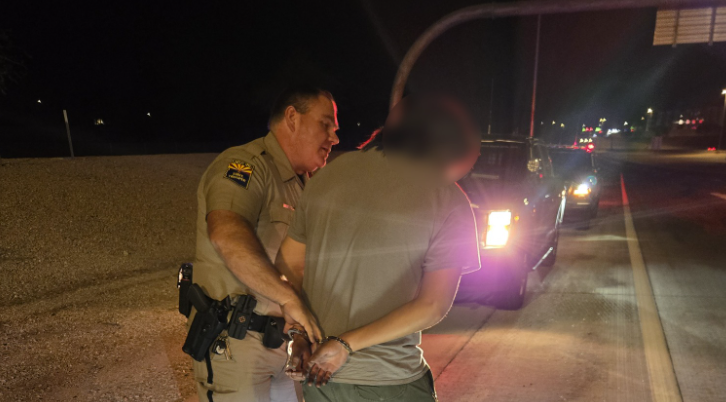
In the early morning hours of May 26, 2026, Arizona Department of Public Safety troopers responded to a single-vehicle rollover on the AZ-101 transition ramp to US-60 in Tempe after dispatch received several calls reporting the crash. What they found was a vehicle that had gone airborne after striking a storm drain, a driver with a story to tell, and enough signs of impairment to make that story considerably shorter.
The driver’s explanation for how the whole thing unfolded was, to put it charitably, creative. According to the trooper’s investigation, the vehicle crossed over a raised landscaping area separating the AZ-101 mainline from the US-60 transition ramp, caught a storm drain on the way through, and went airborne before landing hard on the other side.
The cause, per the driver: a missed exit. The solution attempted: cutting through the gore point. For those unfamiliar, a gore point is the triangular area of pavement between a highway main lane and an exit or on-ramp, and driving through it is both illegal and, as demonstrated here, structurally ambitious.
During the post-crash investigation, the trooper observed signs of impairment. The driver acknowledged having been drinking earlier in the evening and agreed to field sobriety testing, which did not go in their favor. An arrest for DUI followed, along with transportation for further DUI investigation.
The Arizona DPS framed this with their usual dry efficiency: it’s fine to miss your exit, but it is not fine to drive drunk. That about covers it. The two problems here were not equal in weight, and only one of them required handcuffs.
What Is a Gore Point, and Why Do Drivers Keep Hitting Them
A gore point is the paved or striped triangular zone where a ramp diverges from or merges with a highway mainline. It is not a shortcut, a median crossing, or a design oversight. It is specifically delineated to channel traffic safely, and driving through one is prohibited under Arizona law.
Storm drains, curbs, and raised landscape features tend to occupy those zones precisely because they are not intended for vehicle travel. Hitting one at highway speed introduces a launch variable that most drivers are not prepared for.
DUI Enforcement in Arizona: The Numbers Are Not Encouraging
Arizona is one of the more aggressive states when it comes to DUI enforcement, and for good reason. The Arizona Governor’s Office of Highway Safety reports that impaired driving consistently ranks among the leading causes of traffic fatalities statewide.
In 2023, roughly one in four traffic deaths in Arizona involved an impaired driver. The state uses saturation patrols, sobriety checkpoints, and mandatory ignition interlock requirements for first-time offenders to try to move those numbers.
A first-offense DUI in Arizona carries fines, mandatory jail time, license suspension, and the aforementioned ignition interlock device requirement for at least 12 months.
“I Can Sleep It Off” Is Not a Transportation Strategy
The Arizona DPS made a point worth repeating: coffee, sleep, food, and water do not accelerate alcohol metabolism in any meaningful way. The liver processes roughly one standard drink per hour, and that rate does not respond to willpower, urgency, or optimism.
A driver who had several drinks at midnight is still impaired at 2 a.m. regardless of how long they sat in a parking lot beforehand. The only variables that reliably prevent a DUI are not driving or handing the keys to someone who has not been drinking.
What Drivers Should Do When They Miss an Exit
Missing an exit is genuinely not a crisis. Every interstate and freeway in the country has another exit within a reasonable distance, and navigation apps recalculate in seconds. The correct response is to continue to the next exit, take it, and rejoin the highway going the right direction. It adds a few minutes at most.
Cutting through a gore point to avoid that inconvenience introduces a substantial risk of exactly what happened here: a storm drain, an unplanned flight, and a very different kind of inconvenience involving law enforcement. Rideshare apps, taxis, and designated drivers exist specifically for situations where driving is not a responsible option.
They are, in every measurable way, cheaper than a DUI.