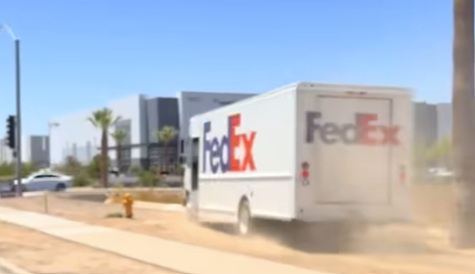
A viral clip making the rounds on Facebook shows a FedEx truck doing what most of us have only fantasized about in gridlock: cutting straight through a sandy median to leapfrog backed-up traffic in Glendale. The caption on the post read, “IN A HURRY! This FedEx driver went the distance to bypass traffic in Glendale,” and frankly, that is one way to put it.
The comment section, predictably, went straight to work. One person wrote that they had told the driver he had 20 minutes to get their package there “or else,” adding, “I guess he understood the assignment.” Another helpfully noted, “If you see delivery people breaking rules to get packages delivered on time, no you didn’t haha.”
There is something genuinely relatable about watching that brown truck bounce across uneven ground at what appears to be a decent clip, surrounded by cars full of people quietly simmering in traffic. Anyone who has ever sat on a California highway watching the clock tick while absolutely nothing moved can probably sympathize, if not quite endorse, the decision-making that led to this moment. The driver saw a gap, calculated the risk, and committed. The comments were right about one thing: there was no hesitation.
Whether the driver made their delivery window is unknown. Whether this stunt drew any attention from law enforcement is also unclear. What is clear is that the video made people laugh, sparked a minor round of applause from the internet, and is now permanently part of the FedEx highlight reel alongside the guy who tossed a computer monitor over a fence and the one who got caught kicking packages worth $30,000 in Baton Rouge just last week. The FedEx PR team stays busy.
It is worth noting that the driver, whoever they are, was operating under some fairly brutal professional conditions before they even made that call. Understanding the workload FedEx drivers carry every day adds a little context to what might otherwise look like a simple case of impatience behind the wheel of a very large vehicle.
FedEx Drivers Are Not Exactly Leisurely Cruising Around
The image of a delivery driver leisurely tossing parcels onto porches is not the reality. On average, a FedEx driver delivers between 75 and 125 packages per day, which is substantially higher than the broader home delivery industry average of 15 to 35 packages per day. Some contractor postings put that expectation even higher, with driver routes routinely expected to hit up to 150 stops a day.
That is a lot of stops. In a city like Glendale, which sits in one of the most congested traffic corridors in the country, shaving even ten minutes off a route can be the difference between completing your day on time and finishing well after dark. Add in the stop-and-go nature of Los Angeles area surface streets, delivery windows for businesses, and the general chaos of urban driving, and it becomes easier to understand why someone might look at a sandy median and see a perfectly reasonable alternate route.
Is It Legal? Spoiler: No
Driving a vehicle through a center median in California is not a recognized traffic maneuver. California Vehicle Code Section 21651 addresses divided highways and the requirement to keep right of the dividing section. The center median is not a lane, a shoulder, or an emergency bypass for delivery drivers who are running behind schedule.
Interestingly, California law does specifically authorize tow trucks to use center medians in emergency situations under California Vehicle Code Section 21719, but only when law enforcement is on scene and gives explicit permission. A FedEx truck full of packages does not meet that bar, however creative the reasoning.
The irony is that Glendale, California, takes traffic enforcement fairly seriously. The Glendale Police Department maintains dedicated traffic enforcement operations and is committed to proactive policing on local roads, which makes the timing of this particular shortcut either very bold or very lucky.
The Delivery Industry Pressure Cooker
The median maneuver is a symptom of a much larger reality in the parcel delivery world. Tight quotas and time pressure in the delivery industry make speed a priority, and drivers who need to make 120 to 150 stops a day do not have much room to waste time. That pressure does not disappear when traffic backs up on a surface street in Los Angeles. If anything, it compounds.
A single FedEx contractor can be responsible for delivering between 500 and 2,500 packages daily across a fleet of vehicles, which means the logistics behind keeping those routes on schedule are genuinely complex. Route optimization software, driver territories, and zip-code based zone assignments all help, but none of that technology prevents a Glendale intersection from seizing up during peak hours. When the route plan meets California traffic, sometimes drivers improvise.
The Internet Has Spoken, and It Approves
The viral reception to this video says something about where public sympathy tends to land in situations like this. People were not outraged. They were delighted. The comments were playful, the shares were enthusiastic, and the general consensus seemed to be that whoever this driver is, they deserve some credit for sheer conviction.
Delivery drivers occupy an interesting cultural space right now. They are simultaneously the target of frustration when a package is late and the object of genuine appreciation when the porch camera catches them treating parcels with care.
When one of them does something this audacious and nobody gets hurt, the internet tends to give them the benefit of the doubt. The sandy median in Glendale may not be on any official FedEx delivery route, but for one brief moment, it was the fastest road in Los Angeles.