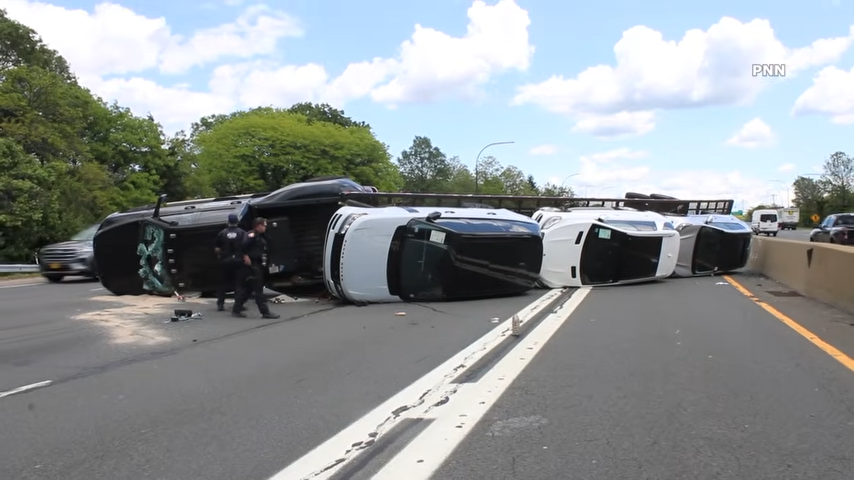
A fully loaded car hauler went over on its side Thursday on one of the most congested stretches of highway in the Northeast, turning the Long Island Expressway’s westbound lanes into a parking lot for hours and reminding every driver in the region why they dread the LIE on a good day.
The incident unfolded around 12:10 p.m. near the interchange where the Seaford-Oyster Bay Expressway feeds onto the LIE, a junction that sees heavy commercial traffic on a daily basis. A pickup truck towing a car carrier trailer carrying three vehicles lost control during or just after the merge and rolled onto its side, scattering debris across the westbound lanes and bringing traffic to a standstill.
For anyone who has driven this corridor, the location alone tells part of the story. The Seaford-Oyster Bay Expressway, also known as Route 135, is a major north-south connector feeding directly into one of the busiest east-west highways in New York. The ramp geometry and the sheer volume of merging vehicles make it an unforgiving stretch for large commercial rigs under any conditions.
As for the driver, the situation was serious but could have been far worse. He was able to free himself from the cab by breaking through the windshield before first responders arrived, which is the kind of detail that tends to stick with you. He was taken to a local hospital with injuries that were not considered life-threatening.
The Emergency Response
Nassau County Police Department and the Syosset Fire Department arrived on scene and managed what was, by any measure, a complicated and labor-intensive recovery operation. An overturned car hauler is not a quick cleanup under any circumstances. The rig itself, the three vehicles on the carrier, and the debris field all had to be addressed before the roadway could be reopened to normal traffic.
Through much of the afternoon, only a single lane near the shoulder remained passable. For westbound commuters and anyone trying to move through Nassau County during the midday and early afternoon hours, delays were significant.
Why Car Haulers Are Particularly Unforgiving in a Crash
Car carrier trailers, whether full-length multi-deck rigs or smaller piggyback setups pulled by pickup trucks, carry an unusual combination of height, weight, and load instability. The vehicles they transport shift the center of gravity considerably higher than a standard flatbed, making rollovers a persistent risk on curved ramps and sudden maneuvers.
Smaller car hauler setups towed by pickup trucks have become increasingly common, particularly among independent auto transporters and dealers moving vehicles regionally. They offer flexibility but demand respect. These are not trailers you can toss around a merge ramp, and any sudden steering correction at highway speed with three cars overhead is a recipe for exactly what happened on the LIE Thursday.
What This Means for the LIE’s Already Strained Capacity
The Long Island Expressway routinely ranks among the most congested highways in the United States. Any incident that takes out multiple westbound lanes, particularly during the midday window when commercial traffic tends to peak, cascades quickly through the surrounding surface streets and alternate routes. Drivers who rely on GPS rerouting found themselves competing with everyone else doing the same thing across Northern State Parkway and local connector roads.
Thursday’s incident also raises the ongoing question of how well Long Island’s highway infrastructure handles commercial hauler traffic. The LIE was not designed with the volume or type of freight movement it currently absorbs, and incidents like this one illustrate how little margin for error exists when something goes wrong.
The Takeaway for Anyone Sharing the Road With Car Haulers
Experienced drivers already know to give car carriers a wide berth. They have significant blind spots, they brake slowly under load, and they cannot maneuver quickly in an emergency. When you see a hauler entering from an on-ramp, giving it room is not just courtesy, it is practical self-preservation.
Thursday’s crash on the LIE is a useful reminder that even experienced commercial operators can find themselves in situations that go sideways in a matter of seconds. The driver’s ability to get himself out of the wreckage before help arrived was fortunate. The three vehicles riding on the carrier presumably fared less well, though their condition was not immediately detailed in early reports from the scene.
No other vehicles were reported to be directly involved in the crash, which, given the location and time of day, qualifies as its own kind of good news.