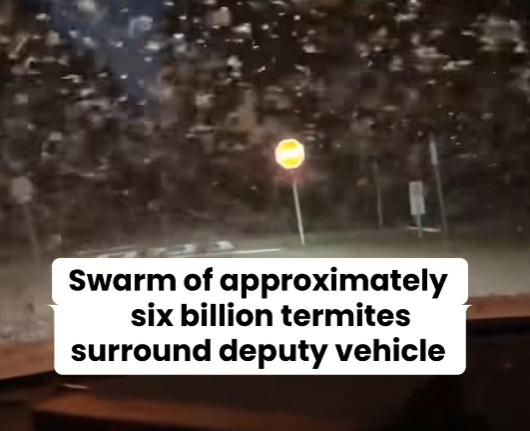
Abita Springs, Louisiana, served up one of the most jaw-dropping roadside moments of the year this week, and thanks to a widely shared TikTok clip from CBS News, the rest of the country got a front-row seat to the chaos. A sheriff’s deputy was driving through town on Tuesday evening when a massive cloud of termites descended on his vehicle, coating the windows and filling the night air with an almost incomprehensible number of insects. The footage is the kind of thing that makes you reconsider your entire stance on where you want to live.
The swarm was not just large. It was estimated at approximately six billion termites, a figure that sent the internet into an immediate spiral. That number is almost too big to process, which is exactly why the comment section lit up with people pointing out the obvious absurdity of it. Someone had to count those, right? The jokes practically wrote themselves, and they did, across thousands of replies.
For locals, though, this was not exactly breaking news. Louisiana residents who have survived a few springs know that termite season is a very real, very annual event. According to Louisiana State University, warm temperatures, high humidity, and rainy weather create the perfect storm for swarming behavior, and this time of year checks every single one of those boxes. The Gulf South is essentially a five-star resort for subterranean insects every spring.
Still, knowing it happens every year does not make it any less unsettling to watch a wall of termites blot out a car window in real time. The deputy could barely see past them, and the video makes clear just how overwhelming the swarm was. It looked less like a bug sighting and more like a weather event.
Why Were the Termites Swarming the Car in the First Place?
@cbsnews A swarm of approximately six billion termites surrounded a deputy’s vehicle as he was driving through Abita Springs, Louisiana on Tuesday evening. Termite swarming typically happens in the state around this time of year, during warm, humid and rainy weather, according to Louisiana State University. #news #termites #louisiana #spring #weather ♬ original sound – cbsnews
The likely culprit is something every driver uses without thinking twice: headlights. Termites that swarm at night are strongly attracted to artificial light sources, a behavior well-documented in entomology research. The deputy’s vehicle, rolling through the dark Louisiana night, would have been a beacon. Once a few termites locked onto the light, more followed, and the situation escalated fast.
This is a key reason why termite swarms tend to feel so dramatic in areas like Abita Springs. It is not just that the bugs are out, it is that cars, porch lights, streetlamps, and storefronts all become unintentional gathering spots. On the worst nights, driving through a swarm can feel like being caught in a blizzard, except the snowflakes have legs and they are not melting.
How Bad Is Louisiana’s Termite Problem, Really?
Pretty bad. One commenter under the viral video shared a map of termite infestation levels across the United States, and Louisiana is not just on the map, it practically is the map. The southeastern corner of the country, and Louisiana in particular, ranks among the most termite-dense regions in the entire nation. The combination of climate, soil composition, and moisture levels makes it ideal habitat for several aggressive species, including the notorious Formosan subterranean termite, which was introduced decades ago and has since made itself very much at home.
Comments under the video ranged from exhausted to resigned. One person summed it up simply: “Literally everywhere. I’m sick of it. Some nights are better than others though.” That kind of commentary only comes from someone who has lived through enough swarm seasons to develop a ranking system for them.
Should People Moving to Louisiana Be Worried?
At least one person in the comments admitted they were planning to relocate to Louisiana and were suddenly feeling a lot less confident about that decision after watching the video. The reassurance they received from locals was equal parts comforting and honest: the swarming is intense, but it only happens for about three weeks out of the year.
That is a reasonable thing to hold onto. Three weeks of termite chaos, even spectacular, six-billion-strong termite chaos, is not the same as a year-round infestation crisis. The bugs do not swarm continuously. They have their season, they make a scene, and then they move on. The structural damage termites can cause to homes is a longer-term concern that requires ongoing prevention, but the dramatic, flying swarms that engulf police cars? Those are a temporary spectacle.
For anyone considering a move to the area, the advice from longtime residents seems to be: turn off your porch lights during swarm season, keep your car in the garage if you can, and accept that some spring evenings are just going to belong to the termites.
What We Can Learn From a Six-Billion-Termite Traffic Stop
Beyond the entertainment value of watching a deputy’s car disappear into a living cloud of insects, this incident is a useful reminder of a few things. First, termite season in the Gulf South is not something to take casually. These are not random stragglers. These are organized, massive reproductive swarms, meaning colonies are active, healthy, and expanding. Homeowners in high-risk zones should treat spring as a prompt to inspect for damage and reinforce any existing pest control measures.
Second, the power of a single viral video to educate people is real. Thousands of people who had no idea what termite swarming looked like now have a very clear mental image. Some will do nothing with that information. Others will check their crawl spaces. That is a win.
And third, maybe the most underrated lesson here: Louisiana deputies are out there doing their jobs in conditions that most of us would consider a genuine emergency. The footage showed a calm response to what was, objectively, a surreal situation. If that is not a testament to Louisiana toughness, it is hard to know what is.