Electric vehicles keep getting quicker and more advanced, yet one major problem still hangs over the industry: batteries are heavy. Automakers have spent years chasing better range and faster charging, though reducing battery weight without sacrificing durability is a far tougher challenge.
Mercedes-Benz may have found an unexpectedly simple solution. A newly published patent (USPTO no. 12614774) reveals a fresh approach to mounting EV battery modules that could improve cooling, reduce weight, and even make battery packs easier to repair.
Instead of relying heavily on bolts, brackets, or one all-purpose adhesive, Mercedes proposes using two separate adhesives with different jobs inside the battery pack. It sounds minor at first glance, but the idea could solve several problems at once.
The patent also offers an interesting glimpse into how automakers are evolving EV technology beyond flashy horsepower numbers and giant battery packs. Sometimes the biggest improvements happen in the background, hidden beneath the car’s floor.
Mercedes Wants Adhesives To Do Different Jobs
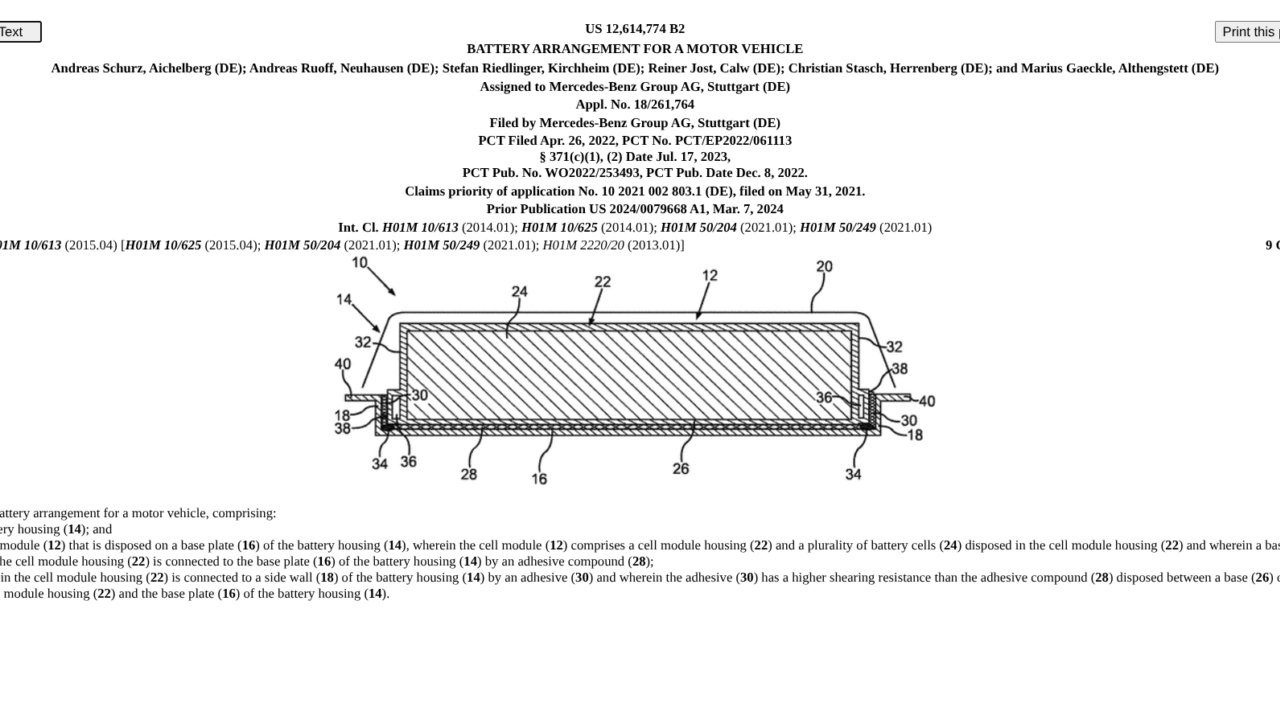
According to the patent filing, Mercedes-Benz plans to split battery module mounting duties between two specialized adhesives. One adhesive sits underneath the module and focuses primarily on heat transfer, helping pull heat away from the battery cells and into the battery housing.
The second adhesive is applied along the sides of the module and is designed for structural strength. Its job is to keep the module securely in place during normal driving conditions and under heavier stress loads.
Most current EV battery packs rely on bolts, brackets, or thick adhesives that handle both cooling and structural support simultaneously. Mercedes’ approach allows each material to specialize in a single role, potentially improving efficiency while reducing unnecessary bulk.
The patent diagrams show a tray-style battery housing with modules mounted neatly inside a compact structure. Fewer heavy mounting components could help trim overall battery pack weight, which remains one of the biggest obstacles facing EV efficiency today.
Better Cooling Could Improve Battery Performance
Thermal management has become increasingly important as EVs gain larger battery packs and faster charging capability. Excessive heat can reduce charging performance, shorten battery lifespan, and negatively affect long-term durability.
By improving how heat moves away from the battery cells, Mercedes’ design could help maintain more stable temperatures under demanding conditions. That may allow batteries to perform more consistently during repeated fast charging sessions or aggressive driving.
The system could also indirectly improve efficiency. Lighter battery packs require less energy to move, which can help offset the weight penalties that often come with larger-capacity EV batteries.
Mercedes is not the only automaker exploring creative battery packaging solutions. Across the industry, manufacturers are experimenting with structural battery packs, cell-to-pack designs, and new cooling methods as they search for better efficiency and lower production costs.
Easier Repairs Could Be Another Major Benefit

One of the more practical advantages of the Mercedes design involves serviceability. According to the patent, the side adhesive is strong enough to secure the modules while still allowing technicians to cut through it if repairs are needed.
That could make replacing damaged battery modules far easier than in some current EV battery designs. Many modern packs are difficult and expensive to repair because modules are permanently bonded or heavily integrated into the structure.
Reducing repair complexity could eventually help lower ownership costs for EV buyers. Battery replacement and repair costs remain one of the biggest concerns for long-term electric vehicle ownership, especially as older EVs age out of warranty coverage.
Using fewer mounting components and less adhesive may also help reduce manufacturing costs. Simplified assembly processes are becoming increasingly important as automakers try to make EV production more profitable.
It’s Still Only A Patent For Now
Like many automotive patents, there is no guarantee this exact design will reach production vehicles anytime soon. Automakers frequently patent experimental ideas that never make it beyond the development phase.
Still, the filing provides insight into how Mercedes-Benz is approaching the next generation of EV development. Rather than focusing only on larger batteries or bigger power figures, the company appears increasingly interested in refining the smaller engineering details that shape everyday ownership.
Those details are more important than ever as the EV market matures. Buyers now expect electric vehicles to deliver not just range, but also lower costs, better durability, and easier long-term maintenance.
If Mercedes can improve cooling, reduce weight, and simplify repairs with a relatively straightforward redesign, it could become one of those behind-the-scenes innovations that make future EVs much better to live with.