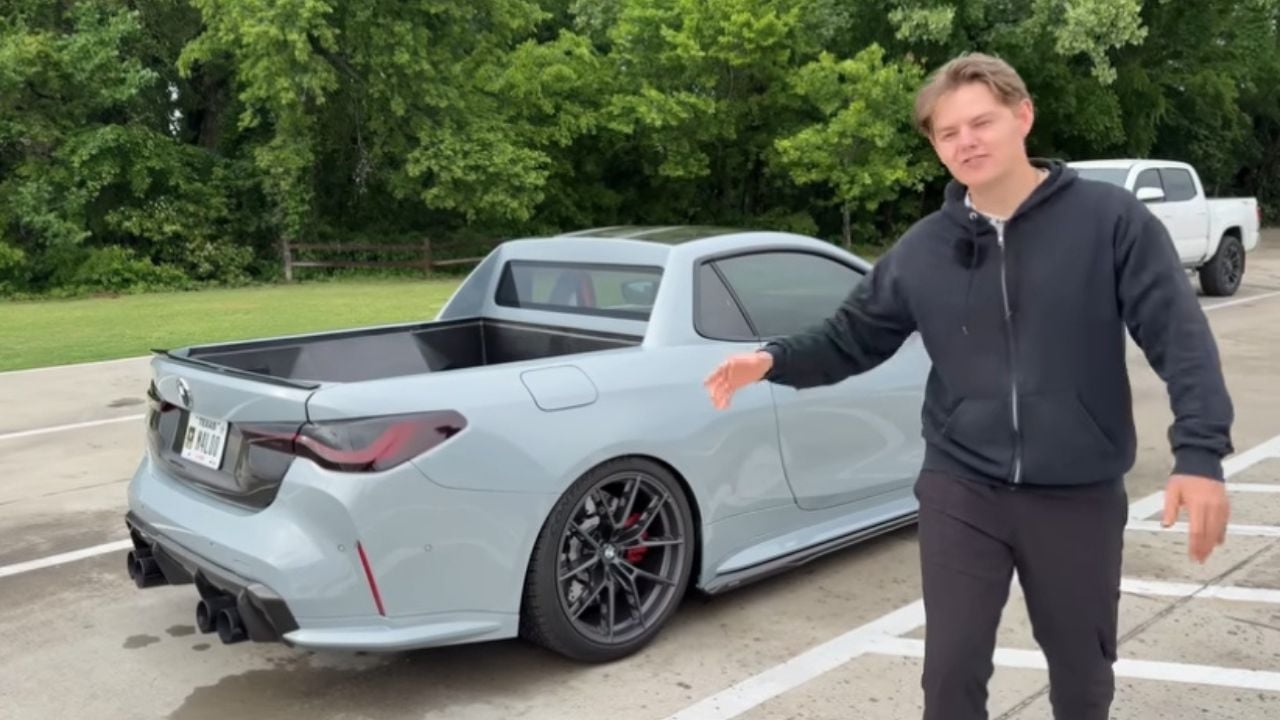

This guy called Canon bought a brand-new BMW M4 (G82) and decided to chop off the roof because he wanted it to be a Ute. A one-off Ute, that is; because this is the first time (and hopefully the last) we’ve seen the M4 treated this way.
No, it wasn’t a spur of the moment decision that you start on a weekend, regret on Monday, and then decide to finish what you started because, well, you’ve already started cutting. It was nothing like that in this guy’s garage.
We know this how? Because the guy who put this on YouTube says he knew this M4 ute long before it was born, when it was still a hatchling in digital rendering form.
So, apparently, this was a carefully, passionately premeditated crime, executed over several years. Canon must really want that ute; we just wish he’d chosen a different guinea pig. I know, I know; his money, his choice.
Let the Cutting Begin
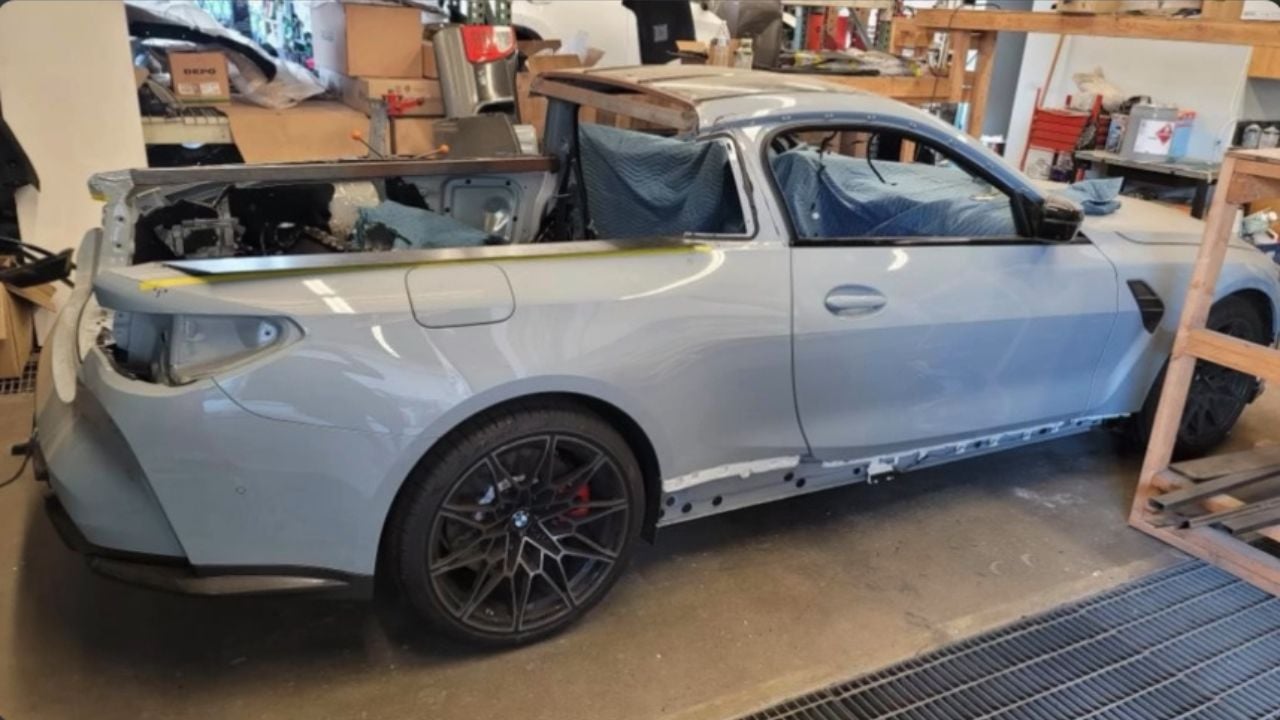
The G82 M4 is built around a carefully tuned body shell where torsional rigidity, crash structures, and load paths work as a single system. Removing the roof and rear structure disrupts that balance in ways that are far more complex than reinforcing a few pillars.
BMW’s chassis engineers design the coupe’s rigidity through a network of stamped steel, adhesives, and laser welds that distribute stress across the entire body. Once that is cut, the car no longer behaves as intended under load, whether during hard cornering or in a collision.
You have to specifically not care about the M4’s inherent road manners to take a knife to its roof. BMW offered the G82 M4 standard with carbon fiber roof that helped reduce overall weight, lower the center of gravity, and sharpened handling performance.
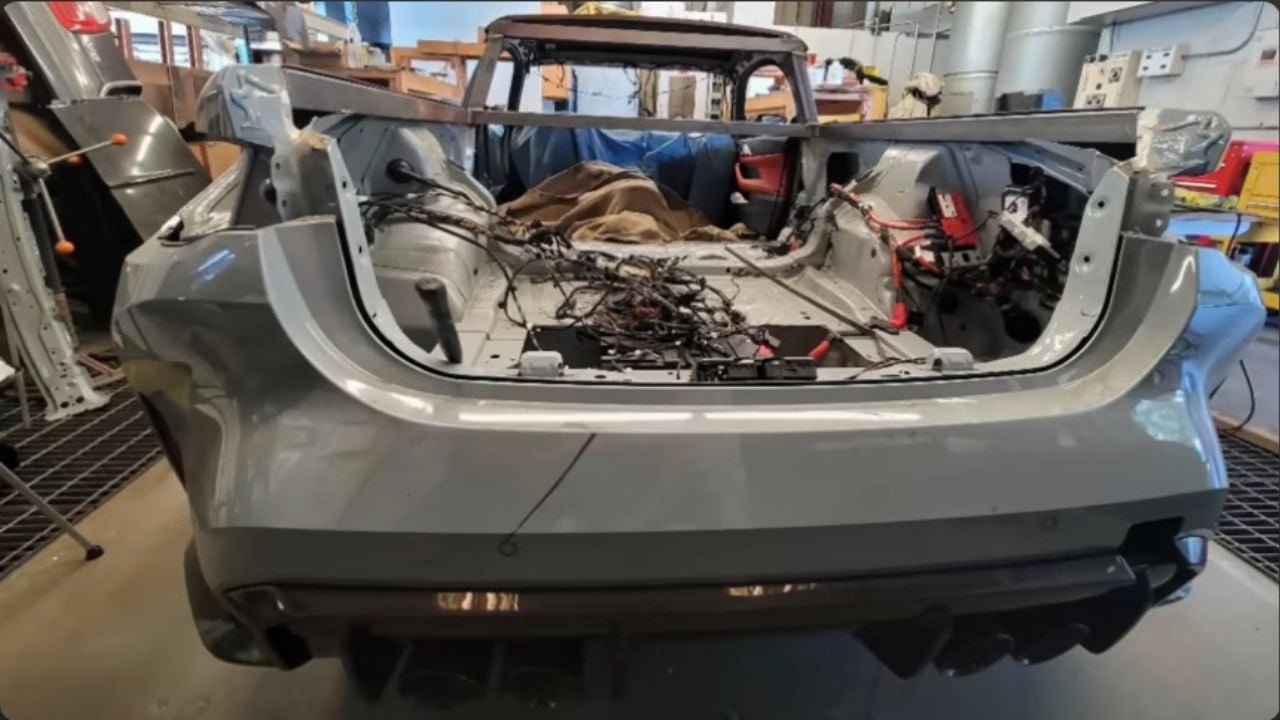
The convertible G83 M4, however, uses a soft top instead of carbon fiber.
Canon claims the reinforced C-pillars act as a substitute for a structural cage, yet this overlooks how modern unibody construction functions. Strength in a car like the M4 comes from the integration of multiple structural members, not a single reinforced section.
Even professionally engineered convertibles require extensive underbody bracing, thicker sills, and recalibrated suspension geometry. Without that level of redesign, the Ute conversion risks increased chassis flex, which can alter handling characteristics and introduce long-term fatigue in the metal.
Blame It on the E30
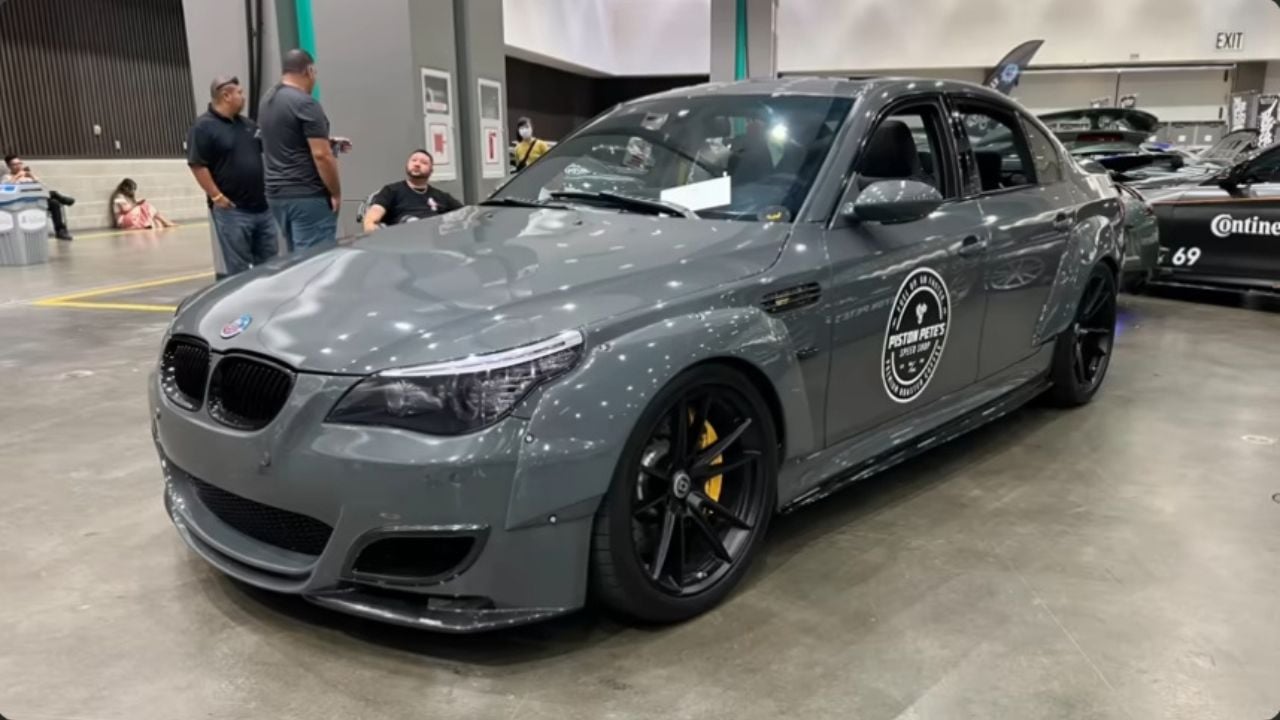
Look, this guy is obviously a Bimmer fan. Or maybe he isn’t. But I think he is because he showed off an M5 of the same grey color as this M4. He had that M5 before he decided to get the 2022 M4 for the sole purpose of chopping off the roof.
It was a bucket list, as he says in the video. And that’s because he met the original E30 Ute in Germany and that car made a lasting impression on him.
The BMW E30 “Ute” was, indeed, a fascinating blend of Bavarian engineering and Australian utility culture. It lived both as a secret BMW prototype and as modern enthusiast builds. It’s essentially a pickup conversion of the iconic E30 3 Series, most famously the M3.
BMW Motorsport built the one-off E30 pickup in 1986 using a convertible shell for added rigidity. Here’s the one tinny detail about its true raison d’être: It was intended as a parts hauler around the M Division campus.
But then this “parts hauler’s” modest 2.0L engine was later replaced with the S14 four-cylinder from the M3. So, it was a true performance utility vehicle. This prototype remained in service until 2012, never entering production.

Only if the story ended there.
Enthusiasts like Canon would not let that happen.
In Australia, BlacKnight Creations developed “Project MUTE,” a custom E30 M3 Ute. But BlacKnight did not chop the roof off a sedan.
Starting from a Baur semi-convertible E30, BlacKnight’s build incorporated $10,000 worth of genuine M3 panels, E46 steering setup, F87 M2 Competition wheels, and Titan coilovers for stance and handling. It benefited from the E36 M3’s S50B32 engine (3.2L, 321 hp).
Physics Says Hello
There is also the issue of weight distribution. The BMW S58 engine in the M4 is paired with a chassis tuned for near-perfect balance between front and rear axles. Removing the rear structure and replacing it with a lighter custom bed shifts that balance forward.
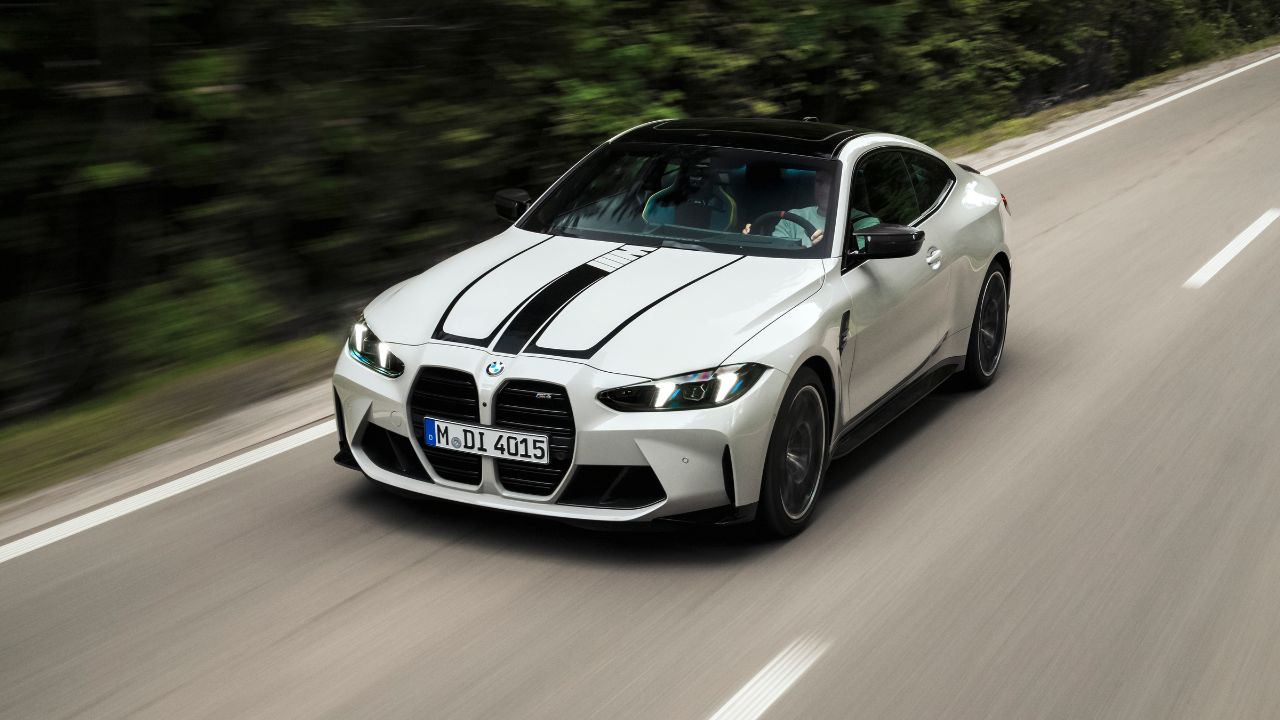
This can lead to reduced rear traction, especially under acceleration, undermining one of the defining traits of the M4’s performance profile. The car’s stability control and traction systems are calibrated for the original mass distribution, not a radically altered one.
From a safety standpoint, well, you don’t build something like this and be obsessed with safety.
The rear crash structure in the G82 M4 is designed to absorb impact energy and protect occupants. Cutting it away removes engineered crumple zones and replaces them with custom metalwork that has not been tested under standardized conditions.
In a rear-end collision, the consequences could be severe, as the energy absorption characteristics are no longer predictable.
Then there is the integration of electronics. Modern BMWs rely on a dense network of sensors, wiring harnesses, and control modules that are routed through the body. Stripping and rerouting these systems introduce potential points of failure.
Features like parking sensors, stability systems, and even fuel system monitoring depend on precise placement and calibration. While the build retains some factory functionality, long-term reliability becomes a question mark when systems are modified outside factory specifications.
But also… That Grille Though
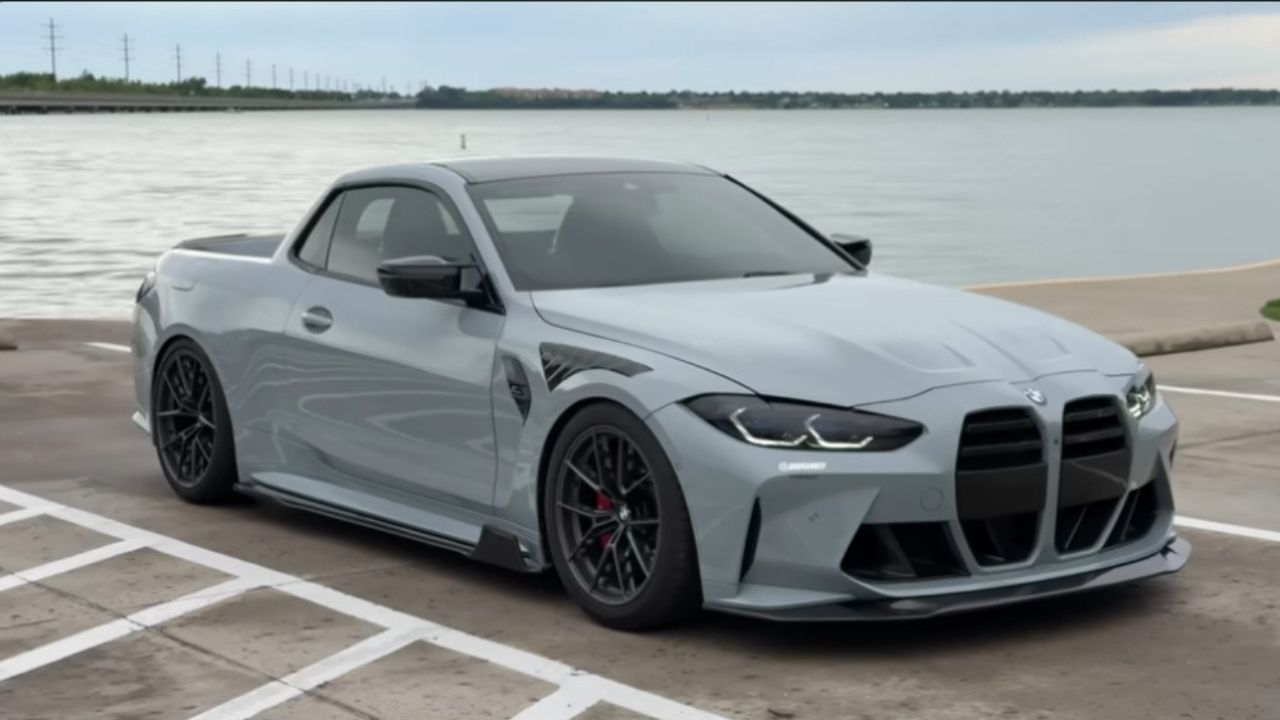
Now, the massive elephant in the room: the look. The G82 generation already had fans and enthusiasts clawing out each other’s eyes over that oversized kidney grille. Be as it may, the car manages an impressive, cohesive design, shaped by aerodynamic testing and brand identity.
Taking that controversial aesthetics and converting it into a Ute is just asking for it, not to speak of how it disrupts those proportions.
This build leaves a silhouette that lacks the visual balance of either a coupe or a traditional pickup. Purpose-built Utes such as the Ford Ranchero or Chevrolet El Camino were designed from the ground up to integrate utility and style, not retrofitted from high-performance coupes.
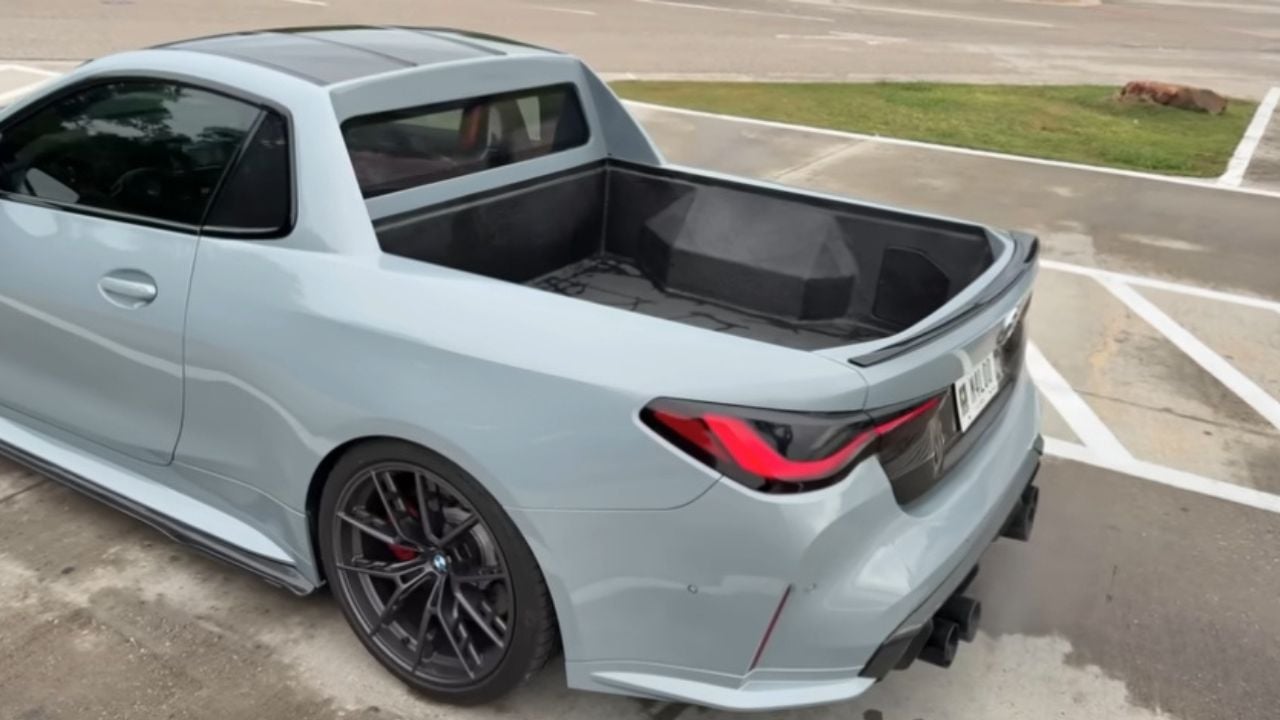
I know, it’s his car, his dream, his project. My opinions would’ve been simply mine if they didn’t put it up on YouTube to try and explain why they chopped off the roof of an M4.
And what about the money? Which I’m sure isn’t a problem with Canon.
Spending the cost of a new M4 plus an additional build fee to create a compromised vehicle raises questions about value. For similar money, you could get factory-engineered performance cars or purpose-built trucks that deliver both capability and reliability without sacrificing structural integrity.
Sorry, Canon
Ultimately, Canon’s build succeeds as a spectacle and a conversation starter, but from an engineering, safety, and performance perspective, it’s a case study in why some platforms should be left as is.
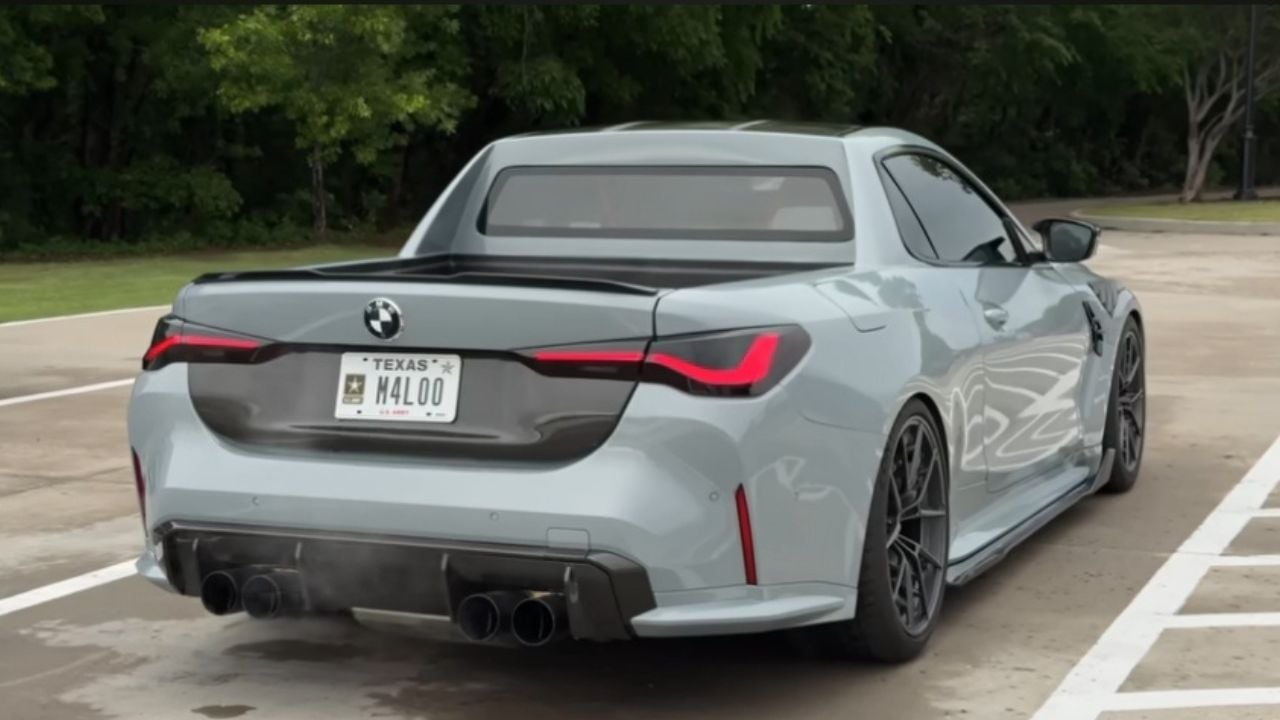
The E30 ute that supposedly made him do this was always destined to remain a curiosity rather than a viable production model, and the reasons are rooted in both engineering and market logic.
The E30 platform was designed as a compact sports sedan, optimized for rigidity, balance, and handling. Converting it into a pickup compromised those strengths: cutting away the rear structure reduced torsional stiffness, even with reinforcement, which undermined the car’s celebrated dynamics.
The load bed offered minimal utility compared to traditional Utes, making it impractical for people with a genuine need of cargo capacity.
From a business standpoint, BMW’s brand identity in the 1980s revolved around premium performance, not utilitarian vehicles. A pickup would have clashed with the company’s image and confused its market positioning. Three decades later, that’s still the case.
Furthermore, the global demand for luxury pickups was virtually nonexistent at the time, meaning the investment required to engineer and certify such a model would never have been recouped. In short, the E30 Ute diluted BMW’s core strengths without offering meaningful utility. Sorry, Canon, we feel the same way about your G82 Ute.
There’s a reason the E30 never stopped being a quirky prototype and never made it to the production line.