
Sometimes what might sound like a crazy idea can turn into something extraordinary. At The Lego Group headquarters in Billund, senior design manager Jeppe Juul Jensen had the ambitious idea of creating a full-scale, 1:1 LEGO version of the Bugatti Chiron.
Building a five-meter-long and 2.5-meter-wide Chiron entirely from LEGO pieces would be no easy task, so Jensen contacted LEGO’s official model-building center in Kladno. The engineers there were already responsible for producing large displays for LEGOLAND parks and LEGO retail stores, making them the perfect team to attempt such an ambitious project.
And the rest, as they say, is history.
Rebuilt Several Times
This mammoth task was not easy by any means, so much so that the team admitted it had to be rebuilt on several separate occasions.

Using only LEGO Technic elements, something the The Lego Group team in Kladno had minimal experience working with, the Danish company and engineer Jakub Mašek explained how exciting the project became: “Honestly, I love challenges like this. I needed to be part of this project. I was like: ‘Who do I kill to be involved?’”
Over 1,000,000 LEGO Technic elements were used during the project, which took six months and 13,000 work hours to complete. Sixteen engineers worked tirelessly to ensure every brick resembled the real Bugatti Chiron as closely as possible.
Talk about dedication to the craft of building something as exciting and ambitious as this remarkable engineering project.
How LEGO Replicated Bugatti’s Curved Body
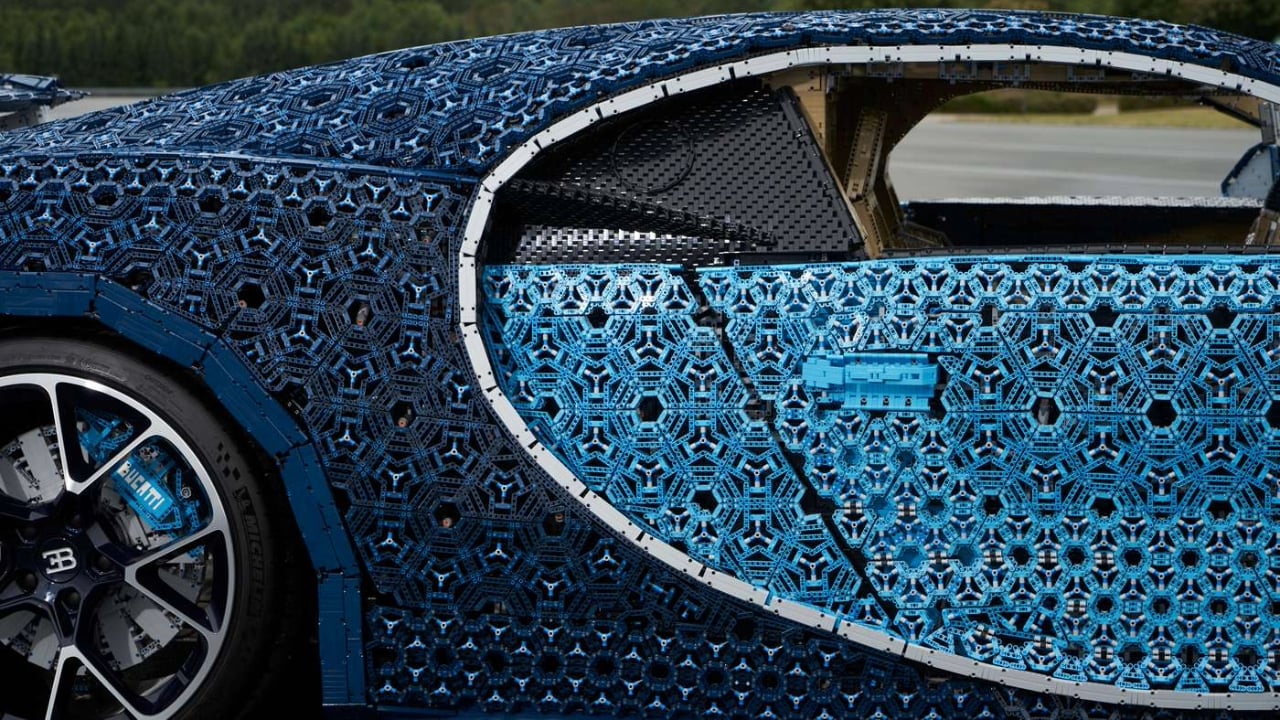
Engineers building the LEGO couldn’t easily make smooth curves because LEGO Technic pieces are mostly straight and rigid. So they came up with a clever workaround.
First, they divided the outside of the car into vertical sections. Between those sections, they built the outer surface (the “skin”) using lots of small triangles made from LEGO pieces.
Triangles are useful because when you combine many of them, you can approximate curves even though each piece is straight.
Then they connected these triangles to the internal frame using small adjustable mechanisms called actuators, which are little mechanical pushers.
Test Driven

The team in Kladno would put their creation to the test 462 kilometers away at the Bugatti test track in Germany. Behind the wheel was official Bugatti test driver Andy Wallace, who admitted he initially struggled to believe a faithful replica of the Bugatti Chiron could be recreated using LEGO pieces. Seeing the finished model in person, however, quickly changed his mind, describing it as remarkably lifelike.
After a slightly nervous start, the LEGO-built Bugatti Chiron began moving and eventually reached speeds of more than 12 miles per hour (20 km/h).
While that may not sound particularly fast, the achievement becomes far more impressive when you consider the car was powered by 2,304 tiny LEGO motors, arranged into 24 packs of 96, all working together to propel it forward.