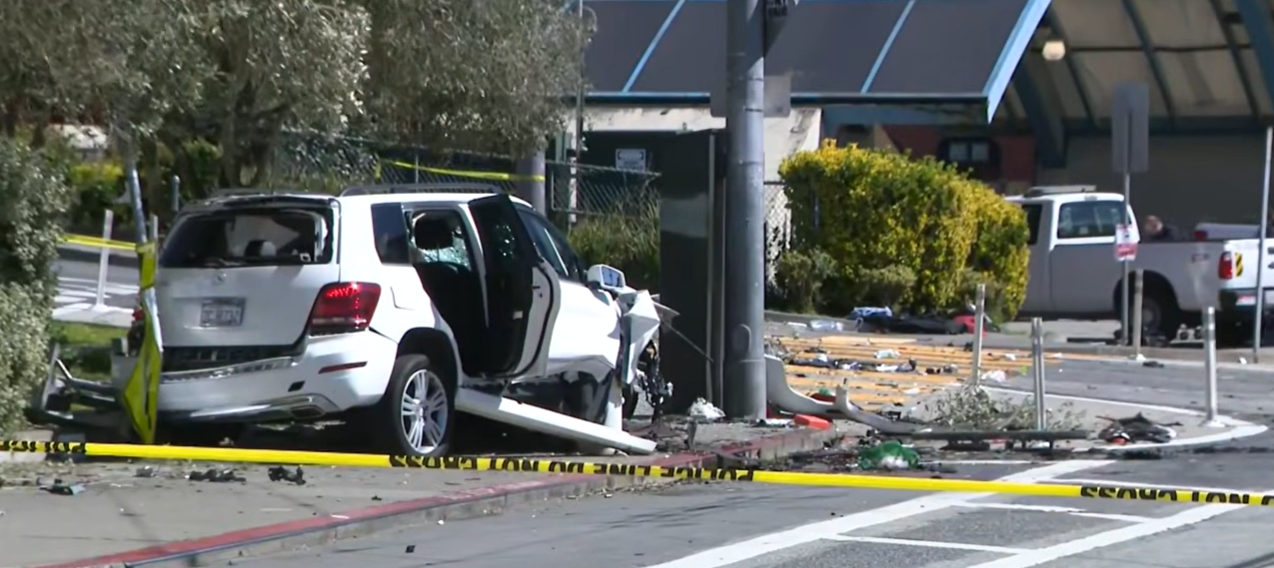
Four people were standing at a bus stop in San Francisco, waiting for a normal day to unfold. A couple celebrating their anniversary. Two young children. A trip to the zoo. None of them made it. A driver lost control and plowed through the stop, wiping out an entire family in seconds.
Investigators say that the driver was traveling at nearly 70 mph in a 25 mph residential zone. Not a gray-area situation. Not a close call. A high-speed impact on a city street where people were simply waiting. The driver later pleaded no contest to four felony counts of gross vehicular manslaughter. The sentence? Two years of formal probation, 200 hours of community service, and a three-year license suspension, after which she could apply to drive again.
This is the part that sticks with you. Every day, people choose to drive aggressively. They choose speed over control. They choose distraction and assume nothing will happen. Most of the time, they get away with it. Until they don’t.
From the outside looking in, it starts to feel like the system is not working. For a lot of people, it is hard to argue that it is. Speed is a choice. When people escape the consequences of reckless choices, behavior does not change.
Driver Who Killed Family of Four Will Not Serve Jail Time
Embedded media follows. Please allow a moment for it to load.
A San Francisco judge sentenced 80-year-old Mary Fong Lau to two years of formal probation after the 2024 crash that killed a family of four at a bus stop. She was also ordered to complete 200 hours of community service and will not be allowed to drive for three years, after which she can apply to have her license reinstated. She will not serve jail time or home detention, according to reporting from the San Francisco Chronicle and details aired in local TV coverage.
Lau pleaded no contest to four felony counts of gross vehicular manslaughter. The judge cited her age, lack of criminal history, and apparent remorse as key factors in the decision, along with the view that incarceration would serve little purpose beyond punishment. The video report also noted that family members were deeply angry with the outcome and said they felt unheard and disrespected by what they saw as a light sentence.
A High-Speed Crash That Wiped Out an Entire Family
Investigators say Lau was driving a Mercedes SUV at speeds approaching 70 mph on a residential street before crashing into a bus stop in San Francisco’s West Portal neighborhood, as reported by The Guardian. Waiting there was a family of four, Diego Cardoso de Oliveira, 40, and Matilde Moncada Ramos Pinto, 38, along with their two young children, as they prepared for a trip to the zoo.
The impact was catastrophic. The crash killed the entire family. Authorities found no evidence of mechanical failure, medical emergency, or impairment contributing to the crash, according to the San Francisco Chronicle. Local TV coverage also emphasized that one of the biggest unanswered questions remains why Lau was allegedly driving that fast in a residential neighborhood at all.
The Legal Line That Changed the Outcome
Despite the extreme speed and the scale of the loss, the case ultimately came down to how the law defines negligence. There was no evidence of drugs, alcohol, distracted driving, or street racing, which made it more difficult to push the case beyond the charges filed. That distinction mattered when it came time for sentencing.
The judge acknowledged the severity of the outcome but determined that incarceration, given the circumstances, would not meaningfully serve justice beyond retribution. Family members, however, said they wanted more accountability, including a guilty plea instead of no contest and at least one year of home detention.
Civil Lawsuits and Allegations of Asset Transfers
The criminal case may be resolved, but the civil fight is still unfolding. The victims’ families have filed wrongful death lawsuits, and a separate suit alleges Lau transferred ownership of multiple San Francisco properties after the crash, including homes and a commercial building, into LLCs, according to the San Francisco Standard.
Attorneys for the families argue the transfers were an attempt to place assets beyond reach if damages are awarded. Lau’s legal team disputes that claim, saying the moves were made based on professional advice and were not intended to avoid liability. If she is found liable, those assets could ultimately determine what compensation the families receive.
Online Reaction: “This Doesn’t Feel Like Justice”
Reaction online has been immediate and overwhelmingly critical, with many focusing on the disconnect between the outcome and the severity of the crash. “This is a miscarriage of justice,” one commenter wrote, while others pointed to the fact that Lau could legally return to driving.
“She can drive again when she’s 83,” one user wrote, questioning how that aligns with public safety. Calls for permanent license revocation, stricter driving laws, and mandatory retesting for older drivers showed up repeatedly. Some comments went further, arguing that cases like this reflect a broader issue. “The easiest way to get away with homicide is to kill someone with a car,” one commenter wrote, a sentiment that, whether fully accurate or not, is clearly gaining traction.
A System That Feels Out of Balance
Step back, and this is what people are reacting to. An entire family was killed. The driver was traveling at speeds far above the limit. There was no mechanical failure, no impairment, and no medical emergency. The result was four felony convictions and no jail time.
At the same time, the victims’ families are now in civil court, fighting over whether assets were moved out of reach after the crash. Those are not opinions. Those are the facts of the case.
What people are struggling with is what those facts add up to. When an outcome like this ends in probation, it raises a broader question about deterrence. If consequences at this level remain limited, it is fair to ask what message that sends about accountability behind the wheel.
What Happens Next Matters
The legal process in this case is not over. Civil lawsuits are ongoing, and regulatory agencies could still take additional action on licensing. But the bigger issue may already be set.
Because once people begin to believe there is little real consequence behind the wheel, that belief becomes part of the risk itself. That is a much harder problem to fix.