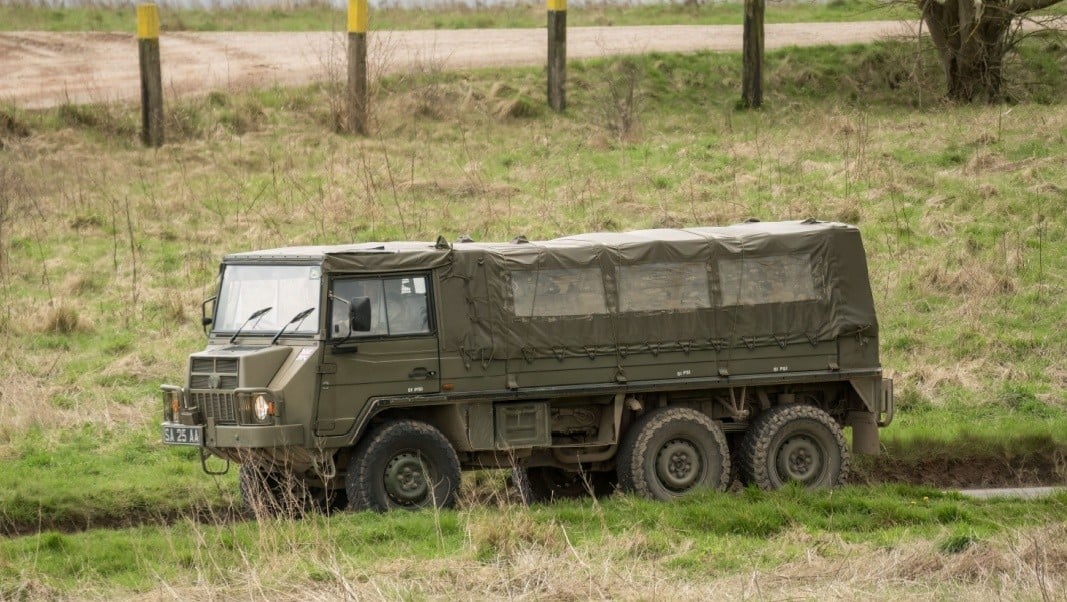
We were scrolling when we came across a Pinzgauer 6×6 converted to electric power, and we instantly fell down the rabbit hole. A rugged, go-anywhere military truck swapping its combustion heart for silent electric torque isn’t something you see every day.
Engine swaps are always tempting. More power. Better efficiency. Modern tech in a vintage shell. What could possibly go wrong?
As anyone who has ever mixed and matched parts from different eras knows, plenty. Once you move beyond well-documented swaps with deep aftermarket support, things get complicated fast. Parts don’t line up. Mounts don’t cooperate. Systems that were never meant to talk to each other suddenly have to.
That’s what makes an EV conversion especially fascinating. You’re not just swapping engines. You’re rethinking how the entire vehicle delivers power. Done right, you eliminate decades of combustion-related headaches and gain instant torque that’s perfect for crawling and climbing.
This particular build, from Creative Engineering Projects, keeps the Pinzgauer’s original six-wheel-drive layout and integrates electric power into a platform already famous for going just about anywhere.
And that’s where things get interesting.
Reimagining a Legendary Off-Roader

The Steyr-Puch Pinzgauer 712M 6×6, first produced in the early 1970s, was engineered for extreme terrain. It can climb steep grades, ford deep water, and haul heavy payloads across hostile environments. Its design makes it a natural candidate for electrification, especially since electric motors deliver instant torque — a major advantage in off-road situations where low-speed control is critical.
In this project, the aging internal combustion engine was removed due to reliability concerns, particularly its inability to sit idle for extended periods without trouble. The plan was ambitious: mount an electric motor directly to the vehicle’s two-speed transfer case while distributing battery packs in the side cargo compartments.
This approach preserves the original drivetrain layout while leveraging electric torque to enhance performance.
However, unlike many EV conversions that prioritize simplicity, this build had to respect the Pinzgauer’s unique mechanical architecture. Its central driveline tube and multi-axle configuration complicate integration, making even basic component placement a challenge.
Engineering Challenges and Setbacks
What started as an exciting conversion didn’t exactly go according to plan. The company originally handling the build shut down mid-project, leaving behind a partially completed Pinzgauer that needed serious sorting before it could move forward.
When the new team picked it up, it became clear this wasn’t a simple bolt-it-together-and-go situation. On a vehicle this unusual, small decisions matter.
One issue could be traced back to motor positioning. It had been mounted at roughly a 45-degree angle, which put a vent in the wrong spot and allowed transmission fluid to escape. Not catastrophic, but definitely not something you want to discover after the fact.
Then came vibrations. The revised geometry created a steeper driveshaft angle than intended, leading to shaking strong enough to loosen mounting bolts. That’s the kind of problem you only find once everything is under load.
There was also a spline adapter that wasn’t secured tightly enough, allowing movement along the motor shaft. On a simple build, that might be minor. On a 6×6 with a central driveline tube and multiple driven axles, tolerances stack up quickly.
That’s the reality of a project like this. Every measurement matters. Every angle matters. And when you’re adapting modern electric components to a platform designed decades ago, the details can make or break the result.
Why Electric Power Still Makes Sense
Despite the setbacks, the upside of electrifying a Pinzgauer is still hard to ignore.
Electric motors deliver instant torque, which is exactly what you want when you’re crawling over rocks, climbing steep grades, or easing down something that looks a little too vertical. No stalling. No clutch work. Just smooth, controllable power.
The goal here isn’t just to make it different. It’s to make it better. With the motor properly mounted, the driveline angles sorted, and the batteries positioned correctly, this electric Pinzgauer has the potential to be more usable and possibly more capable than the original gas-powered version.
Zooming out, this build is part of a much bigger shift. Instead of parking older machines when parts get scarce or engines get tired, more builders are giving them a second life with electric power. From classic coupes to full-blown expedition rigs, the idea is the same: keep the character, upgrade the guts.
Converting a Pinzgauer 6×6 to electric isn’t easy. However, when it works, you end up with something pretty wild. Vintage military toughness, modern torque, and a platform that might just be as comfortable on a remote trail as it is in a post-TEOTWAWKI world.