

Elon Musk and Alphabet’s autonomous‑vehicle unit Waymo have turned a simmering competitive dynamic into a social‑media spectacle — with Musk declaring what he calls an “early victory” over a rival valued at roughly $45 billion and Waymo’s supporters firing back with hard mileage and safety data.
At its core, the exchange is more than ego‑driven posturing. It’s a proxy battle over the future of mobility: whether Tesla’s camera‑focused, fleet‑software‑driven path will ultimately outpace Waymo’s lidar‑equipped, fully autonomous infrastructure that has already clocked millions of driverless miles and tens of millions of paid robotaxi rides.
What Sparked the X (formerly Twitter) Fight?
The back‑and‑forth began with Jeff Dean, Chief Scientist at Google DeepMind and Google Research, weighing in on the autonomy debate. Dean publicly stated (on the prompting of a Tesla fan) that Tesla does not yet have anywhere near the volume of “rider‑only autonomous miles” that Waymo has logged, implying Waymo’s lead in real, unsupervised vehicle operations.
That prompted this blistering rejoinder from Musk on X:
“Waymo never really had a chance against Tesla. This will be obvious in hindsight.”
Tesla did report in April that they have accumulated 50,000 miles driving cars from the end of the factory line to the outbound logistics lot in their factories in TX and CA.https://t.co/bl5xKruWDY
— Jeff Dean (@JeffDean) December 9, 2025
It’s a strikingly confident (some would say provocative) declaration given the data. It’s also straight Musk: bold, headline‑grabbing, and unfiltered.
The fight reflects deep technical differences in how the two companies approach autonomy:
- Waymo uses a sensor suite including lidar, radar, and cameras alongside highly detailed maps — a redundancy‑focused strategy designed for robust, generalized autonomy without human supervision.
- Tesla has famously rejected lidar and many forms of specialized sensors, instead relying on camera‑only vision and neural nets trained on its massive fleet of customer vehicles. This vision‑only strategy aims for scalability but has drawn criticism for safety and performance in complex scenarios.
It’s important to note that Waymo’s fleet continues to drive millions of fully autonomous miles without a safety monitor, and that’s a key threshold Tesla’s Robotaxis haven’t yet consistently achieved.
Musk argues Tesla’s route will prevail because of the company’s integration of software and hardware at scale, its production volume, and massive installed base of vehicles that can, in theory, receive over‑the‑air autonomy upgrades.
Reality on the Ground: Who’s Ahead?
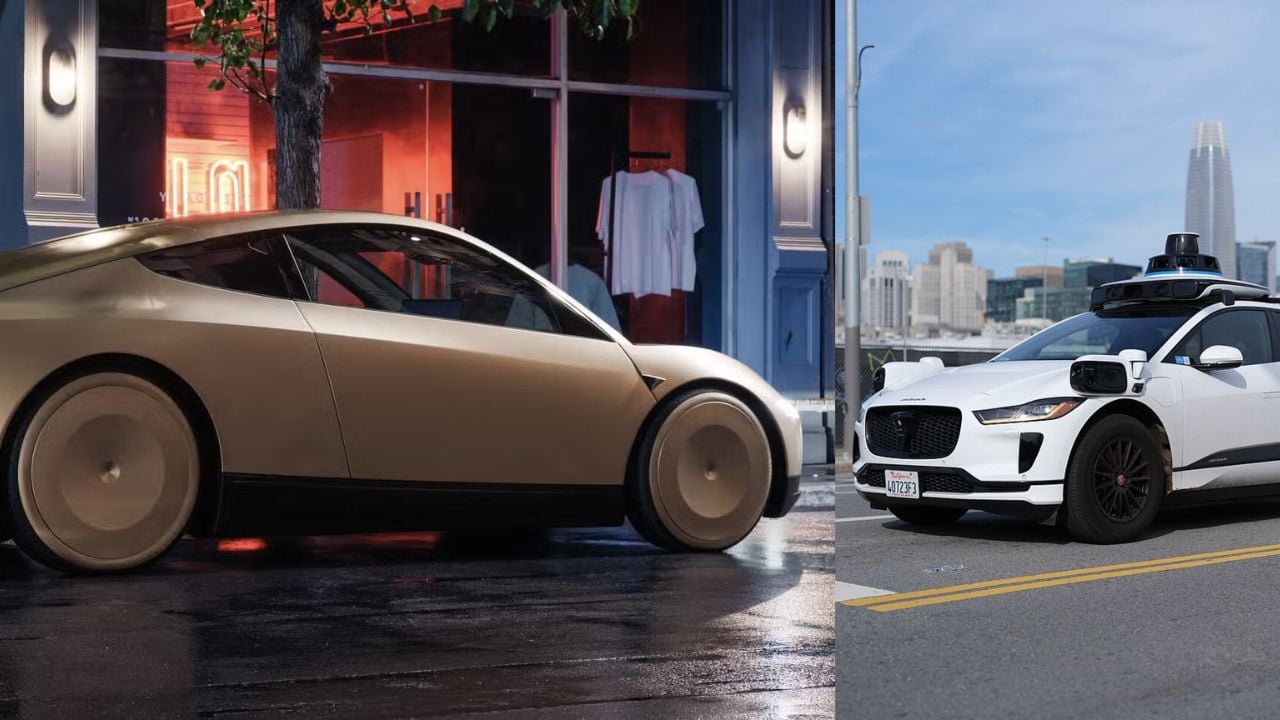
Waymo’s numbers are impressive. As of late 2025, Waymo has ~2,500 fully autonomous vehicles in operation and is reporting ~450,000 paid robotaxi rides per week. This figure dwarfs Tesla’s current, limited rollout.
Waymo’s vehicles operate driverless in cities such as Phoenix, San Francisco, Los Angeles, and others — with expansion plans into Boston, Atlanta, Miami, Minneapolis, Tampa, and New Orleans.
Tesla’s Robotaxi service, meanwhile, has launched commercially only in Austin, Texas, with a small fleet and still requires a safety monitor in many cases, though Musk has repeatedly pledged unsupervised operation “by the end of the year”.
Musk’s camp counters that once Tesla’s software is ready, the company’s huge installed base of vehicles and its software‑updatable platform could scale far faster than Waymo’s purpose‑built fleet.
Broader Voices and Industry Reaction
Musk and Dean aren’t alone in this fight. Other industry figures have weighed in alongside the Musk‑Waymo exchange. Uber’s CEO Dara Khosrowshahi said he believes Musk eventually will achieve viable scale, but for the next five years he would bet on Waymo’s lead. It’s a predictable stance from a company already partnered with Waymo for robotaxi service. Investors and analysts have celebrated Waymo’s consistent growth and safety metrics as validation of a sensor‑rich, data‑intensive strategy. Meanwhile, Musk’s supporters highlight Tesla’s massive software data pool (from millions of vehicles) and point to early metrics like app download rates that outpaced competitors, though that’s not the same as actual autonomous mileage.
Beyond tweets and bravado, this exchange illuminates the central tension in the autonomous‑vehicle industry:
- Safety vs. scale: Waymo currently offers safer, more proven autonomy in limited markets.
- Vision vs. sensors: Tesla bets on a generalized vision‑AI platform that could someday leapfrog specialized hardware.
- Marketing vs. metrics: Musk’s social presence and narrative control can shape perception — but hard adoption data still favors Waymo for now.
As both sides push toward 2026 goals, regulators, public safety narratives, and real‑world service performance will matter more than Twitter soundbites. For now, Musk’s “early victory” is as much rhetorical as it is empirical — and the rest of the AV world is watching closely.