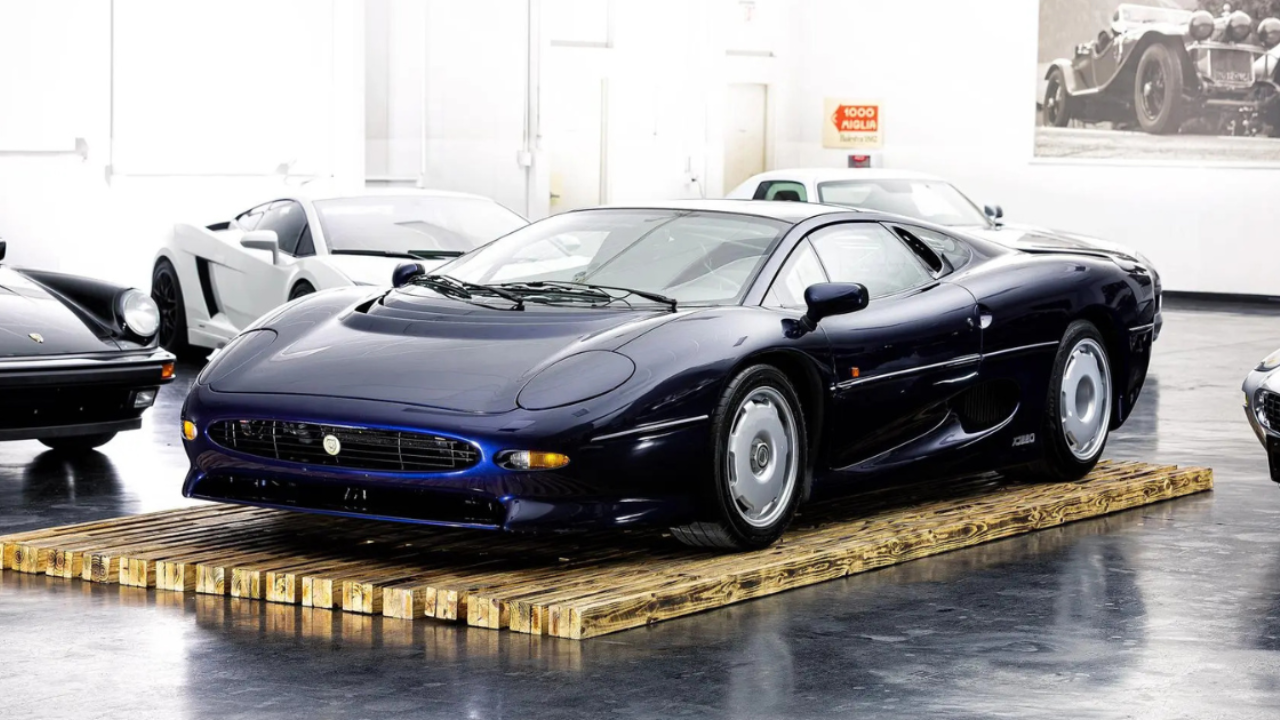
Born from a fever dream of British engineering and ambition combined with Formula 1 know-how and the daring spirit of Group B rally racing, few cars capture the essence of the early ’90s supercar arms race like the Jaguar XJ220. Now, one of the most striking examples ever built, a 1993 Jaguar XJ220 finished in Le Mans Blue, is crossing the auction block on Bring a Trailer, offering collectors a rare opportunity to own a machine that defined an era.
This example isn’t just another low-mileage XJ220; it’s a unique one. It has a story as unique as the car itself, having spent more than a decade nested on the 37th floor of a skyscraper in Tokyo before making its way to the United States. Since then, it has been meticulously maintained, shown at significant events, and admired by enthusiasts worldwide.
A Supercar Legend
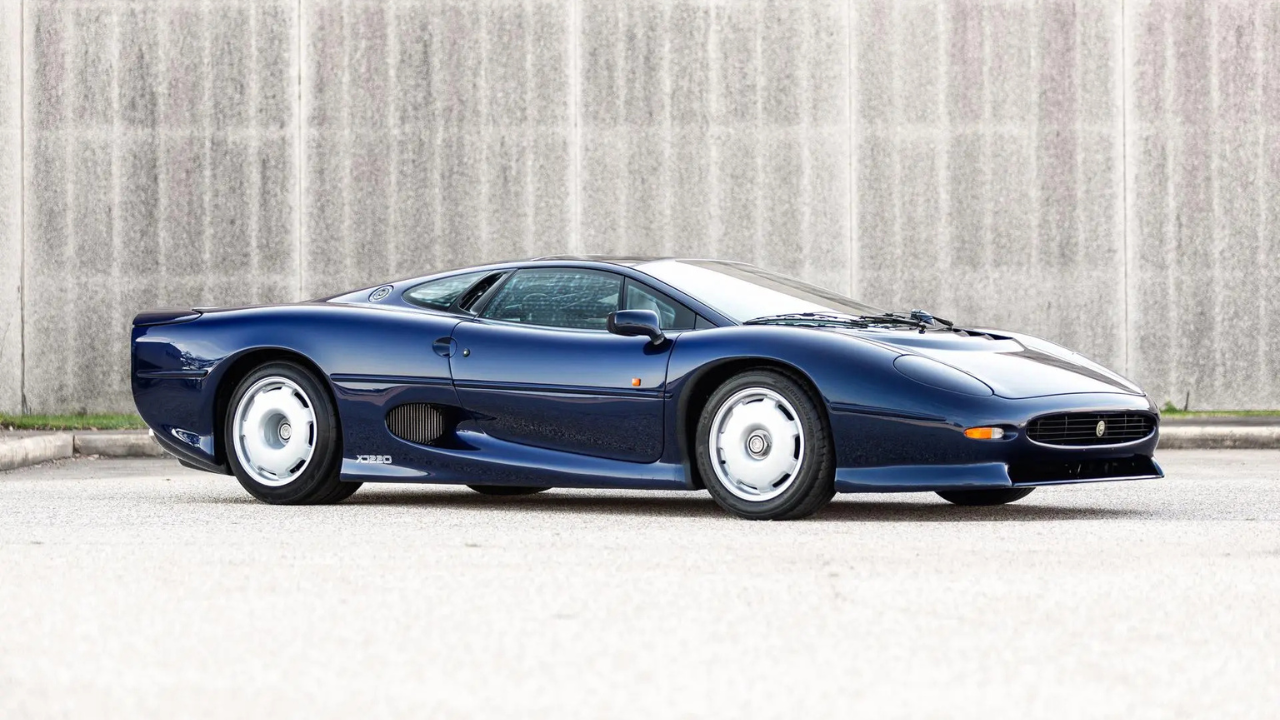
When the XJ220 was first revealed as a concept car at the 1988 British International Motor Show, it created an uproar. The prototype promised a road-going Jaguar with a V12 engine, all-wheel drive, and space-age aerodynamics; a car that would outgun anything from Ferrari, Porsche, or Lamborghini. The response was so overwhelming that Jaguar decided to make it a reality.
But between concept and production, the V12 was replaced with a lighter, more compact 3.5-liter twin-turbocharged V6, developed in collaboration with Tom Walkinshaw Racing, and the car became rear-wheel drive only. The purists grumbled, but the numbers silenced critics. The XJ220 became the fastest production car in the world in 1991, topping out at 212.3 mph in testing. With its catalytic converters removed, it reached an even more staggering 217.1 mph the following year, a record that stood until the McLaren F1 came along.
To enthusiasts, the XJ220 represented the very best of what a supercar could be in that moment: lightweight, aerodynamically advanced, and uncompromisingly fast. As Bring a Trailer commenter ripper996 aptly put it, “The Holy Grail of late 80s/early 90s supercars.”
Hand-Built Excellence

Each XJ220 was painstakingly hand-built by JaguarSport, the joint venture between Jaguar and Tom Walkinshaw Racing, in Bloxham, England. Just 280 examples were produced over a two-year period, making them rarer than many of their period rivals.
The bonded aluminum honeycomb chassis was paired with sleek, flowing bodywork crafted by Abbey Panels of Coventry. The design remains one of the cleanest of the analog supercar era, with smooth, uninterrupted lines that look fast even at a standstill. This example wears its original Le Mans Blue paint, a color that perfectly complements its low, wide silhouette.
Functional aerodynamics define every inch of the car. Louvers at the base of the windshield and rear window help stabilize airflow, underbody venturi tunnels channel air into a rear diffuser, and a subtle trunk-mounted spoiler adds downforce without disrupting the car’s graceful profile.
Collector-Grade Details

Open the dihedral doors, and the interior tells another story, one of understated British luxury mixed with motorsport functionality. The Smoke Grey leather upholstery, bolstered sport seats, and dark microsuede accents give the cabin a period-correct, minimalist vibe. The dashboard wraps around the driver, with gauges carefully arranged for easy visibility, including a 360 km/h speedometer and a tachometer with a 7,000-rpm redline.
Even the more minor details speak to its hand-built nature. The instrument binnacle flows into the adjacent door panel, where auxiliary gauges for boost, transaxle temperature, and an ammeter are located. Amenities like air conditioning, power windows, and a CD stereo system remind you that the XJ220 was as much a grand tourer as it was a hyper-focused performance machine.
This example shows just 8,000 kilometers — roughly 5,000 miles — on its six-digit odometer, making it one of the lower-mileage cars to surface in recent years. A subtle patina in the leather and a light scuff on the microsuede door panel reflect careful use rather than neglect.
The Penthouse Years

What sets this car apart is its incredible provenance. After leaving the factory in July of 1993, it was shipped to Japan, where it spent over a decade as a static display, parked high above the city streets on the 37th floor of a Tokyo office tower. The image alone is almost cinematic: one of the world’s fastest cars sitting quietly in the clouds, untouched by time.
When it finally left Japan, it was imported to the United States by a Los Angeles collector, where it joined an exclusive stable of exotic machinery. In the years since, it has been showcased at select events and has earned admiration from enthusiasts and collectors alike.
As Bring a Trailer user Stratos shared in the comments: “A few years ago, I was wandering around the shop at Autosport Designs. Tucked into a back corner was a silver XJ220. First time sighting. Surprisingly, what stood out more than the advanced design was how I felt in its presence. ‘Stunningly beautiful’ is too trite a description. This thing evoked something in my soul.”
Race-Bred Performance

At the heart of the XJ220 lies its 3.5-liter JV6 V6, an evolution of the powerplant developed for the MG Metro 6R4 Group B rally car. In this application, the engine features twin Garrett turbochargers, dual intercoolers, an aluminum block and heads, dual overhead cams per bank, four valves per cylinder, and Zytek electronic engine management. The result is 542 horsepower and 475 lb-ft of torque, enough to rocket the car from 0 to 60 mph in a reported 3.6 seconds, a number that still commands respect today.
A five-speed manual transaxle with a limited-slip differential sends power to the rear wheels. The suspension is just as exotic, featuring unequal-length wishbones, inboard-mounted Bilstein coilovers, and anti-roll bars for exceptional balance and control. Braking is handled by AP Racing cross-drilled discs with four-piston calipers, ensuring the car stops as impressively as it accelerates.
This particular example recently underwent servicing that included electrical work, a fresh oil and filter change, and replacement of the fuel pump, spark plugs, and wires. A compression test was also performed in preparation for the sale. The selling dealer notes that a full inspection and service are recommended before extended road use — a common step for collector-grade cars of this caliber.
Why the XJ220 Still Matters

More than 30 years after its debut, the Jaguar XJ220 remains one of the most fascinating supercars ever produced. It represents a moment when the boundaries of speed and design were being pushed harder than ever, before electronics and hybrid systems took over the performance landscape.
Its rarity, technical innovation, and undeniable beauty have made it a blue-chip collectible. The car’s combination of understated British elegance and raw, analog performance has cemented its status as one of the era’s icons.
Bring a Trailer commenter RAllen8800 captured the sentiment perfectly: “This is one of those cars that has you daydreaming about selling your house to buy the sports car, and worrying about where you will live later.”
Ready for Its Next Chapter

Now part of DriverSource’s Legends Vol. This XJ220 is part of the III collection and is offered with a Jaguar Heritage Trust Certificate, a clean Carfax report, and a Texas title. Its rare color, low mileage, and fascinating backstory make it one of the most compelling examples to hit the market in recent years.
Opportunities to own an XJ220 are rare. Opportunities to own one with this kind of history are almost unheard of. Whether it ends up in another private collection or with a brave driver willing to let the twin turbos sing, one thing is sure: this car will remain an object of awe and desire for decades to come.