From the days when racing meant arriving at the track with a toolbox and a prayer, to today’s data-driven battles where engineers know more about tire temperatures than most of us know about our own blood pressure, BMW has been there; usually winning, always making noise, and occasionally making other manufacturers very, very nervous.
These racing machines didn’t just compete; they dominated, innovated, and sometimes rewrote the rulebook entirely. So grab your favorite beverage and let’s take a tour through BMW’s racing hall of fame.
Our Criteria for the Ultimate BMW Race Cars

Choosing the greatest BMW race cars is like picking your favorite child…except some of your children have won Le Mans. Okay, so maybe not the best comparison, but you get the point: BMW race cars all have their own traits, performance, looks, and history that make them special in their own way. This made it tough to pick just 10, but we focused on purpose-built racers that actually showed up to win, not just participate in the automotive parade.
Each car had to prove itself in a recognized series, influence BMW’s racing DNA, and represent different eras of motorsport. We wanted touring cars that could dice it up wheel-to-wheel, endurance monsters that could run flat-out for 24 hours, and prototypes that pushed boundaries so hard they occasionally broke physics. Think of it as BMW’s greatest hits album, but with more horsepower and fewer synthesizers.
BMW 3.0 CSL

This car wasn’t officially nicknamed the Batmobile, but look at those rear spoilers and tell us Batman wouldn’t have been proud. The 3.0 CSL debuted in 1972 as BMW’s serious answer to touring car racing, and it was about as subtle as a brick through a greenhouse window.
The “L” stood for “Leicht” (lightweight), and BMW meant business. They stripped out everything that wasn’t bolted down, then questioned whether those bolts were really necessary. At 2,285 pounds, it was 440 pounds lighter than the standard 3.0 CS, thanks to aluminum doors, hood, and trunk lid. The racing version pushed this even further with fiberglass body panels and a roll cage that probably weighed more than the seats.
Under that distinctive hood sat a 3.0-liter inline-six producing around 206 horsepower in street trim, but the racing versions could push 340+ horsepower depending on regulations. The European Touring Car Championship became the CSL’s playground, where it collected wins like some people collect coffee mugs.
The aerodynamic package was pure 1970s excess – a front air dam that looked like it could part the Red Sea, side skirts that channeled airflow with Germanic precision, and that rear spoiler that made every other car look underdressed. Wind tunnel testing was still relatively new, but BMW’s engineers understood that making air work for you instead of against you was basically free horsepower.
BMW M1 Procar

Here’s a car with a story so wild it sounds like someone’s racing fantasy come to life. In 1979, BMW had a problem: they’d built this gorgeous mid-engine supercar called the M1, but homologation rules meant they needed to make 400 road cars before they could go racing. Instead of waiting around, BMW’s racing chief Jochen Neerpasch had a brilliant idea: why not create an entire racing series just for the M1?
The Procar series was pure genius. Take 20 identical M1s, invite the best Formula One drivers to race them as support events for F1 weekends, and watch the sparks fly. Suddenly, you had Niki Lauda, Nelson Piquet, and Alan Jones beating and banging in identical BMWs while their F1 mechanics probably had heart attacks in the pits.
The M1 Procar packed a 3.5-liter inline-six producing 470 horsepower – serious business in 1979. The mid-engine layout meant perfect weight distribution (47/53 front-to-rear), and the suspension was tuned for predictable handling at the limit. These weren’t temperamental exotics; they were purpose-built racing machines that happened to look like supercars.
The series ran for just two seasons (1979-1980), but what a ride it was. Niki Lauda won the first championship, proving that even after his horrific 1976 crash, he could still make any car dance. The races were often more exciting than the F1 main events, which probably wasn’t what Bernie Ecclestone wanted to hear.
BMW E30 M3 DTM

If the E30 M3 were a person, it would be that unassuming guy at the gym who quietly benches twice his body weight. Looking at its square-jawed, practical exterior, you’d never guess this thing was about to rewrite the touring car playbook. But BMW’s engineers had learned some hard lessons from the CSL era, and they were ready to build something truly special.
The road-going E30 M3 debuted in 1985 with a 2.3-liter four-cylinder engine producing 192 horsepower – not exactly earth-shattering numbers. But the DTM (Deutsche Tourenwagen Meisterschaft) racing version? That was a different animal entirely. The competition engine could produce over 300 horsepower, and with a curb weight around 2,200 pounds, the power-to-weight ratio was absolutely vicious.
The bodywork told the whole story. Those flared wheel arches weren’t just for show – they covered wider tracks and bigger wheels. The rear spoiler looked modest compared to the CSL’s wing, but it was precisely calculated for maximum downforce with minimal drag. Even the iconic “power dome” hood bulge served a purpose, clearing the larger air intake systems.
Between 1987 and 1992, the E30 M3 won the DTM championship four times. Roberto Ravaglia became a household name among touring car fans, piloting his red and white M3 to victory after victory. The car’s success was so complete that BMW essentially had to beat itself – other manufacturers were playing catch-up for years.
What made the E30 M3 DTM special wasn’t just speed; it was reliability. While other manufacturers built fragile rockets that looked fast in qualifying but retired with mechanical failures, the M3 just kept running. Race engineers loved it because it was consistent, drivers loved it because it was predictable, and accountants loved it because it actually finished races.
BMW V12 LMR

Alright, it’s 1999, and BMW decides they want to win the world’s most famous endurance race. Not participate, not “have a good showing” – win. The V12 LMR was their answer, and it was built with the kind of obsessive attention to detail that makes German engineers smile in their sleep.
The car used a 6.0-liter V12 engine producing around 580 horsepower, which sounds modest until you remember this thing had to run flat-out for 24 hours straight. The engine was actually derived from BMW’s Formula One program, but redesigned for endurance racing with improved reliability and fuel efficiency. Because there’s no point in having 800 horsepower if your engine grenades itself after 6 hours.
Carbon fiber construction kept the weight down to approximately 1,900 pounds – remarkably light for a car with a V12 engine. The aerodynamic package was pure wind tunnel science, with every surface calculated to generate downforce while minimizing drag. At Le Mans, where you spend huge chunks of the lap at maximum speed, aerodynamic efficiency can mean the difference between victory and watching someone else spray champagne.
The 1999 Le Mans victory was poetry in motion. Pierluigi Martini, Yannick Dalmas, and Joachim Winkelhock brought the V12 LMR home first, giving BMW their first overall Le Mans win since 1939. The car covered 4,610 kilometers (2,863 miles) at an average speed of 191.96 km/h (119.3 mph) – imagine maintaining highway speeds for 24 hours straight while other drivers are actively trying to pass you.
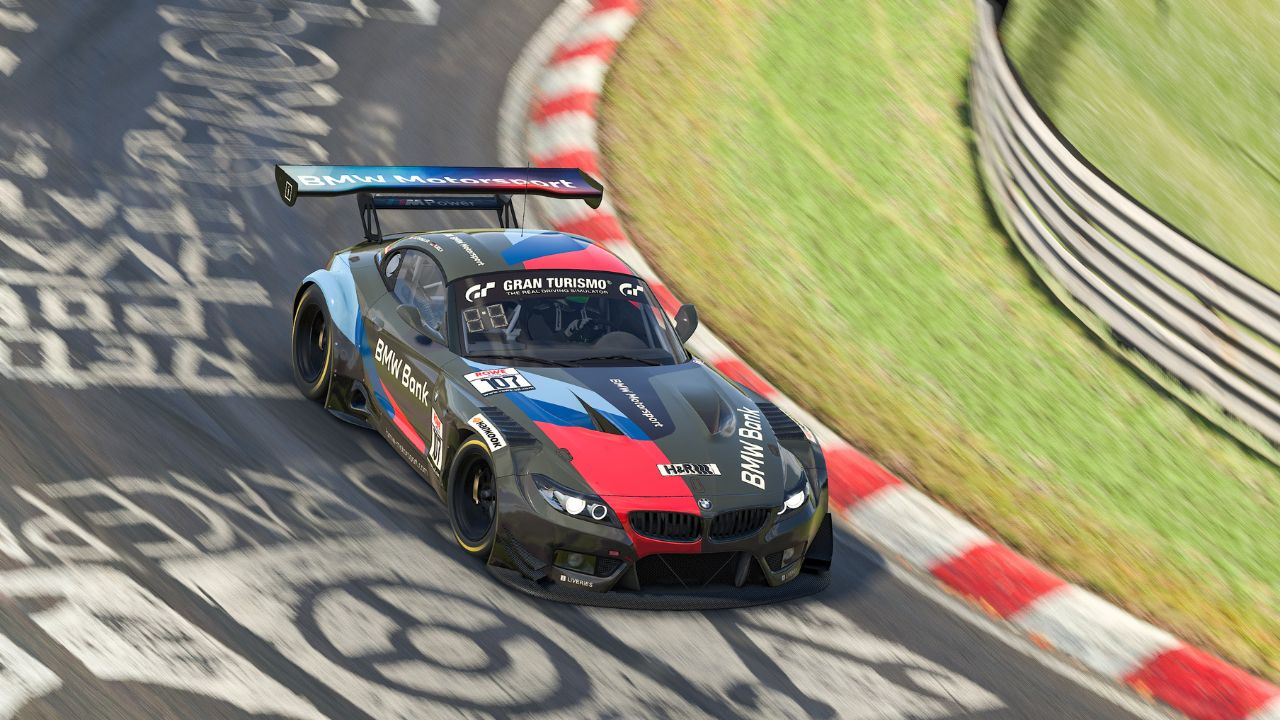
BMW Z4 GT3

By 2010, GT3 racing had become the thinking person’s motorsport category. Unlike prototype racing, where engineers with PhDs in aerodynamics design cars that look like spaceships, GT3 kept some connection to road cars while still allowing serious performance modifications. The Z4 GT3 was BMW’s entry into this sophisticated world, and it brought both style and substance.
The production Z4 was already a looker, but the GT3 version took things to another level. Wider fenders accommodated racing-width tires, a massive rear wing provided downforce, and the front splitter looked like it could double as a snow plow. Under the hood, a 4.4-liter V8 produced around 480 horsepower – plenty of grunt for a car weighing just 2,750 pounds.
What made the Z4 GT3 extra special was its accessibility. Customer teams could buy one for around $500,000 (a bargain in modern racing terms) and have a legitimate shot at winning races. The car was reliable enough for weekend warriors but sophisticated enough for factory-backed teams. BMW sold over 100 examples, making it one of the most successful customer racing programs in recent memory.
The Z4 GT3 racked up wins in series from the Nürburgring 24 Hours to the Spa 24 Hours, proving that sometimes the best racing car is the one that just works, weekend after weekend. Professional drivers praised its balanced handling, while amateur racers appreciated that it didn’t try to kill them for minor mistakes.
BMW M6 GT3

When BMW announced they were building a GT3 car based on the M6, some people wondered if they’d lost their minds. The M6 was a big, luxurious grand tourer; hardly the lightweight, nimble image most people associate with successful racing cars. But BMW’s engineers had learned a thing or two about making large cars handle, and the M6 GT3 proved that sometimes bigger can be better.
At 4,700 pounds, the M6 GT3 was nobody’s idea of a lightweight, but that mass came with advantages. The long wheelbase provided stability at high speeds, and the substantial chassis could handle serious aerodynamic loads without flexing. The 4.4-liter twin-turbo V8 produced around 500 horsepower, giving it excellent straight-line performance to go with surprisingly nimble handling.
The car’s size actually helped in endurance racing, where comfort matters during long stints. Drivers could maintain concentration over multiple hours, and the stable platform reduced fatigue. The M6 GT3 proved particularly strong at tracks like Spa-Francorchamps and the Nürburgring, where high-speed stability and strong brakes were essential.
Customer teams embraced the M6 GT3’s user-friendly nature and robust construction. BMW sold nearly 150 examples worldwide, and the car continued winning races well into its competition lifecycle. It proved that with enough engineering talent, you can make anything work on a racetrack – even a luxury grand tourer.
BMW 320 Turbo Group 5

The late 1970s were a magical time in motorsport when regulations were more like polite suggestions and engineers interpreted “based on a production car” very creatively. The BMW 320 Turbo Group 5 emerged from this wonderfully chaotic era as a 2002-based racer that shared approximately zero parts with anything you could buy at a dealership.
Group 5 rules allowed extensive modifications as long as the basic silhouette remained recognizable. BMW’s interpretation involved widening the car by several inches, adding enough aerodynamic devices to change local weather patterns, and installing a turbocharged engine that produced around 280 horsepower from just 2.0 liters – impressive numbers when most street cars were struggling to meet new emissions standards.
The visual impact was stunning. Massive wheel arches covered racing slicks that looked borrowed from a Formula car, the front spoiler extended so far it needed its own zip code, and the rear wing was large enough to provide shade for a small family. The whole package screamed, “I am here to go fast and look good doing it.”
The 320 Turbo found success in various national championships and endurance events throughout Europe. Although it wasn’t the most successful BMW racer in terms of major victories, it represented the company’s willingness to push boundaries and experiment with new technology. Plus, it looked absolutely fantastic.
BMW M4 GT3

The current BMW M4 GT3 represents everything the company has learned about racing over the past five decades, distilled into a package that would make the engineers of the 3.0 CSL era weep with envy. Modern materials, advanced aerodynamics, and electronic systems that can adjust suspension settings faster than you can say “oversteer” – this is racing technology that borders on science fiction.
The heart of the machine is a 3.0-liter twin-turbo inline-six producing around 510 horsepower. BMW could have gone with a V8 like many competitors, but they stuck with their inline-six heritage – because if it was good enough for the 3.0 CSL, it’s good enough for today. The engine features direct injection, variable valve timing, and enough electronic management to run a small city.
Advanced aerodynamics provide over 1,100 pounds of downforce at racing speeds, while the carbon fiber construction keeps weight to a competitive 2,740 pounds. The chassis uses racing-specific suspension components with adjustable dampers, anti-roll bars, and alignment settings that can be fine-tuned for each track.
Customer teams love the M4 GT3’s user-friendly nature and comprehensive support package. BMW provides extensive technical assistance, parts availability, and setup data that would have seemed like witchcraft to racing teams just 20 years ago. It’s currently one of the most successful GT3 cars in international competition, proving that BMW’s racing heritage continues to evolve.
BMW M8 GTE

Competing against Porsche in endurance racing is like challenging Mozart to a piano-off, but BMW was ready for the seemingly impossible challenge. The BMW M8 GTE was BMW’s latest attempt to dethrone the Stuttgart kings at places like Le Mans and Sebring, and it came equipped with enough advanced technology to make NASA jealous.
The M8 GTE features a 4.0-liter twin-turbo V8 producing around 500 horsepower, carefully tuned for the unique demands of Balance of Performance regulations. Unlike prototype racing, where engineers can let their imaginations run wild, GTE competition requires working within strict performance windows that keep different manufacturers competitive.
The aerodynamic package is a masterpiece of computational fluid dynamics. Every surface has been optimized for the car’s specific weight and power characteristics, with active systems that can adjust during the race. The carbon fiber chassis provides tremendous rigidity while keeping the weight to approximately 2,700 pounds.
Professional drivers consistently praise the M8 GTE’s predictable handling and strong braking performance. The car excels in mixed conditions, where its advanced traction control systems and stability management help drivers extract maximum performance regardless of weather. It’s proven particularly strong at technical circuits where handling balance matters more than raw horsepower.
BMW 2002ti Group 2

Every racing dynasty has humble beginnings, and for BMW, it started with a small sedan that looked like it belonged in a suburban driveway rather than a racing grid. The 2002ti Group 2 was BMW’s first serious attempt at international touring car competition, and it punched so far above its weight that other manufacturers probably filed formal complaints.
Based on the charming 2002 sedan, the Group 2 racer featured a heavily modified 2.0-liter four-cylinder engine producing around 180 horsepower – not overwhelming by today’s standards, but competitive in the early 1970s. The real magic was in the chassis work: lightened body panels, racing suspension, wider wheels, and enough roll cage to protect the driver from both crashes and overly enthusiastic spectators.
The car’s success in European touring car events during the early 1970s established BMW as a serious racing manufacturer. Drivers loved its nimble handling and reliable mechanicals, while team managers appreciated that it actually finished races instead of providing expensive fireworks displays.
More importantly, the 2002ti Group 2 established BMW’s racing philosophy: build cars that are fast, reliable, and engineered to win rather than just look impressive. This approach would serve them well in the decades to come, when racing became more sophisticated but the fundamental requirements remained the same.
Racing Icons That Define BMW’s Legacy

These racing machines represent more than just fast cars – they’re chapters in a story that began over 50 years ago and continues today. Each one solved unique engineering challenges, won important races, and contributed to BMW’s reputation as a manufacturer that takes competition seriously.
From the lightweight philosophy of the 3.0 CSL to the advanced electronics of the M4 GT3, BMW’s racing evolution reflects broader changes in motorsport technology and philosophy. What hasn’t changed is the company’s commitment to building cars that win races rather than just looking pretty in the paddock.