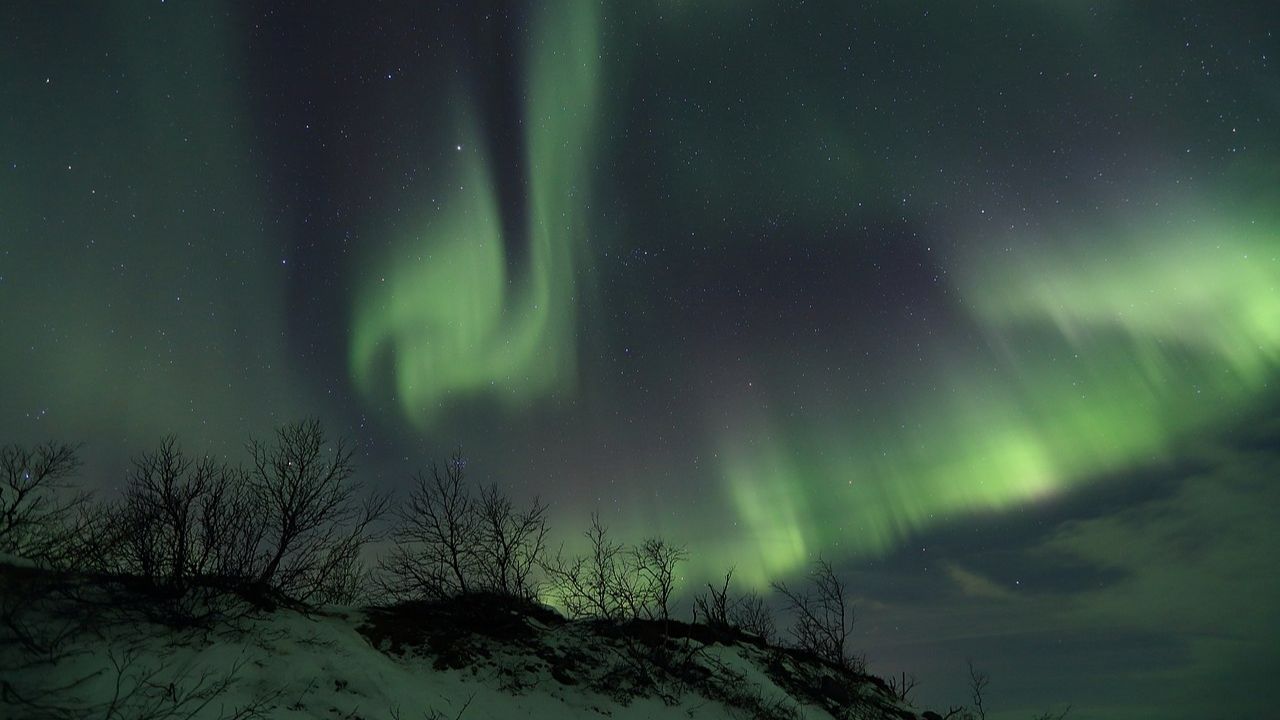
If you’ve only ever seen pictures of the aurora borealis, I promise that it is somehow more astonishing in person. It makes it onto most people’s bucket lists, but somehow manages to slip through the cracks with the idea that you have to travel to the Arctic Circle just to see it (which, for the record, I did on an 8,000-mile road trip in a Porsche Cayenne).
The Aurora is caused when charged solar particles collide with the Earth’s magnetic field, causing the most vibrant natural display of colors in the sky. What you may not know from just images, however, is how much and how fast it moves, making a road trip the perfect way to chase it. The first time I watched it take shape over our car as we trekked through the Yukon territory late into the night, it felt like magic. Yeah, that may sound cliché, but there are hardly any better words to describe it. Driving alongside it? Otherworldly.
How We Picked These Roads Without Getting Lost
Auroras aren’t random; they follow patterns based on Earth’s magnetic field and solar activity. That means you’ll generally need to be above 55 degrees latitude, under clear skies, and away from city lights or any form of light pollution. We focused on drives in areas known for regular aurora sightings between late fall and early spring, when nights are long and dark. Alaska, northern Maine, the Yukon, and parts of Montana all sit in or near the auroral zone, making them consistent viewing grounds. We also considered areas where intense solar storms can occasionally push aurora visibility farther south.
Each route was chosen for its balance of accessibility, scenic value, and low light pollution. We gave preference to paved roads and well-maintained routes that allow safe travel in colder months, while still putting you close to nature. Locations with open horizons or higher elevations were favored, since tree lines and terrain can easily block the view. These aren’t just pretty drives; they’re practical routes for aurora chasing, selected to give travelers the best odds of witnessing one of nature’s most striking events from the comfort of a car.
Alaskas Dalton Highway Fairbanks to Deadhorse

This was the route we took. The Dalton Highway stretches 414 miles from Fairbanks to Deadhorse, cutting through remote Alaskan wilderness and some of the best aurora-viewing territory in North America. Originally built to support the Trans-Alaska Pipeline (which you’ll drive alongside), this gravel-and-asphalt route runs parallel to that massive engineering project for much of its length. Travelers cross the Yukon River, pass through the boreal forest, and climb over the Brooks Range before reaching the windswept Arctic tundra near the top of the world.
Because it lies well within the auroral oval, the Dalton Highway offers some of the most consistent northern lights activity in the U.S. Winter nights are long and dark, with low humidity and minimal light pollution — ideal conditions for viewing. Pullouts and pipeline access roads offer space to park and gaze at the sky, especially around the higher elevations near Atigun Pass. Please note that services are limited and the weather can change rapidly, so preparation is crucial.
Maines Route 11 Aroostook County

Route 11 runs through the heart of Aroostook County, stretching north from Ashland to Fort Kent. This corridor is one of the best places in the lower 48 states to reliably view the northern lights, thanks to its high latitude, low population density, and clear winter skies. The road passes through farmland, evergreen forests, and quiet towns where roadside pull-offs and open fields offer unobstructed views of the sky. With minimal light pollution and frequent high-pressure weather systems in winter, the conditions here are often ideal for aurora visibility.
Route 11 is also plowed regularly and well-maintained during winter, making it a reliable option for travelers hoping to catch the aurora without venturing into extreme backcountry conditions.
The Yukons Klondike Highway Whitehorse to Dawson City

The Klondike Highway traces a historic route through the Yukon that once guided prospectors toward the promise of gold. Today, it offers some of the best winter driving for aurora viewing, with long stretches of clear sky, low light pollution, and scenic access to key vantage points. The Klondike Highway runs from Whitehorse to Dawson City, passing through boreal forests, frozen lakes, and valleys carved by the Yukon River. In winter, snow settles thick on the trees, and the cold air often brings clear, cloudless nights, exactly the kind of conditions you want for watching the Northern Lights. I, personally, would recommend traveling in late summer to avoid the harsh winters of the Yukon.
As you approach Dawson City, the scenery takes on a historical character, with restored 19th-century buildings and wooden sidewalks that preserve the look of the Klondike Gold Rush era. The town is situated near the confluence of the Yukon and Klondike Rivers, both of which offer unobstructed views of the sky. Aurora displays here are often vivid, appearing as broad ribbons of green and purple that drift above the valley and reflect off nearby snow and ice. It’s a route that delivers not just a view, but a sense of place, connecting natural beauty with one of the most storied chapters in Canada’s northern frontier.
Montanas Highway 89 Great Falls to Glacier National Park

Highway 89 appears to be designed primarily for one purpose: to lead you directly into the breathtaking scenery of Montana. As you drive across vast, open plains that stretch on endlessly, the mountains suddenly appear—large, jagged, and impossible to overlook. The air smells like dry grass and snow, and the light shifts constantly, especially in winter when the sun hangs low and paints everything in a golden glow.
Once night falls, you’re in some of the darkest skies you’ll find anywhere in the lower 48. I’ve pulled off near Browning more than once just to kill the engine and stare up. When the aurora shows up, it’s not subtle; it rolls over the horizon in green waves that light up the snow like a backlit screen. You can see every detail in the landscape even at midnight. There’s a quiet out here that’s hard to describe until you’ve stood in it. It’s the kind of road that makes you slow down and just take it all in, because the drive is the destination.
Minnesotas North Shore Drive Duluth to Grand Portage

North Shore Drive hugs the shoreline of Lake Superior from Duluth up to Grand Portage, and it’s one of those routes that never stops delivering views. In winter, it’s especially striking as ice builds along the edges of the lake in wild formations, and when the aurora’s out, you’ll see it reflecting right off the water. The drive passes through quiet lake towns like Two Harbors and Grand Marais, where it’s easy to grab a hot meal or walk down to the harbor for a better look at the sky.
The road itself is a pleasure to drive, with long sweeping curves and constant glimpses of the lake through the trees. You’re never far from a state park, scenic turnout, or frozen waterfall. Gooseberry Falls and Split Rock Lighthouse are worth stopping for, even in the cold. The farther north you go, the darker the skies get, which means even better conditions for spotting the northern lights. If you’re into photography or just want a night you’ll remember, this stretch of Highway 61 delivers.
Norway’s E6 Highway Troms to Alta

Driving the E6 through northern Norway is like getting front-row seats to some of the most dramatic scenery in Europe. The road traces the edge of deep fjords where mountains rise almost vertically from the water, and in winter, those slopes are blanketed in snow. You’ll pass through small fishing villages with brightly painted homes that really stand out against the ice and rock. The route includes tunnels and high bridges, and nearly every bend reveals a new view of steep cliffs, frozen inlets, or wide-open water with reflections that double the drama when the aurora shows up.
This stretch of the E6 is one of the best places in the world to spot the northern lights from the road. The mix of ocean air, wood smoke, and cold adds to the atmosphere, and the snow acts like a natural light amplifier, reflecting the green and purple hues overhead.
Iceland’s Ring Road Akureyri to Egilsstair

The Ring Road around Iceland stretches between Akureyri and Egilsstaðir. You’ll pass through wide valleys carved by glaciers and framed by mountains with jagged, snow-covered peaks. The road stays clear most of the year, even in winter, and offers long, uninterrupted stretches that let you settle into the drive. Small farms appear along the way, lit warmly in the evenings, and waterfalls like Goðafoss and Dettifoss freeze into towering ice formations just off the shoulder.
This area sees regular aurora activity thanks to its northern location, low light pollution, and often clear winter skies. With the Atlantic to the north and geothermal fields nearby, the air has a sharp, clean edge with a hint of sulfur and salt. You’ll find plenty of pullouts for viewing and photography, and the combination of volcanic terrain and open skies makes this one of the best drives in the country for catching the lights.
Scotlands A9 Inverness to Thurso

The A9 is the spine of Scotland’s Highland road network, stretching from Perth to Inverness and beyond. In winter, snow often dusts the higher elevations, and on clear nights, the lack of light pollution makes this a surprisingly good spot for viewing the aurora. Places like Drumochter Pass and the stretch near Aviemore offer broad horizons and open skies, making them ideal conditions for capturing the lights when solar activity cooperates.
The road is well-maintained, featuring steady climbs and long straights that provide ample time to take in the views. This isn’t the flashiest drive on the list, but it’s one of the most peaceful; an honest road through a rugged landscape that rewards slow travel and quiet moments.
Turning off the Headlights, Letting the Sky Drive

Each route brings its own conditions that make the aurora possible: the high latitudes, the long nights, and the absence of city lights. The memory of those ribbons of color often lasts longer than the journey itself, but for a few fleeting moments, you see one of Earth’s most spectacular natural wonders materialize before you.
What makes these roads special is that they don’t just take you to a destination; they put you in the middle of an environment where the aurora feels close enough to touch (like, actually, it feels like you could reach up and grab it). The experience changes how you see the night sky and how you remember the drive. Long after the trip is over, the roads remain in your mind as paths back to those rare nights when the horizon came alive with color.