Ford has built its legacy on icons like the Mustang and the F-150, vehicles that defined segments and captured imaginations. Yet not every model received the spotlight it deserved. Over the decades, the Blue Oval quietly released cars that were ahead of their time, surprisingly capable, or simply misunderstood. These vehicles may not have dominated sales charts or earned glowing headlines, but they left a lasting impression on those who drove them.
Some offered performance that rivaled more expensive competitors. Others delivered practicality, comfort, and reliability in ways that made everyday driving easier and more enjoyable. A few introduced innovations that the market wasn’t quite ready to embrace. What they all shared was a clear sense of purpose and execution that favored substance over spectacle.
From sporty sedans to cleverly designed crossovers, these 12 underrated Fords deserve a second look, not because they were perfect, but because they were better than most people remember.
The Blue Oval’s Legacy of Surprises

Each vehicle on this list earned its place by excelling in ways that were often overlooked. Some delivered impressive performance beneath understated styling. Others focused on practicality, comfort, and reliability — qualities that matter most in everyday driving. A few introduced innovations ahead of their time, only to be misunderstood or ignored by the market.
What connects these cars is a clear sense of purpose. Each one was built to fulfill a specific role and did so with quiet confidence. There was no need for exaggerated styling or overhyped marketing. These were well-engineered vehicles wrapped in thoughtful design, appreciated most by those who experienced their strengths firsthand.
They may not have dominated headlines or generated buzz in showrooms, but they turned owners into loyal advocates. These are the kinds of cars that build reputations gradually, through real-world performance and lasting value rather than spectacle.
Ford Contour SVT

In the late 1990s, while luxury brands were commanding premium prices for sport sedans and mainstream rivals were leaning on marketing rather than engineering, Ford’s Special Vehicle Team quietly delivered one of the most well-balanced performance sedans of the decade. The Contour SVT featured a high-revving 2.5-liter Duratec V6 and a chassis tuned with genuine European driving dynamics in mind.
This wasn’t a superficial upgrade. SVT engineers reworked the suspension geometry, enhanced the braking system, and installed supportive sport seats designed for spirited driving. The result was a sedan that handled twisty roads with precision, yet remained practical enough for daily family duties.
Its biggest challenge? Styling. The Contour SVT looked nearly identical to its rental-fleet siblings, with only subtle cues like unique wheels, dual exhausts, and slightly revised bumpers hinting at its capabilities. By the time enthusiasts caught on to its performance potential, production had already ended, a classic case of excellent engineering overshadowed by understated design.
Ford Freestyle

Before three-row crossovers became the default choice for suburban families, Ford introduced the Freestyle. This smartly packaged vehicle blended the practicality of a minivan with the drivability of a car. With seating for seven, a spacious cargo area, and available all-wheel drive that performed well in winter conditions, the Freestyle offered real-world versatility without the bulk of a traditional SUV.
Its strength was in its thoughtful design. The Freestyle was easy to maneuver and park, making it ideal for daily errands and school runs. The continuously variable transmission (CVT) delivered smooth acceleration at a time when many competitors were still struggling with clunky automatics. Ground clearance was sufficient for weekend adventures, yet entry and exit remained comfortable for all passengers.
Despite its practicality, the Freestyle struggled to gain traction in a market that favored aggressive styling and oversized proportions. Buyers gravitated toward flashier options like the Tahoe and Escalade, leaving the Freestyle’s understated approach underappreciated. Ford eventually rebranded it as the Taurus X, but the change did little to boost its visibility.
Today, the Freestyle stands as a reminder that clever design doesn’t always win the popularity contest, but it often makes for a better ownership experience.
Ford Taurus SHO (Yamaha V6 era)

The original SHO proved that Ford could build a genuinely world-class performance sedan when they put its mind to it. Yamaha’s hand-built V6 was a masterpiece — 220 horsepower from 3.0 liters when most V6s were making 140. More importantly, it delivered power with a soundtrack that could make grown enthusiasts weep with joy.
Available only with a manual transmission in the early years, the SHO rewarded drivers who actually knew how to drive. The clutch was heavy, the shifter required deliberate inputs, and the engine demanded revs to wake up. This wasn’t a car for poseurs or people who thought “sport mode” meant turning the air conditioning down.
Ford’s marketing department, however, seemed determined to keep it a secret. While Toyota was launching the Camry All-Trac with full-page ads, the SHO got buried in fine print at the bottom of Taurus brochures. Most buyers never even knew it existed. Those who did often discovered it by accident, usually when some sleepy-looking sedan pulled alongside and proceeded to disappear into the distance with a glorious high-rev wail.
Ford Fusion Sport (2.7L EcoBoost)

After years of producing practical but forgettable family sedans, Ford made a bold move with the Fusion Sport. Engineers equipped it with a 2.7-liter twin-turbocharged EcoBoost V6, borrowed from the F-150, delivering 325 horsepower and all-wheel drive. The result was a midsize sedan that could accelerate faster than several premium German competitors.
Performance extended beyond straight-line speed. The Fusion Sport featured a chassis tuned to handle the extra power, an adaptive suspension that responded well to changing road conditions, and an all-wheel-drive system designed to distribute torque intelligently. These enhancements gave the car sharp handling and confident road manners, all while maintaining the comfort and practicality expected from a family sedan.
Despite its strengths, the Fusion Sport arrived during a period of declining sedan sales. American buyers increasingly favored large SUVs, often prioritizing size and styling over driving dynamics. As interest in sedans faded, the Fusion Sport struggled to gain traction and was eventually discontinued along with the rest of Ford’s sedan lineup.
The Fusion Sport remains a reminder of what happens when a mainstream automaker builds something genuinely exciting. It may not have found commercial success, but it delivered a driving experience that deserved far more attention.
Ford Five Hundred

Built on Volvo’s P2 derived platform and powered by a naturally aspirated V6, the Ford Five Hundred was designed with practicality and safety in mind. It offered features that many American buyers claimed to prioritize, including a spacious interior, excellent visibility, solid fuel economy, and a reputation for reliability. The trunk was among the largest in its class, and the overall build quality rivaled that of some entry-level luxury sedans.
The driving position struck a near-perfect balance. It provided a commanding view of the road without feeling overly elevated, and the thin pillars combined with large windows created exceptional outward visibility. Ride quality was smooth and composed, handling was predictable, and the cabin materials felt substantial and well-assembled.
Despite its strengths, the Five Hundred struggled to connect with buyers. Its conservative styling and understated personality were overshadowed by competitors that emphasized sportiness or tech-forward features. Emotional appeal often wins in the showroom, and the Five Hundred’s rational design failed to generate excitement. Ford eventually rebranded it as the Taurus, hoping to revive interest, but the effort came too late.
The Five Hundred remains a reminder that well-engineered, sensible cars don’t always get the recognition they deserve. It delivered exactly what many drivers needed, even if it wasn’t what they thought they wanted.
Ford C-Max

While Toyota was congratulating itself on the Prius’s wind-cheating aerodynamics (and completely ignoring its penalty box interior), Ford built a hybrid that actual humans might want to drive. The C-Max offered Prius-level fuel economy in a package that looked like a real car rather than a rolling environmental statement.
The tall, upright seating position provided excellent visibility, while the clever interior packaging maximized space efficiency. The hybrid powertrain was smoother than Toyota’s CVT-based system, and the handling was actually decent thanks to European suspension tuning. It used eCVT that felt very smooth and natural.
Ford Granada Coupe

During the 1970s, American automakers faced strict emissions regulations that often left cars feeling sluggish and uninspired. Yet, the Ford Granada Coupe stood out by offering a balanced, dignified alternative. Its clean, understated design avoided the flashy excesses that dated many of its contemporaries, and its proportions gave the two-door model a visual harmony missing from the sedan version.
Inside, the Granada delivered respectable comfort and space, along with fuel economy that was competitive for the time. The available V8 engine didn’t deliver thrilling performance, but it provided smooth, reliable power for everyday driving. This wasn’t a muscle car or a luxury cruiser — it was a well-built, thoughtfully designed vehicle for drivers who valued substance over style.
While modern enthusiasts may dismiss it as a product of the “malaise era,” the Granada succeeded by focusing on the fundamentals: practicality, reliability, and restraint. It didn’t try to be more than it was, and in doing so, it quietly met the needs of its time.
Ford Escape (First Generation)

Before crossovers evolved into oversized, tech-laden family haulers, the original Ford Escape showed that utility vehicles could be compact, efficient, and genuinely helpful. Sharing its platform with the Mazda Tribute, the Escape offered real-world versatility, including available all-wheel drive and enough ground clearance for light off-road use. At the same time, it remained easy to maneuver in urban environments and fit into tight parking spaces.
Inside, the Escape featured a thoughtfully designed cabin with multiple storage compartments and rear seats that folded flat to maximize cargo space. Buyers could opt for all-wheel drive, though front-wheel-drive models kept pricing accessible for those who didn’t need extra traction. The driving experience leaned more toward car-like comfort than truck-like ruggedness, making it a pleasant choice for daily commuting and weekend errands.
Despite its practicality, the Escape’s modest proportions and understated styling struggled to compete with larger, more imposing SUVs. Many buyers gravitated toward vehicles like the Explorer or Expedition, drawn by their size and visual presence. Over time, Ford responded by increasing the Escape’s dimensions, eventually transforming it into a more conventional crossover.
The original Escape remains a standout for its balance of utility and drivability. It delivered what many drivers needed, even if the market was already shifting toward something bigger.
Ford ZX2

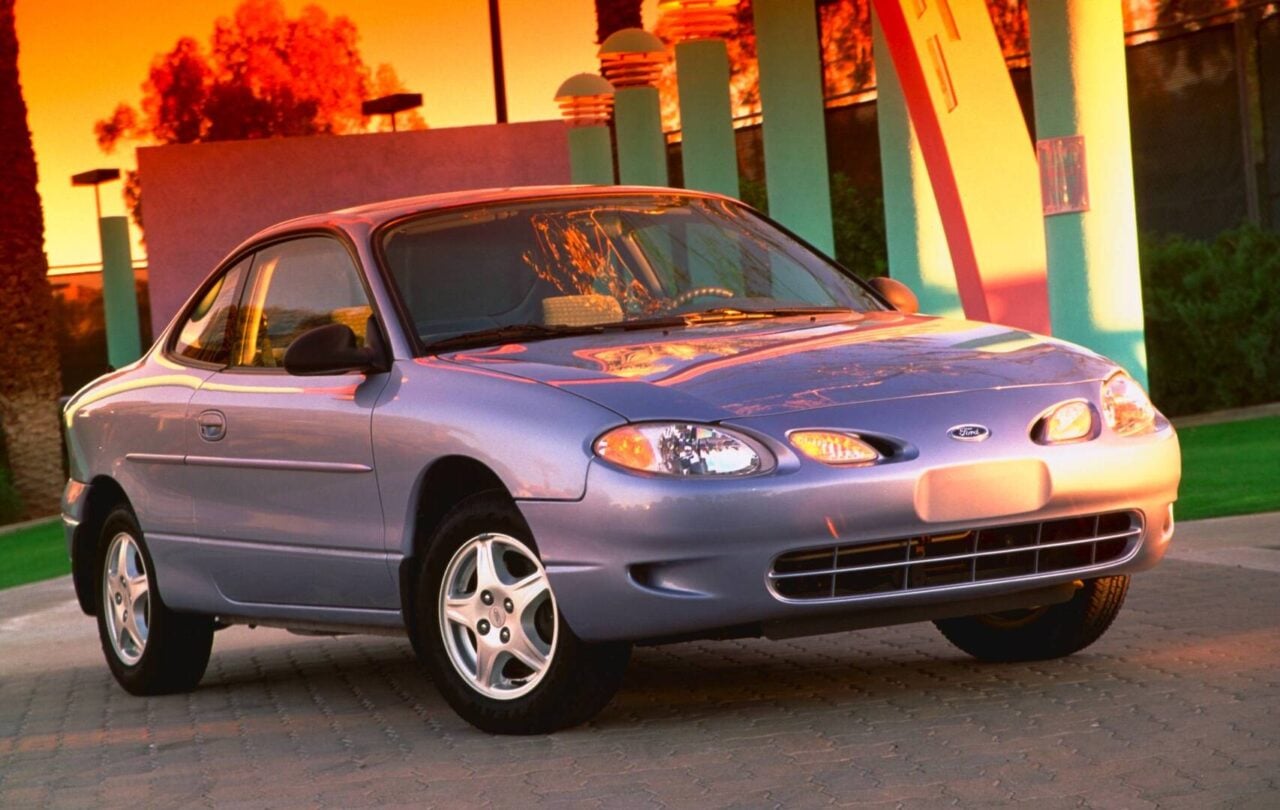
While many economy cars treated driving dynamics as an afterthought, the Ford ZX2 offered a surprisingly engaging experience behind the wheel. Built on the European Ford Escort platform before the Focus arrived in the U.S., the ZX2 featured responsive steering, solid body control, and an engine that felt eager to rev. It delivered more than just basic transportation — it made driving fun.
The styling was clean and purposeful, avoiding the exaggerated cues often used to suggest sportiness. Inside, the ZX2 provided supportive seats, intuitive controls, and build quality that exceeded expectations for its price point. With a manual transmission, it offered genuine driving enjoyment without requiring a premium budget.
Timing worked against it. The ZX2 entered the market just as American buyers were shifting away from small cars in favor of larger SUVs. It exited just as rising fuel prices renewed interest in compact, efficient vehicles. Ford replaced it with the Focus, a more refined car in many ways, though arguably less engaging for enthusiasts.
The ZX2 marked the end of an era when even affordable cars could have personality. It may not have been a sales leader, but it left a lasting impression on those who appreciated its balance of simplicity and spirit.
Probe GT

The Ford Probe represented one of the company’s most serious efforts to build a modern sports car since the original Mustang. Developed on Mazda’s MX-6 platform and powered by a turbocharged four-cylinder engine in GT trim for the first generation and 2.5 naturally aspirated V6 for the second generation, the Probe delivered impressive performance wrapped in sleek, aerodynamic styling that still holds up decades later.
Design elements like pop-up headlights, a long hood, and a dramatic roofline gave the Probe a distinctive presence that even the Mustang of the era struggled to match. Inside, the cabin was driver-focused, featuring supportive seats and intuitive controls. On the road, the Probe handled with balance and precision, offering a driving experience that leaned more toward sports car agility than muscle car brute force.
The Probe faced resistance from Mustang loyalists who opposed the idea of a front-wheel-drive replacement for their rear-wheel-drive icon. Ford responded by keeping the Mustang unchanged and positioning the Probe as a separate model. While sales were respectable, they never reached breakout levels. Eventually, Ford discontinued the Probe as Mazda shifted Focus to its own sports car lineup.
The Probe GT remains a reminder of Ford’s willingness to take risks and innovate. It was a well-executed car that arrived at a time when the market wasn’t quite ready to embrace its forward-thinking design and engineering.
Ford Crown Victoria LX (First Generation)

At a time when many manufacturers were chasing European handling and compact efficiency, Ford continued to build traditional American sedans. The Crown Victoria offered rear-wheel drive, V8 power, and a spacious interior that felt more like a lounge than a cabin. It embraced old-school values with confidence and clarity.
The LX trim elevated the experience with genuine luxury touches. Leather seats felt substantial, wood accents looked refined, and the controls were intuitive and easy to use. Ride quality was tuned for long stretches of highway, delivering comfort and composure, while the V8 provided smooth, effortless acceleration.
Fleet buyers kept the Crown Victoria alive for years. Police departments and taxi companies relied on their durability and simplicity, ordering them in large volumes. Private buyers, however, increasingly turned to smaller, more fuel-efficient vehicles. Ford eventually ended production in 2011, closing the chapter on nearly a century of large, rear-wheel-drive American sedans.
The Crown Victoria served its purpose with quiet excellence. It may not have been flashy, but it represented a kind of automotive honesty that is increasingly rare.
Ford Fairmont Futura

At first glance, the late-1970s Ford Fairmont might seem like a forgettable entry in the brand’s lineup. However, its significance lies in the Fox platform it introduced — a rear-wheel-drive architecture that would go on to underpin some of Ford’s most iconic vehicles, including multiple generations of the Mustang.
The Fairmont Futura coupe stood out with its wraparound rear window and formal roofline, offering a clean and restrained design during a time when many cars leaned toward excessive ornamentation. While the Fairmont itself was modest in performance and styling, its underlying structure proved remarkably versatile.
The Fox platform’s lightweight construction and adaptable layout supported everything from fuel-efficient sedans to high-performance Mustangs and police cruisers. Modern enthusiasts searching for Fox-body Mustangs are driving vehicles built on a foundation that began with the Fairmont.
The Futura deserves recognition not for headline-grabbing specs, but for quietly enabling decades of innovation. It was a foundational model that helped shape Ford’s future, proving that lasting impact often begins with understated engineering.
Every Ford Has a Story, Don’t Skip These Chapters

Ford’s most underrated vehicles share a common philosophy: thoughtful engineering, honest design, and a focus on substance over spectacle. These cars didn’t fail because they lacked quality — they were overlooked because their strengths weren’t easily captured in advertisements or showroom glitz.
The automotive world would be richer if buyers rewarded competence over flash, if marketing celebrated innovation rather than image, and if timing didn’t bury good ideas before they had a chance to thrive. These twelve Fords remind us that some of the best vehicles are the ones that quietly do their job and do it well.
Every enthusiast has a story about the one that got away. These cars represent twelve such stories, each deserving more recognition than they received. The good news is that many of them are still out there, waiting on used lots and classifieds for drivers who value quiet excellence over fleeting trends.