Most amphibious vehicles sound like the stuff of spy movies: part car, part boat, usually all hype. But every now and then, someone actually built one that worked. These machines didn’t just float in concept drawings or sink in test pools. They drove into the water, motored across, and kept on going.
Some were built for war, others for fun, and a few tried to crack the consumer market. Whether you picture James Bond escaping a villain’s lair or a vacationer cruising from road to river, these vehicles proved that you really can drive into the lake and come out on the other side.
Here are the amphibious vehicles that didn’t just make headlines — they made waves.
How We Chose These Amphibious Wonders
We weren’t looking for pipe dreams or one-off movie props. To make this list, a vehicle had to do three things: drive on land, float on water, and actually work. No CGI. No “prototype-only” excuses. Just real machines that could take you from pavement to pond without sinking or stalling.
We included a mix of military, civilian, and recreational models: some built for battle, some for beach days. If it rolled, swam, and had at least some production or operational history, it made the cut. Bonus points for style, speed, or just sheer audacity. Because when it comes to amphibious vehicles, if you’re going to break the rules, you might as well do it with flair.
Volkswagen Schwimmwagen

World War II’s answer to “what if your Jeep could swim?” The Schwimmwagen (literally “swimming car”) was based on the VW Type 166 and came with a retractable propeller and four-wheel drive. It didn’t break speed records in the water, but it did get the job done. Over 15,000 were produced, making it the most mass-produced amphibious car ever.
Gibbs Aquada

This British-built speedster from the early 2000s looked like a futuristic roadster… and then it turned into a jet ski. The Aquada could hit 100 mph on land and 30 mph on water, retracting its wheels in just five seconds. Richard Branson famously used one to cross the English Channel and break an amphibious speed record.
Amphicar Model 770

Built in West Germany and sold in the U.S. during the 1960s, the Amphicar was the first (and only) mass-market amphibious vehicle sold to civilians.
It wasn’t fast — just 70 mph on land and 7 knots in water — but it was charming. Drivers could cruise down the road, steer into the water, and keep right on going, waving at confused onlookers as they floated by.
Gibbs Humdinga

Designed more for rugged utility than beach-day fun, the Humdinga is a high-speed amphibious SUV that can seat five, hit 80 mph on land, and 30 mph on water. It’s pitched as a rescue or patrol vehicle for remote areas, and it looks like it came straight out of a sci-fi military movie.
Dutton Surf

Think of it as a Ford Fiesta that moonlights as a boat. Built by British company Dutton, the Surf is a kit car based on a Suzuki Jimny. Once it hits the water, it switches to jet propulsion and becomes a surprisingly competent little amphibian.
You won’t be crossing oceans, but you can drive straight into a lake and head to your cabin’s dock.
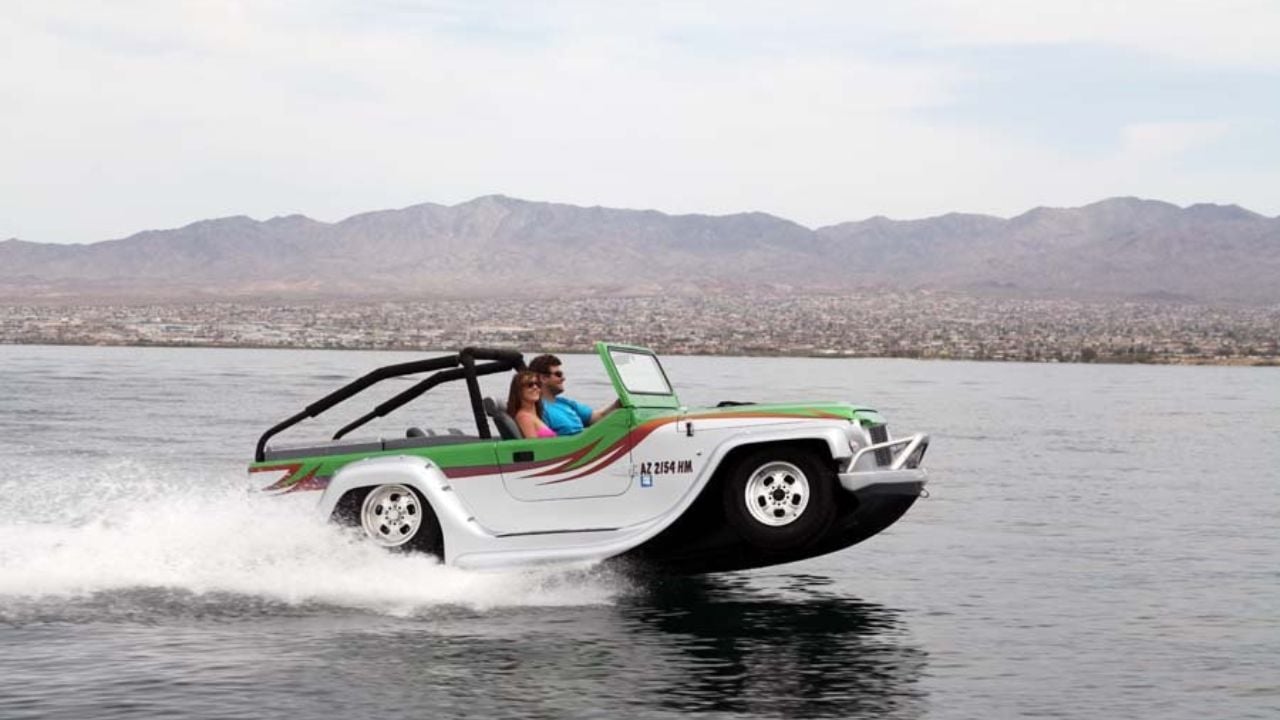
WaterCar Panther

If a Jeep and a speedboat had a baby, it might look like the Panther. Built in California, this amphibious beast uses a Honda V6 engine and can hit highway speeds on land and about 45 mph on water, making it one of the fastest amphibious vehicles you can actually buy.
It’s loud, fun, and totally impractical. We love it.
U.S. Army DUKW (“Duck”)

The DUKW was built for war but found a second life in peace. Used heavily in WWII and the Korean War, this 6-wheeled amphibious truck could haul troops and cargo across rivers and beaches.
Many survive today as tourist attractions. If you’ve ever taken a duck boat tour in a harbor city, you’ve probably ridden in one.
Gibbs Quadski

Part ATV, part jet ski, the Gibbs Quadski is a personal amphibious vehicle that transitions from land to water in about five seconds. With a top speed of 45 mph on both surfaces, it’s built for fun, not function.
Perfect for weekend adventurers, it offers off-road thrills and waterborne freedom in one slick, high-tech package.
FV620 Stalwart

Nicknamed the “Stolly,” the FV620 Stalwart was a British Army amphibious cargo truck built in the 1960s. With six-wheel drive, a sealed hull, and water-jet propulsion, it could haul over three tons of gear across rough terrain and rivers without flinching.
It was loud, hard to steer, and famously tough to maintain — but it worked. Despite its quirks, the Stalwart proved itself in the field and remains a favorite among collectors who appreciate a machine that looks like it should sink but doesn’t.
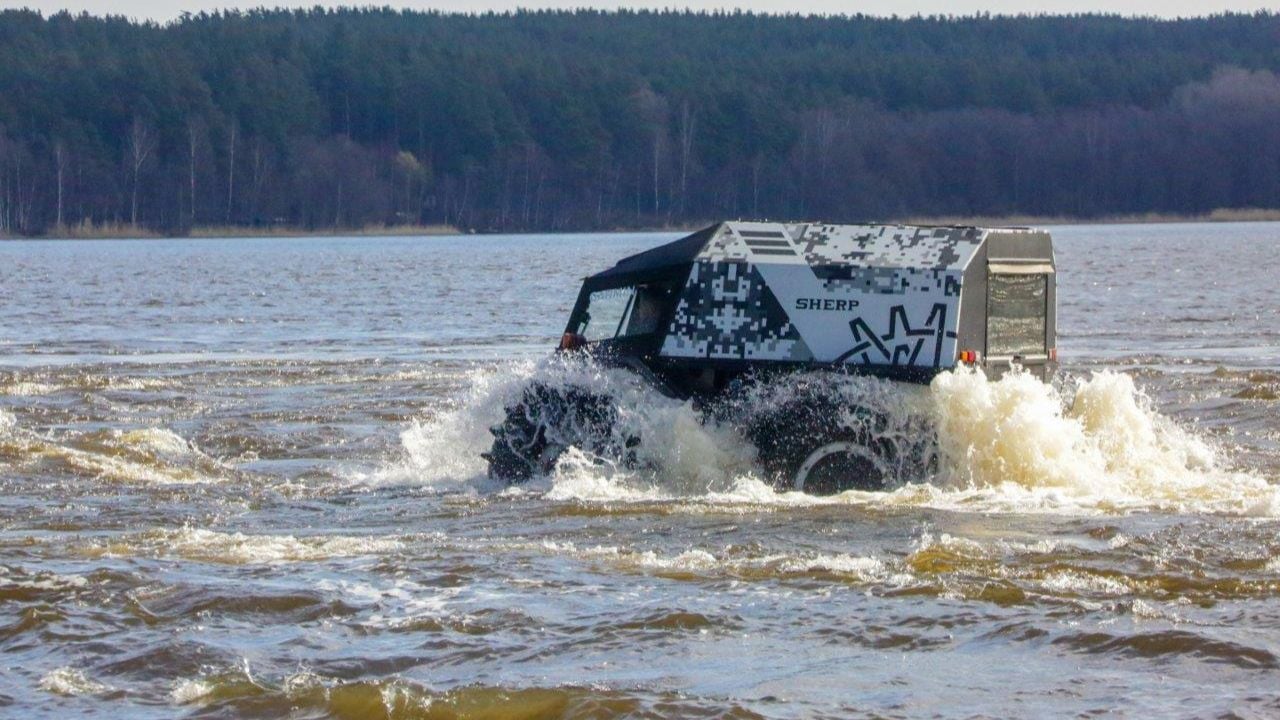
Sherp ATV

This is one of my personal favorites. Imagine a Tonka truck that grew up and went feral. The Sherp is a Russian-Ukrainian-built amphibious all-terrain vehicle designed to conquer the unconquerable. With massive self-inflating tires, a tiny footprint, and a top land speed of around 25 mph, it looks like it shouldn’t work, but it does.
And yes, it floats. The tires act like paddles in the water, propelling it forward while shrugging off ice, mud, and marshes. The Sherp isn’t about speed; it’s about unstoppable capability. If you need to drive through a swamp, across a frozen lake, or over a fallen forest, this is your machine.
Not Just a Gimmick

These amphibious rides weren’t dreams — they were drivable, floatable, and in some cases, even mass-produced. Sure, they have tradeoffs (most aren’t great boats or cars), but they prove the concept isn’t just fantasy.
From military muscle to waterfront joyrides, these vehicles crossed the line—literally—from land to sea and back again.