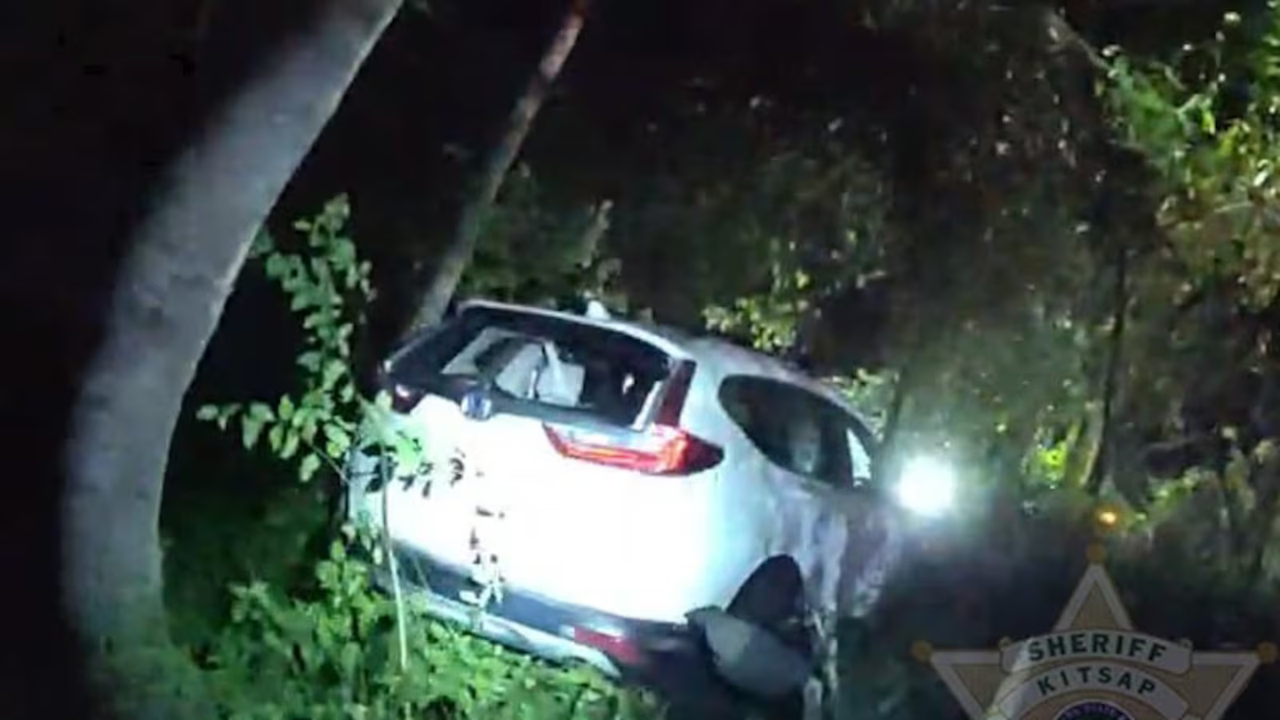
A late-night crash in Bremerton allegedly started with a 19-year-old taking his mother’s SUV without permission and ended with the vehicle stuck in a wooded embankment.
Kitsap County sheriff’s deputies were called to Tracyton Boulevard NW shortly before midnight on Sept. 18 after the SUV hit a mailbox, left the road, and became stuck among the trees. By the time deputies arrived, the driver was gone.
A witness told deputies that a man had been seen walking out of the woods. The vehicle supplied the next lead: a deputy ran the license plate, traced it to the registered owner’s address, and went looking for the person who had been behind the wheel.
What followed was not the explanation deputies ultimately accepted. KIRO 7 reported that the Seabeck man first claimed a friend had been driving. He later admitted that he had taken his mother’s SUV without her permission and had been the driver.
Field sobriety testing followed. The tests showed signs of impairment, and a breath test produced an alcohol concentration described as nearly twice the legal limit. The exact breath result was not included in the report.
A Lower Line
The missing number leaves an important distinction unresolved because Washington has more than one alcohol threshold relevant to a 19-year-old driver.
Under Washington’s DUI statute, a driver can be convicted of DUI with a breath or blood alcohol concentration of 0.08 or higher within two hours of driving. The statute also permits a DUI conviction based on impairment even without a 0.08-or-higher test result.
Drivers younger than 21 are also covered by a separate Washington provision that applies when their alcohol concentration is at least 0.02 but below 0.08. Without the actual breath result, the phrase “nearly twice the legal limit” does not establish a specific number.
Washington traffic data also put impairment among the state’s persistent road-safety problems. Preliminary 2025 figures from the Washington Traffic Safety Commission counted 659 traffic deaths statewide, down from 731 in 2024. The commission said alcohol was the most common impairing substance identified among impaired drivers in the preliminary data, while cautioning that impairment figures can change as toxicology results arrive.
Off The Road
The mailbox adds another legal thread. Washington law requires a driver who damages property fixed beside a public highway to make reasonable efforts to notify the owner or leave identifying information. Violating that provision is a misdemeanor.
The suspended-license allegation has its own variables. State law divides driving while suspended or revoked into different degrees depending on why the license was invalid and whether the driver was eligible to reinstate it. The report does not specify which degree applies in this case.
KIRO reported that the 19-year-old now faces charges of driving under the influence, hit-and-run, and driving with a suspended license.