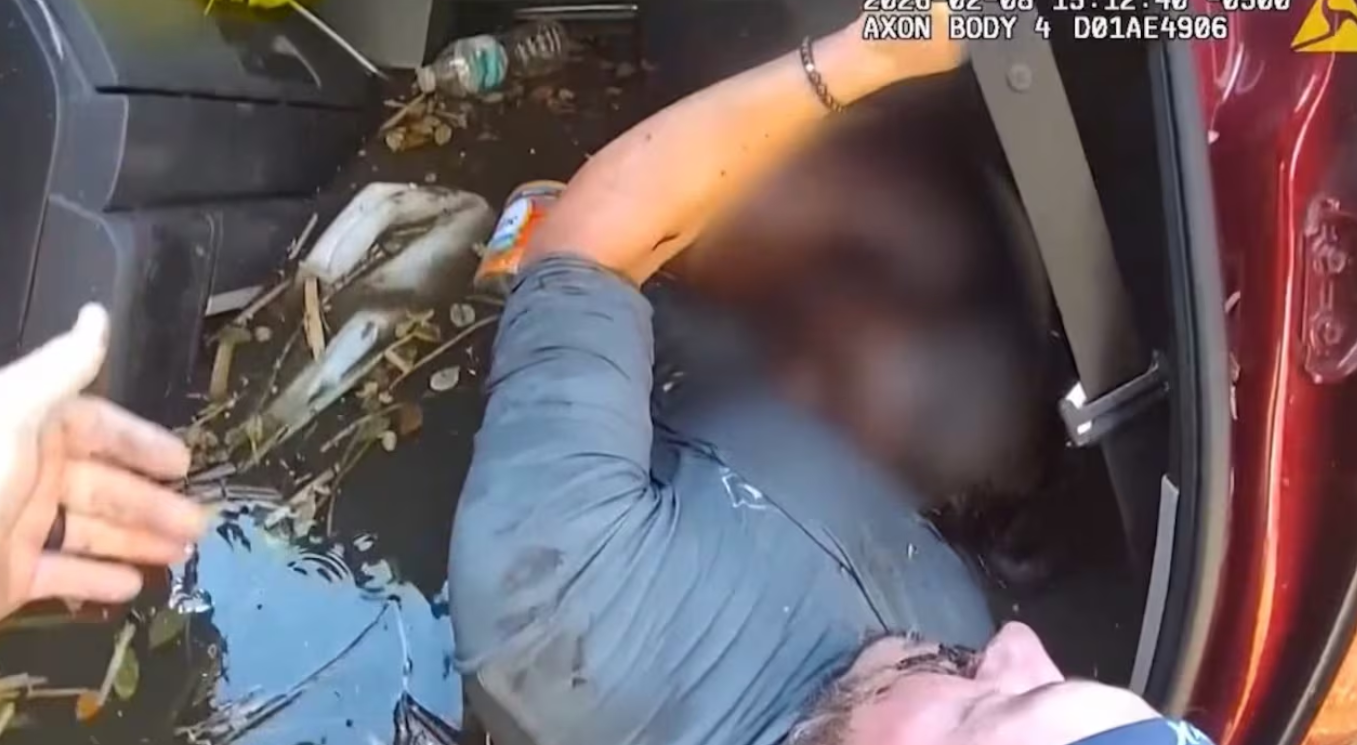
A split-second decision by a complete stranger is the reason a family of four is alive today. On a quiet Sunday in Indiantown, Florida, what should have been a forgettable drive home from work turned into one of the most harrowing rescues Martin County has seen in recent memory. A mother lost consciousness at the wheel, her Jeep veered off the road, and within seconds, she and her three young children, ages 8, 2, and just 4 months old, were submerged upside down in a canal hidden behind heavy brush.
Casey Curtis was the man behind them. He noticed the vehicle in his rearview mirror, watched it suddenly accelerate and disappear off the side of the road, and did not hesitate for a single second. He pulled over, called 911, followed the tire tracks into the brush, and found the car before anyone else even knew something had gone wrong.
What he found when he got there was nothing short of a nightmare. The Jeep was flipped and submerged, the children were trapped inside staring at him through the water, and their mother, Shyenique Wilkins, was unresponsive, still buckled into her seat with her head underwater.
Curtis did not wait for first responders. He got in, secured the children on the bank, climbed back into the sinking vehicle, lifted Wilkins’ head above water, and gave her a rescue breath. She started breathing. That moment, in a canal behind a wall of Florida brush, is almost certainly the moment this story went from tragedy to survival.
What Happened in Indiantown
View this post on Instagram
According to investigators, Wilkins suffered a medical seizure before the crash, which caused her to lose control of the vehicle. The Jeep left the road and flipped into a canal in Indiantown, a small community in Martin County on Florida’s Treasure Coast. The area where the vehicle came to rest was not visible from the road, tucked behind dense vegetation.
Curtis followed the tire tracks through that brush, heard the children screaming, and used that sound to find the car. By the time first responders from Martin County arrived, Curtis had already moved the children to safety and was inside the car holding their mother’s head above the waterline. Emergency crews helped extract Wilkins from the vehicle, and the entire family was transported to Lawnwood Medical Center.
The Condition of the Family
As of Tuesday afternoon following the incident, all three children were reported to be okay. Wilkins, however, remained hospitalized on a ventilator. The seizure she experienced before the crash, combined with the trauma of the accident and time spent with her head submerged, left her in serious condition. Family members have been asking the community to keep Wilkins in their prayers as she works toward recovery.
A GoFundMe campaign has been set up to help the family navigate the medical costs that come with a situation like this. For a single mother of three young children, the financial weight of a hospitalization like this can be just as devastating as the event itself.
Why This Rescue Could Easily Have Gone the Other Way
Curtis said something after the rescue that is worth sitting with for a moment. He pointed out that there was nobody else around, that the car was invisible from the road, and that those three children had no way to open the doors or break the windows themselves. In his own words, there was no way they would have survived without someone stumbling upon them exactly when he did.
That is not an exaggeration. The youngest child was just 4 months old. The oldest was 8. A submerged, overturned vehicle gives even adults very little time, and children that age are entirely dependent on outside help. If Curtis had not been directly behind Wilkins when she lost consciousness, if he had looked away for a moment, if he had not followed the tire tracks rather than simply calling 911 and waiting, the outcome of this story would be almost unimaginably different.
Curtis credited God and being in the right place at the right time, but his instincts, his speed, and his willingness to get into an overturned car in a canal deserve a fair amount of credit too.
What We Can Learn From This Incident
Stories like this one tend to get shared as feel-good news, and rightfully so. But there are real, practical takeaways worth pulling from what happened in Indiantown.
First, medical emergencies behind the wheel are more common than most people realize. Seizures, strokes, and cardiac events can strike without warning, and a driver who loses consciousness has no ability to brake or steer. If you notice a vehicle ahead of you behaving erratically, accelerating without cause, or drifting off the road, calling 911 immediately could matter more than you know.
Second, Curtis followed the tire tracks. He did not assume that a car going off the road meant a fender bender. He tracked the path of the vehicle even when it led him through brush and out of sight. That kind of thorough thinking in a chaotic moment is something anyone can adopt.
Third, knowing basic rescue breathing is a skill with a very real return on investment. Curtis gave Wilkins a single breath and she started breathing again. That one action, simple in theory and terrifying in practice, may be the reason she survived. CPR and rescue breathing courses are widely available through the Red Cross and local fire departments, often free of charge or low cost.
Finally, Good Samaritans exist, and they are worth celebrating loudly. In a news cycle that can feel relentlessly grim, Casey Curtis is a reminder that ordinary people do extraordinary things all the time, usually without thinking twice about it.