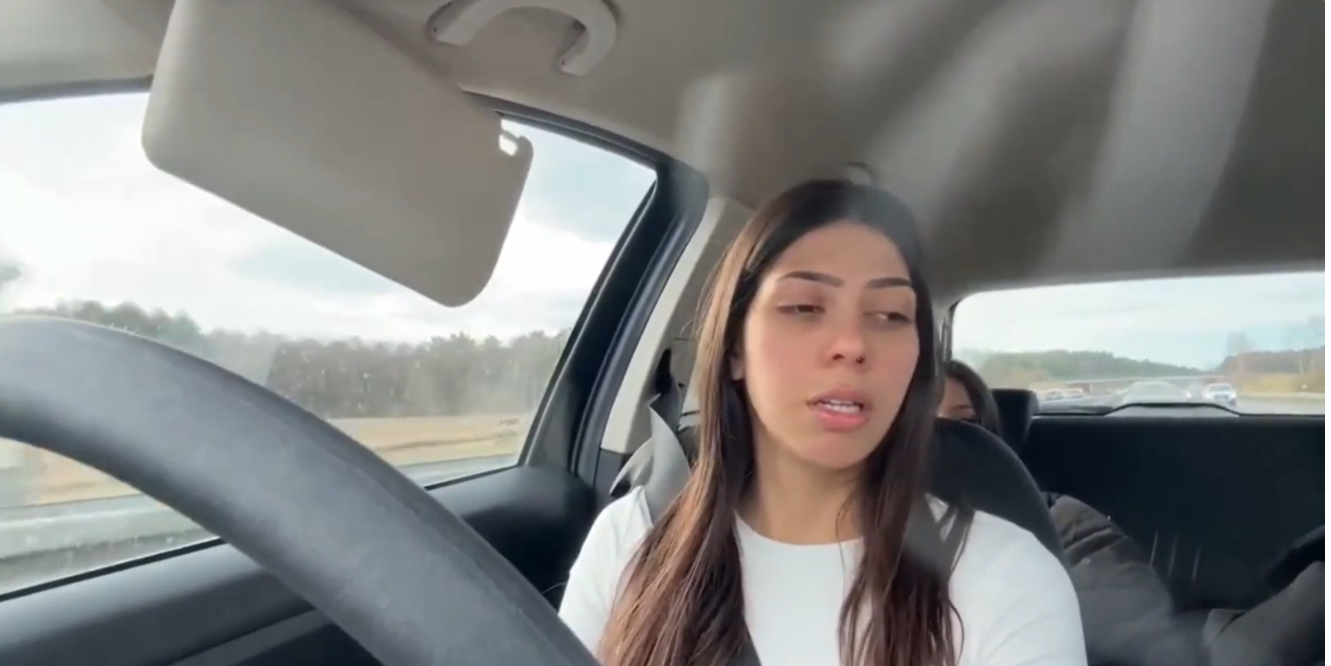
There is a good chance you had never heard the name MissMeensy until this story started circulating online. She is not one of the internet’s biggest influencers, and her audience is relatively small compared with the massive followings that dominate platforms like TikTok, YouTube, and Kick.
That fact is actually part of the larger story. Social media has created an environment where almost everyone is chasing the same thing: a viral moment, a sudden spike in followers, or a clip that explodes across the internet. The pressure to perform for the camera can push aspiring influencers to behave in ways they might never consider otherwise.
When those decisions happen behind the wheel of a car, the risks extend far beyond the person holding the phone.
A livestream titled “IRL IN BERLIN” recently turned into a viral crash clip after Kick streamer MissMeensy collided with traffic on Germany’s Autobahn while broadcasting to viewers. Clips from the stream quickly spread across social media after viewers reposted portions of the broadcast, reigniting debate about distracted driving and livestream culture.
Livestreaming on the Autobahn Went About as Expected
MissMeensy crashed her car live on stream seconds after looking away from the road on the German Autobahn pic.twitter.com/Qrru1nZZWG
— TaraBull (@TaraBull) March 14, 2026
The crash happened while MissMeensy was talking to viewers about driving on the Autobahn during her livestream. Germany’s Autobahn network is well known for sections without a general speed limit, though drivers are still required to adjust their speed based on traffic, visibility, and road conditions.
According to the German automobile club ADAC, motorists are expected to maintain control of their vehicles and keep a safe following distance even on unrestricted sections of highway. Those expectations are part of why the Autobahn can safely accommodate high-speed travel when drivers remain attentive.
Video clips circulating online show the streamer mentioning a car in front of her shortly before the collision. Moments later, she appears to glance away from the road while interacting with chat. Within seconds, the vehicle collides with traffic ahead.
The impact sends the livestream camera backward, leaving viewers briefly staring at the sky while the aftermath unfolds inside the vehicle. Audio captured during the stream records MissMeensy repeatedly asking whether everyone in the car is okay while passengers react to the crash.
An Apple iPhone inside the vehicle also appears to trigger the company’s Crash Detection emergency feature, which can automatically initiate an Emergency SOS prompt after detecting a serious collision. The livestream ends shortly afterward.
Missmeensy Issues a Statement After the Crash
statement regarding my car accident that was live-streamed. pic.twitter.com/nsg5E3XnEa
— m. (@missxmeensy) March 15, 2026
After the video began circulating online, MissMeensy released a public statement addressing the incident. She said everyone involved in the crash walked away safely and described the primary loss as the vehicle itself, which she said was totaled.
Her statement also addressed rumors that had begun spreading online. She said hospital toxicology tests were negative and that she was not under the influence at the time of the crash.
Additional clarification in the statement noted that there were no children in the vehicle. She also stated that everyone inside the car was an adult wearing a seatbelt and that no one had been lying down in the vehicle at the time of the crash.
Legal matters connected to the accident limit how much she can publicly discuss the circumstances of the collision. Her statement describes the incident as a serious wake-up call and emphasizes the importance of remaining fully focused while driving.
She also acknowledged that viewers were upset that the crash occurred during a livestream.
Reddit’s Reaction Was Brutal, but Not Entirely Undeserved
Clips of the crash quickly appeared on Reddit, particularly in communities that track livestream mishaps and viral internet moments. Watching a collision unfold live on camera tends to produce strong reactions, and this situation proved no different.
Many viewers focused on the moments immediately before the impact. One Reddit user wrote, “And right before that she says ‘there is a car right in front of me’ then looks away and hits it lol.”
Speed quickly became another focal point in the discussion. High-speed driving dramatically reduces reaction time, making even brief distractions dangerous. One commenter summarized that concern by writing, “All it took was 3 seconds, eyes off the road for this accident to happen.”
The following distance also became part of the debate. One commenter argued that proper spacing between vehicles should have prevented the collision, writing, “She must always be able to stop and not hit the car in front of her. That is the law. Too fast or too close.”
Criticism also extended beyond the specific details of this crash. Several commenters focused on the broader trend of livestreaming while driving and the risks it creates for other motorists.
One user wrote, “Streaming while driving should be banned everywhere.” Another commenter warned that the growing trend could eventually have tragic consequences, adding, “Someone getting killed is inevitable.”
One observation appeared repeatedly throughout the discussion. Because the crash occurred during a livestream, the footage itself effectively records the moments leading up to the collision. As one Reddit user put it, “Streaming through the accident is a brilliant way to make the negligence case against yourself.”
This Isn’t the First Livestream Crash
MissMeensy’s crash may be the latest viral example, yet livestream-related driving incidents have appeared repeatedly over the past decade.
One of the most widely known cases occurred in 2017 when 18-year-old Obdulia Sanchez livestreamed a crash on Instagram while driving in California. The vehicle rolled over after leaving the road, killing her 14-year-old sister. Sanchez continued filming after the accident and was later sentenced to prison for vehicular manslaughter, according to reporting from TIME.
Influencers themselves have also experienced high-profile livestream crashes. In 2024, YouTuber Jack Doherty crashed a McLaren 570S while livestreaming on Kick after glancing down at his phone while driving on a Miami highway, an incident reported by People.
These incidents illustrate a recurring pattern. Technology that allows anyone to broadcast their lives in real time has also created a new form of distracted driving, one where the pressure to entertain an audience competes directly with the responsibility of operating a vehicle safely.
The Autobahn Isn’t a Free-For-All
One theme that recurs throughout the discussion concerns the common misunderstanding of Germany’s Autobahn system. Certain sections do not have a fixed speed limit, though that does not mean drivers can ignore safety responsibilities.
Germany maintains a long-standing recommended speed of 130 km/h (about 81 mph) on unrestricted sections. Drivers who exceed that speed can still face increased liability if they are involved in a crash.
Commenters familiar with German driving culture emphasized the discipline required for high-speed travel. One wrote, “Just because there is no limitation rule doesn’t mean you cannot self-moderate with discipline and awareness.”
Another added that attention to the road is essential when traveling at Autobahn speeds. “You are driving on the Autobahn. You pay more attention to the road because your life depends on it.”
Cars Are Not Content Studios
MissMeensy’s statement serves as a reminder that distractions can happen while driving, whether from adjusting the radio, reaching for a drink, or reacting to something around you.
Many viewers saw the situation differently. The crash occurred during a livestream with a camera running and chat scrolling while the vehicle was traveling at highway speed.
That distinction explains why the clip generated such a strong response online. A car moving at high speed is not simply a backdrop for content creation.
The broader concern is not whether MissMeensy was famous before the crash. The real issue is a social media culture in which thousands of aspiring influencers are willing to engage in risky behavior on camera in the hope that one clip might go viral.
When that performance takes place behind the wheel, the consequences extend to everyone sharing the road.
What Can Actually Be Done About It
Incidents like this are bigger than any single streamer or viral clip. They reflect a broader problem created by technology, social pressure, and a culture that sometimes rewards risky behavior with attention. Preventing the next crash will require more than simply criticizing the person involved after the fact.
One of the most important steps starts close to home. If you have younger drivers in your life, talk to them about the dangers of livestreaming while driving, aggressive driving, and distracted driving. Many younger drivers have grown up with phones and social media as constant companions, and the temptation to check messages, record videos, or interact with an audience can feel normal even when they are behind the wheel.
Parents, teachers, and mentors can make a difference by setting expectations early. Driving requires full attention, and anything that takes your focus off the road for even a few seconds can have serious consequences. A moment of distraction at highway speeds can cover hundreds of feet before a driver even realizes something has gone wrong.
Technology platforms also play a role. Livestream services make it easier than ever to broadcast from anywhere, including behind the wheel of a moving vehicle. When content clearly shows dangerous driving or livestreaming while operating a vehicle, platforms should consider removing that content and discouraging creators from repeating the behavior.
No single change will eliminate distracted driving entirely. Education, responsible platform policies, and stronger cultural expectations can at least reduce how often people treat a moving vehicle like a stage for content creation. The goal should be simple: fewer viral crash clips and more drivers who understand that the road deserves their full attention.