There’s a common assumption in the automotive world that weight is the enemy of handling. While that’s often true, some sporty cars prove that clever engineering can overcome the tyranny of the scales.
These heavyweight contenders use advanced suspension geometry, sophisticated electronics, and strategic weight distribution to dance through corners with surprising grace.
Porsche Taycan Turbo S

Tipping the scales at about 5,062 lb (U.S. curb weight), with other published standards around 5,049 lb DIN / 5,214 lb EC depending on measurement, the Taycan Turbo S is nobody’s idea of lightweight, yet it corners like a car half its weight. Porsche achieved this magic through a low center of gravity thanks to the battery pack placement and active suspension that adjusts in milliseconds.
Systems like Porsche Torque Vectoring Plus (PTV Plus) (with an electronically controlled rear differential lock) and Porsche’s AWD control help rotate the car into corners with precision that belies its hefty curb weight.
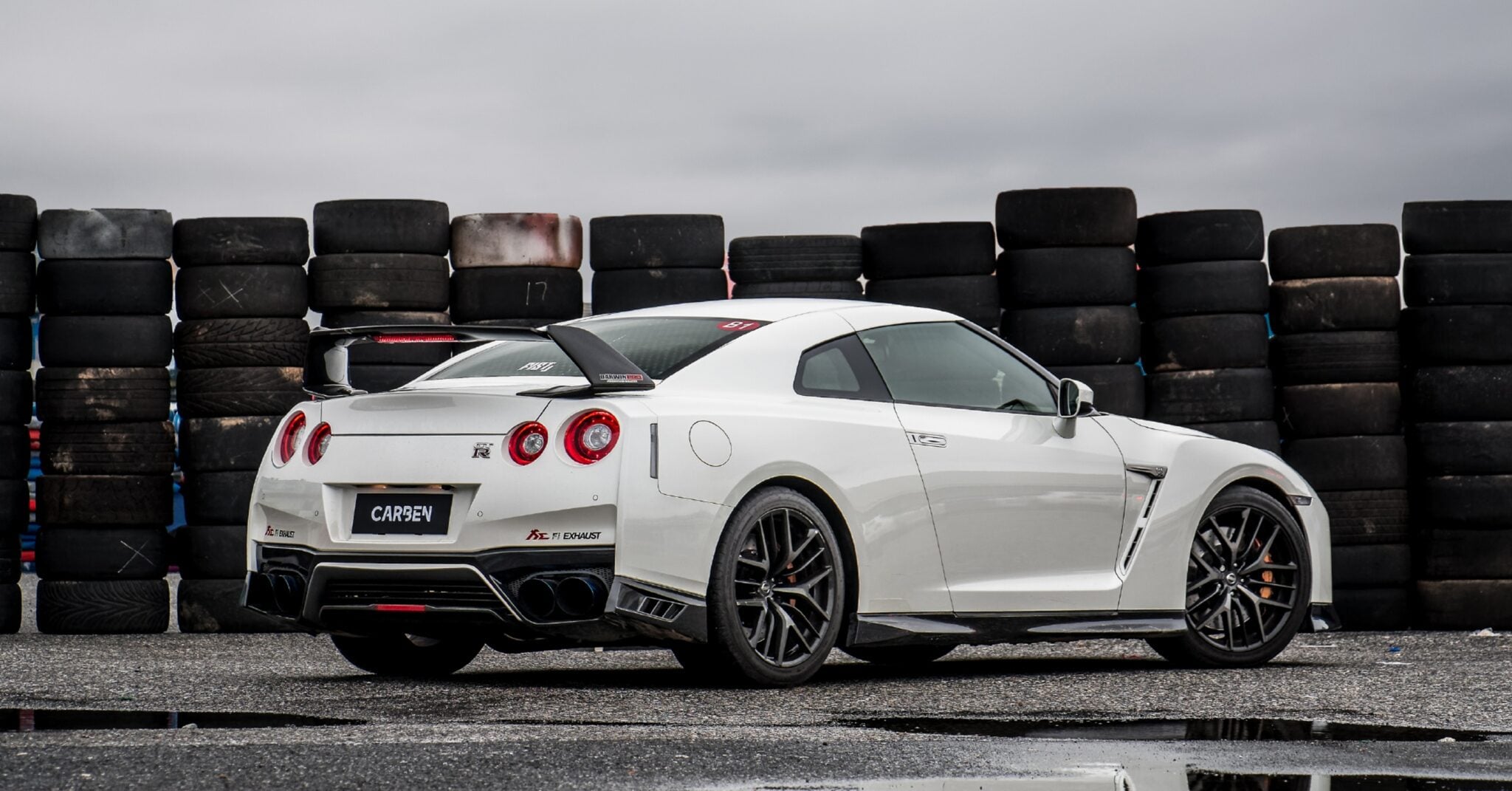
Nissan GT-R

The GT-R has always been a technological tour de force, and at roughly 3,935 pounds, it’s no featherweight. Its advanced all-wheel-drive system and adaptive suspension work together to mask the mass when you’re carving up a mountain road.
The computer-controlled torque distribution can shift power between wheels faster than any human could react, giving it handling characteristics that feel almost supernatural.
Audi R8 V10

Weighing roughly 3,638–3,957 lb depending on the version (many coupes are ~3,638 lb, Spyders can be ~3,957 lb), the R8 carries its weight with the poise of a ballet dancer. The mid-engine layout and Quattro all-wheel drive create a planted feel that inspires confidence through even the tightest switchbacks.
Magnetic ride suspension reads the road surface constantly, making adjustments that keep the chassis composed without sacrificing ride quality.
Chevrolet Corvette C8 Z06

At roughly 3,434 lb with carbon-fiber wheels, up to about 3,500–3,599 lb depending on configuration, the C8 Z06 isn’t exactly light, especially compared to its supercar rivals. However, the mid-engine layout and sophisticated Magnetic Ride Control 4.0 system help it punch above its weight class in the handling department.
The wider track and aggressive aerodynamics generate serious downforce, essentially adding virtual lightness when you need it most.
BMW M5 CS

This super sedan weighs about 4,114 lb (BMW quoted curb weight), yet it tackles corners with an enthusiasm that seems physically impossible. BMW’s xDrive all-wheel-drive system and adaptive M suspension work in concert to manage all that mass, while the M-specific tuning allows just enough rotation to keep things entertaining.
It’s proof that a heavy car can still feel engaging when the engineering is dialed in perfectly.
Mercedes-AMG GT 63 S

At roughly 4,700 lb in common U.S. curb-weight listings (varies by year/spec), this four-door coupe has no business handling as well as it does. The rear-biased all-wheel drive and active rear-wheel steering give it the agility of a much smaller car, while adaptive dampers keep body roll in check.
The long wheelbase that adds weight also contributes to high-speed stability, making it a better handler on fast, flowing roads than tight autocross courses.
Dodge Challenger SRT Hellcat

Yes, the ~4,479 lb Hellcat Widebody (example spec) is a modern muscle car first, but the Widebody version handles far better than its reputation suggests. The wider track, Brembo brakes, and adaptive Bilstein suspension transform it from a straight-line specialist to a surprisingly capable canyon carver.
You’ll never mistake it for a Miata, but it’s remarkably composed given its supercharged V8 and drag-strip credentials.
Lexus LC 500

At about 4,340 lb for the LC 500 coupe (the convertible is heavier), the LC 500 prioritizes grand touring comfort over outright lap times, yet it still handles with grace and precision. The multi-link suspension and low center of gravity give it a planted feel that makes long drives through twisty roads genuinely enjoyable.
Active rear steering tightens the turning circle at low speeds and stabilizes the car at highway velocities.
Alfa Romeo Giulia Quadrifoglio

Weighing about 3,806 lb (base curb weight listing), the Giulia QV uses near-perfect 50/50 weight distribution to deliver handling that honors the brand’s racing heritage. The carbon fiber driveshaft and aluminum construction help keep weight down where possible, while the active suspension constantly adapts to maintain optimal contact with the road.
It’s one of those rare sedans that genuinely feels like a sports car when you’re attacking a favorite road.
Acura NSX

The hybrid powertrain puts the NSX around 3,803 lb in early spec listings, while later official Acura specs list roughly 3,879–3,945 lb depending on equipment; the Type S is 3,903–3,960 lb, which is hefty for a mid-engine exotic. However, the three electric motors work with the V6 to provide torque vectoring that actively helps steer the car through corners.
The chassis is so well-balanced and the computers so sophisticated that the weight becomes invisible once you’re up to speed.
Jaguar F-Type R

At roughly 3,900 pounds, the F-Type R isn’t the lightest sports car in its segment, but the aluminum-intensive construction keeps weight as low as possible. The active electronically controlled differential and adaptive dynamics suspension work together to deliver confident handling that flatters drivers of all skill levels.
The long hood does require some respect in tight corners, but the chassis has the grip and composure to back up the supercharged V8’s power.
Maserati MC20

Car and Driver measured a curb weight of 3,757 lb, the MC20 is one of the lighter cars on this list, though still heavier than some competitors. The carbon fiber monocoque and double-wishbone suspension at all four corners give it the handling precision you’d expect from a proper Italian supercar.
The mid-engine layout provides natural balance that makes it easy to place accurately through corner after corner.
Conclusion

Weight might be the enemy of performance, but these twelve cars prove it’s not an insurmountable obstacle. Through advanced suspension technology, strategic weight distribution, and clever electronic aids, modern engineers have found ways to make heavy, sporty cars handle with surprising finesse.
The next time you see a curb weight spec that makes you wince, remember that the number on the scale doesn’t tell the whole story about how a car behaves on a great road.