I was working on a post about the SVT Contour, a car I loved back when it was new. I couldn’t afford one then, even though it was a bargain, but doing some research on it recently made me appreciate it even more.
That got me thinking: What other cool performance Fords might have existed? Not the obvious ones, but the weird ones, the forgotten ones, the “you sure that was fast?” ones. Turns out, Ford’s been sneakily building quick-ish versions of commuter cars for decades, and most of them flew under the radar.
Some of these Fords weren’t exactly Mustang rivals or performance icons but that’s what makes rediscovering them so much fun. It’s a chance to look back and see the clever, quirky, or just plain gutsy ways Ford tried to spice up the commuter car segment. They may not have topped any horsepower charts, but they’re full of stories, specs, and surprises you can bust out the next time your buddies start talking shop. Like the specs of the elusive Escort Turbo GT — which, yes, actually existed.
Methodology (Sort Of)
-

1999 Ford Contour SVT; Image Credit Ford.

I called this article “Forgotten Fast Fords” because I like alliteration, and because “Fords That Are Marginally Quicker Than the Mundane Version of the Same Car” is, frankly, a terrible headline.
Not all of these cars are fast in the “smoked a Viper” sense. But they were quicker, more interesting, or just more enthusiast-friendly than their base-model counterparts.
What makes them cool is that Ford actually tried. Tried to inject performance into commuter cars. Tried to go toe-to-toe with European sport sedans. Sometimes it worked. Sometimes it didn’t. Sometimes it was like watching a lumberjack attempt ballet. Clumsy, but oddly captivating.
Sure, we all wish Ford had just sent over the stuff they were already crushing with in Europe, like the Escort RS Cosworth or the original Focus RS. Instead, we got V6-powered Tempos and turbocharged hatchbacks that faded into obscurity before most people even knew they existed.
If you have or hard one of these more ellusive rides, read out to use we would love to feature it.
Ford SVT Contour
-

Image Credit: Ford

The Euro-American Sleeper
The SVT Contour was Ford’s late-‘90s attempt at a BMW 3 Series fighter and a surprisingly dang good one. Based on the European Mondeo, it was as if Ford quietly imported a proper sport sedan, then slapped a Ford badge on it and hoped nobody would notice.
Ford’s SVT (Special Vehicle Team) tuned its 2.5L Duratec V6 to produce up to 200 horsepower, paired it with a butter-smooth 5-speed manual, and gave it a tight, well-balanced chassis. It was quick, refined, legitimately fun to drive, and a bargain for anyone who understood what it was.
Conservative styling that looked like a back brace and a name that sounded like a map line certainly didn’t help sales, but for those in the know, it was an absolute gem. You probably still can’t find a clean one, because those who bought them drove them into the ground once they realized what they had. And I can’t help but be jealous as I continue scrolling Facebook Marketplace.
Ford Taurus SHO
-

Image Credit: Ben Schumin – Own work/Wiki Commons.

When Your Dad’s Car Ate Camaros
The Taurus SHO snuck into dealerships looking like your standard rental car, ready for a long, boring drive to grandma’s house. But under the hood? It lived up to its “Super High Output” namesake: A Yamaha-developed DOHC V6 that revved to a glorious 7,000 rpm and made a shocking 220 hp. It was doing the “fast family sedan” thing long before the Germans made it trendy.
Later versions added a V8 (don’t even get us started on the cam sprocket issue). However, that came with a less inspiring automatic transmission, proving that sometimes, two more cylinders isn’t always the answer. Still, the early SHOs were wild: fast, capable, and weirdly refined. A proper sleeper that probably left more than a few IROCs scratching their heads at the stoplight.
Ford Fusion Sport (2017–2019)
-

Image Credit: Charles, CC SA-2.0 / WikiCommons.

EcoBoosted, All-Wheel-Drive Rocket
The Fusion Sport was a true stealth bomber, capable of shocking much more expensive machinery. With 325 hp, a monstrous 380 lb-ft of torque, and standard AWD, it was quicker than most people realized — and quieter than Ford ever admitted, probably because they were too busy putting all their marketing dollars into trucks and SUVs.
It had sharp steering, legitimate power from its 2.7L twin-turbo EcoBoost V6, and room for the whole family — including that annoying dog your kid begged for that you now pretend to hate. Then it quietly disappeared, along with every other Ford sedan, because apparently, car guys don’t have families who also need to get places.
The best modern Ford nobody knew about because Ford forgot to tell anyone it existed.
Ford Tempo GLS
-

Image Credit: Ford.

V6 Power in a Car Nobody Bragged About
By 1992, the Ford Tempo had matured into a sensible, familiar compact for what would end up beinf its final years, Ford gave the GLS trim a more spirited twist. In its last and most compelling configuration, the GLS received a meaningful performance upgrade: the 3.0L Vulcan V6 from the Taurus, replacing the previous high-output 2.3L four-cylinder.
Output rose to 130 horsepower, making the 1992 GLS notably more responsive than earlier models. This V6-powered GLS was available only in 1992, making it a low-production, one-year-only variant. While it didn’t rewrite the definition of a sport sedan, it stands out today as a rarely remembered footnote in Ford’s effort to inject character into its compact lineup. A modest but meaningful upgrade, the 1992 GLS is now a largely forgotten curiosity — and perhaps the most interesting Tempo ever built.
Mercury Topaz XR5
-

Image Credit: Ford

The Escort GT’s Cousin in a Buttoned-Up Blazer
You probably forgot that Mercury was a division of Ford. Well, you probably forgot about Mercury, period. But the XR5 trim tried to make the Mercury Topaz interesting — and, in a “bless its heart” kind of way, it kinda succeeded.
Early models used a 2.3L four-cylinder shared with the Escort GT, while the 1992 model finally added the 135 hp Vulcan V6. With black trim, a tiny spoiler, bucket seats, and a 5-speed, it was the business-suit version of an economy car trying to cut loose on a Friday night.
Not exactly fast, but definitely trying, and that earns it a spot here. It was basically Mercury’s last-ditch effort to make anyone under 60 notice their brand.
Ford Escort Turbo GT (1984–1985)
-

Image Credit: Ford

The Bigfoot of Blue Oval Performance Compacts
The Ford Escort Turbo GT is one of the most elusive performance models the brand ever built — not necessarily because it was a track monster (though we’re not saying it wasn’t trying), but because information on this car has been surprisingly harder to than big foot.
Offered only in 1984 and 1985, it’s rarely documented, with just a few scattered forum posts even acknowledging its existence. That’s what makes the discovery of a 1984 Ford dealer brochure in the Ford Heritage Vault so significant — it confirms the Escort Turbo GT was real, and Ford gave it more than just a badge and a puff of boost.
It came equipped with a 1.6-liter turbocharged EFI four-cylinder engine paired with a 5-speed manual transmission, controlled by Ford’s “advanced” EEC-IV computer. A blow-through turbo layout gave it smoother drivability than most carbureted turbo compacts of the era, with crisp throttle response and usable torque for dodging potholes. Upgrades included TR performance suspension, stiffer springs, and a black rear spoiler that set it apart from your aunt’s tired commuter.
If anyone out there has actually seen one of these unicorns, or even owned one, let us know in the comments. We’re pretty sure it’s rarer than a functional turn signal on a BMW.
Ford Escort ZX2
-

Image Credit: Grant. C, CC BY-SA 2.0 / WikiCommons.

The ’90s Coupe That Danced Like a Hot Hatch
The ZX2 replaced the Escort GT in 1998 with sleeker looks and a surprisingly lively 2.0L Zetec engine. With 130–143 hp, decent handling, and a curb weight under 2,600 lbs, it was a light, quick coupe that could actually hang with Civics and Sentras of its day — just without the street cred or the obnoxious coffee-can exhaust.
In fact, it couldn’t shake its reputation as the official car of pizza delivery and hydroplaning at 5 mph. But be real — it may have been a s—box, but it was a car that made you say, “hey, that’s my s—box.”
It was the affordable fun coupe that fell through the cracks, often overlooked for more “mod-friendly” (read: often ruined) imports. You could still find one for cheap and have a blast.
Merkur XR4Ti
-
Image: dave_7, Flickr, CC-BY-SA-2.0/ Wiki Commons

Euro Muscle with a Turbo Twist
Imported from Europe and sold through beleaguered Lincoln-Mercury dealers, the Merkur XR4Ti was Ford’s weirdly brief attempt to be European in the U.S.
It was a rear-drive hatchback with a turbocharged 2.3L Lima engine, a 5-speed manual transmission, and handling that felt more BMW than Buick. It made up to 175 hp (more if you knew how to work a wrench) and had a wild double rear spoiler that was either genius or insanity, depending on your taste.
Weird name, great car. Too bad the marketing department had no idea what to do with it, probably confusing it for a new line of German washing machines. The Merkur suffered the same fate as beans on soggy toast — strangely, a hit in the UK but makes Americans ill at the thought.
Ford Focus SVT (2002–2004)
-

Image Credit: Ford

Cosworth-Tuned Compact Hero
Before hot hatches were a recognized thing stateside, Ford quietly gave us the SVT Focus — a 170-hp, 6-speed, Cosworth-tuned bundle of pure driving joy. It handled brilliantly, revved like crazy, and actually looked the part with chunky wheels and Euro-inspired bodywork.
It was a proper driver’s car in a market full of bland sedans, proving that Ford could build something genuinely fun and tossable. A little loud, a little raw, and way more fun than people gave it credit for.
It was basically a Euro-spec hot hatch in disguise, waiting for America to catch up.
Ford Focus RS (2016–2018)

Rally-Bred Maniac with Drift Mode
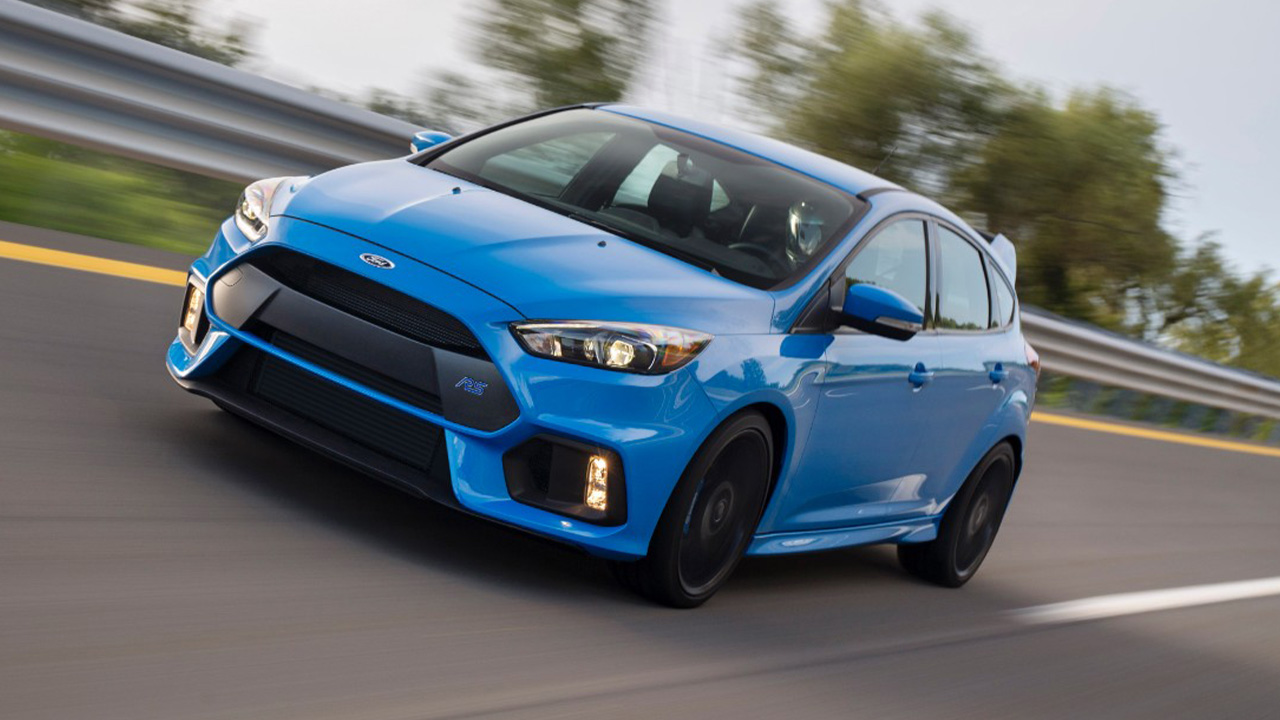
The Focus RS came in like a wrecking ball, slammed into the hot hatch segment, and then promptly blew itself up (mostly figuratively, sometimes literally). With 350 hp, AWD, torque vectoring, and yes, a dedicated Drift Mode (because why not?), it was bonkers fast and sticky in corners.
The ride quality? About as forgiving as your ex-girlfriend when she found out you had a collection of centerfolds under your bed — hey, they were of cars! Still, it’s one of the most exciting cars Ford ever sold in the U.S. — a true rally-bred maniac for the road. And of course, Ford only gave us three glorious model years before pulling the plug.
Ford’s best compact ever? Arguably. Shortest-lived? Definitely.
Lincoln LS (V8)
-
Image Credit: Stopsign002, CC BY-SA 3.0/WikiCommons.

A Rear-Drive Sport Sedan Hiding in a Luxury Suit
The Lincoln LS was Ford’s brief, intriguing attempt to build a proper Euro-style executive sport sedan — rear-wheel drive, near 50/50 weight balance, and a 3.9L V8 under the hood. Early models, surprisingly, could even be had with a 5-speed manual transmission (alas, only with the V6, but still). The handling is what made it really stand out, with a suspension system quite advanced for the time.
It rode on a Jaguar-based platform (the DEW98, shared with the S-Type and Thunderbird) with legitimate sport sedan credentials. Too refined for Lincoln loyalists who wanted floaty land yachts, too subtle for enthusiasts who wanted manual V8s, and largely ignored by everyone else — but seriously underrated if you know what to look for on the used market.
It was a proper RWD V8 sedan before they became extinct. But maybe Ford has finally learned its lesson about trying to make the European and American markets agree on something. Americans fought a war to stop this kinda thing.
The Finish Line
-
Image Credit: dave_7, CC BY-SA 2.0/WikiCommons.

Ford’s performance legacy is much deeper than just the Mustang, although there’s nothing wrong with a Mustang (unless it has a V6). Still, most of these cars were overshadowed, underpromoted, or underpowered compared to what they could’ve been (if marketing hadn’t had a stroke, or if we got the truly insane Euro versions). Still, they all tried — some boldly, some awkwardly — to bring a little excitement to everyday driving for the average American.
Whether it was slapping a turbo on an Escort and hoping for the best, stuffing a V6 into a Tempo and calling it “sporty,” or just generally building a surprisingly competent sleeper sedan, we salute Ford’s efforts to turn the mundane into the memorable… even if most of us forgot about them until now.
So next time you’re stuck in traffic, just remember, somewhere out there, a Taurus SHO is probably waiting to humble a Mustang GT from a few decades ago. That’s the Ford way.