
A one-star Google review of an Ohio manufacturing company has moved beyond the usual territory of irritated customers, terse owner responses, and arguments over star ratings.
Starr Manufacturing Inc., a Vienna, Ohio-based industrial equipment manufacturer, filed a lawsuit against Columbus resident Julie Watson in Trumbull County Common Pleas Court in August. The company alleges Watson made false statements about its manufacturing work in a Google review posted earlier this year. The Tribune Chronicle reported that the lawsuit includes claims for defamation, defamation per se, and defamation by implication.
Starr isn’t complaining merely that Watson gave the company one star. Her review made specific claims about quality-control problems, subcontractors, repairs at well-pad sites, and improperly connected or tightened fasteners. She also wrote that she could provide locations and people who could confirm what she described as recent production and quality failures.
The company says those claims are false. Its attorney has added another detail that substantially changes the dispute: Starr says Watson was never one of its customers.
One Star, Many Claims
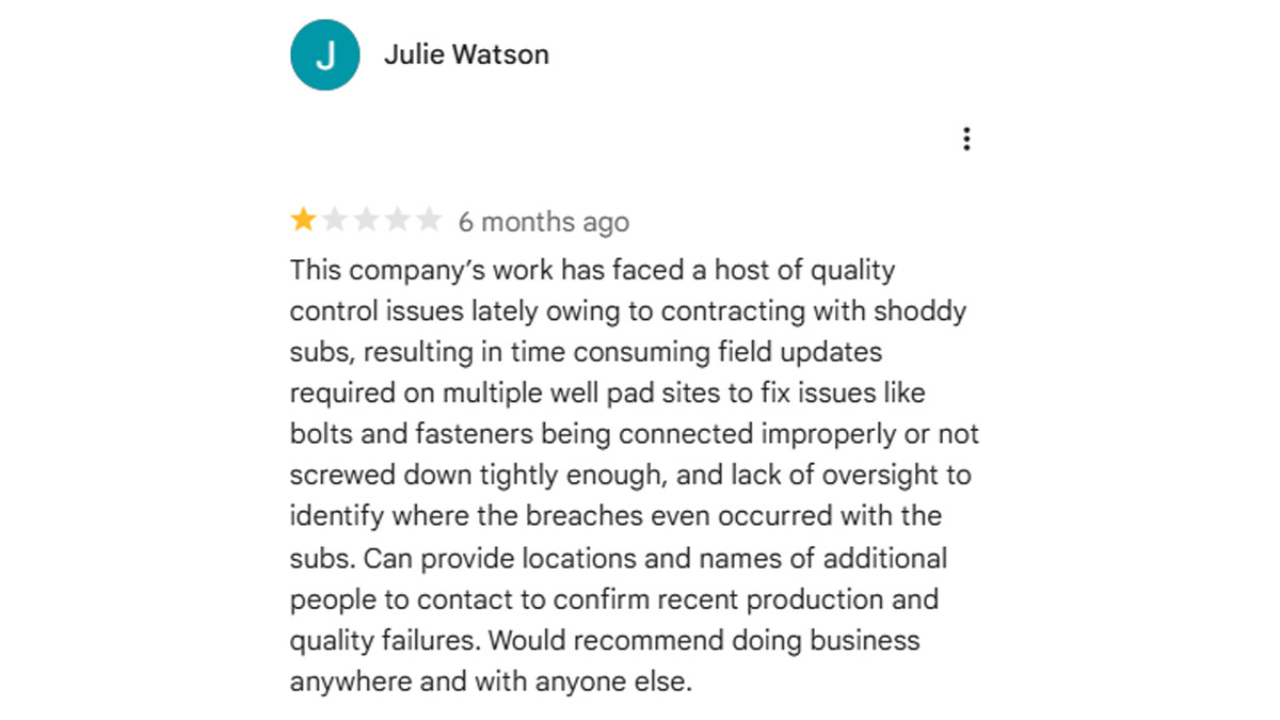
Watson’s review said Starr’s work had recently experienced what she characterized as numerous quality-control problems because the company used poor subcontractors.
According to the review quoted by 614NOW, Watson alleged that those problems resulted in field work at multiple well-pad sites. Among other things, she claimed bolts and fasteners had been improperly connected or inadequately tightened and alleged insufficient oversight of the subcontractors’ work.
Watson ended by recommending that people do business elsewhere.
Those are the statements at the center of the lawsuit, rather than the star rating itself.
Starr’s complaint alleges Watson made the statements “falsely and maliciously” and that people in Ohio viewed, read, and believed her allegations. The company says the review caused significant reputational harm and damages.
The lawsuit also alleges Watson knew her statements were false or acted with reckless disregard for their truth.
Not A Customer
Starr attorney Thomas Nader provided another side of the dispute in a statement to People.
Nader said Watson “has never been a customer” of Starr Manufacturing. He instead attributed the review to a personal relationship involving Watson and one of the company’s employees.
“This is a personal vendetta,” Nader told the publication.
That allegation provides substantially different context from what a person encountering the review on Google might reasonably assume.
The publicly posted review discusses Starr’s work, subcontractors, alleged production failures, and alleged problems at multiple job sites without saying Watson was a customer. Starr’s lawsuit goes further, alleging the review created the implication that other people had experience with and knowledge of the alleged product-quality problems.
That allegation forms the basis of Starr’s defamation-by-implication claim.
Watson could not be reached for comment by People. Her response to the allegations therefore remains absent from the public accounts reviewed for this story.
Thirteen Reviews
The review wasn’t exactly disappearing into a sea of customer feedback.
The Tribune Chronicle reported that Watson’s review was one of only 13 Google reviews for Starr around the time the lawsuit was filed. 614NOW reported that Watson’s review had accumulated 59 likes when it checked the listing.
People also reviewed Watson’s Google reviewing history and reported that the handful of other reviews she had posted during the previous seven years were all five-star reviews.
Starr, meanwhile, is not a consumer storefront where most visitors would necessarily be expected to leave Google reviews after buying something.
The company’s website says it has operated since 1965 and manufactures industrial products including pressure vessels, structural steel fabrication, storage tanks, and oil-and-gas equipment. Its oil-and-gas products include separators, line heaters, processing units, towers, piping components, and custom equipment skids.
That industrial focus also provides context for why Watson’s allegations concerning well pads, manufacturing, and subcontractor work are more consequential than a generic complaint about customer service.
More Than $25,000
Starr is asking the court for actual and compensatory damages, punitive damages, attorney fees, and litigation costs.
The complaint seeks damages in an amount exceeding $25,000, with the precise amount to be determined.
That does not mean Starr has established that the Google review cost the company $25,000. It is the amount of damages sought in the company’s lawsuit, and the allegations have not yet been adjudicated.
Starr also wants the court to stop Watson from continuing to publish the statements. The complaint alleges that without an injunction, Watson will continue posting what the company characterizes as false and malicious allegations online.
Ohio does now have another wrinkle for lawsuits involving certain forms of speech.
The state’s Uniform Public Expression Protection Act took effect April 9, 2025. Among other things, the law establishes procedures involving certain civil claims based on constitutionally protected speech concerning matters of public concern.
Whether that law applies to Watson’s particular review and Starr’s lawsuit would be a question for the court. Nothing in the material reviewed establishes that Watson has invoked it, and Starr’s lawsuit should not be characterized as a SLAPP simply because Ohio has an anti-SLAPP law.
For now, what began as one star among 13 Google reviews is sitting in Trumbull County Common Pleas Court, where Starr Manufacturing is asking for considerably more than a better rating