

Remember when you thought electric cars meant golf carts with delusions of grandeur? Well, automakers have been developing some genuinely clever EV concepts for decades, long before Tesla made batteries a popular choice. These weren’t your typical show ponies designed to wow crowds and gather dust. These five electric concepts may have looked absolutely bonkers, but they solved real problems that city drivers face daily.
Sure, they never made it to your local dealership, but their DNA lives on in today’s EVs. From spinning passenger compartments to motorcycles with training wheels, these machines prove that sometimes the best engineering solutions look completely insane at first glance.
Ford Comuta (1967)

Picture this: It’s 1967, The Beatles just released “Sgt. Pepper’s,” and Ford’s British division drops a battery-powered city car that makes a Smart ForTwo look massive. The Comuta stretched just 6 feet, 8 inches long; about the same height as a modern Honda CR-V. You could practically parallel park it in your driveway.
Ford’s engineers weren’t messing around with the specs. Four 12-volt lead-acid batteries (the same type used in your lawn mower) powered compact electric motors, providing a range of about 37 miles at a steady 25 mph. The top speed reached nearly 37 mph, which was perfect for dodging London traffic without alarming pedestrians. The entire structure weighed roughly 1,540 pounds, which is lighter than most motorcycles today.
The genius was in the packaging. Those tall windows weren’t just for style; they made the tiny cabin feel spacious instead of claustrophobic. Short overhangs meant you could judge corners without a spotter, and the upright seating position gave you a commanding view of the road ahead. It was like driving a very civilized phone booth.
Only a handful were ever built, and one survivor lives in a British museum where it continues to make modern city cars look bloated. The Comuta proved that small doesn’t mean compromised – it means focused. Every dimension served the mission: to move people and groceries across short distances without burning fossil fuels or requiring a CDL to park.
Nissan Pivo 2 (2007)
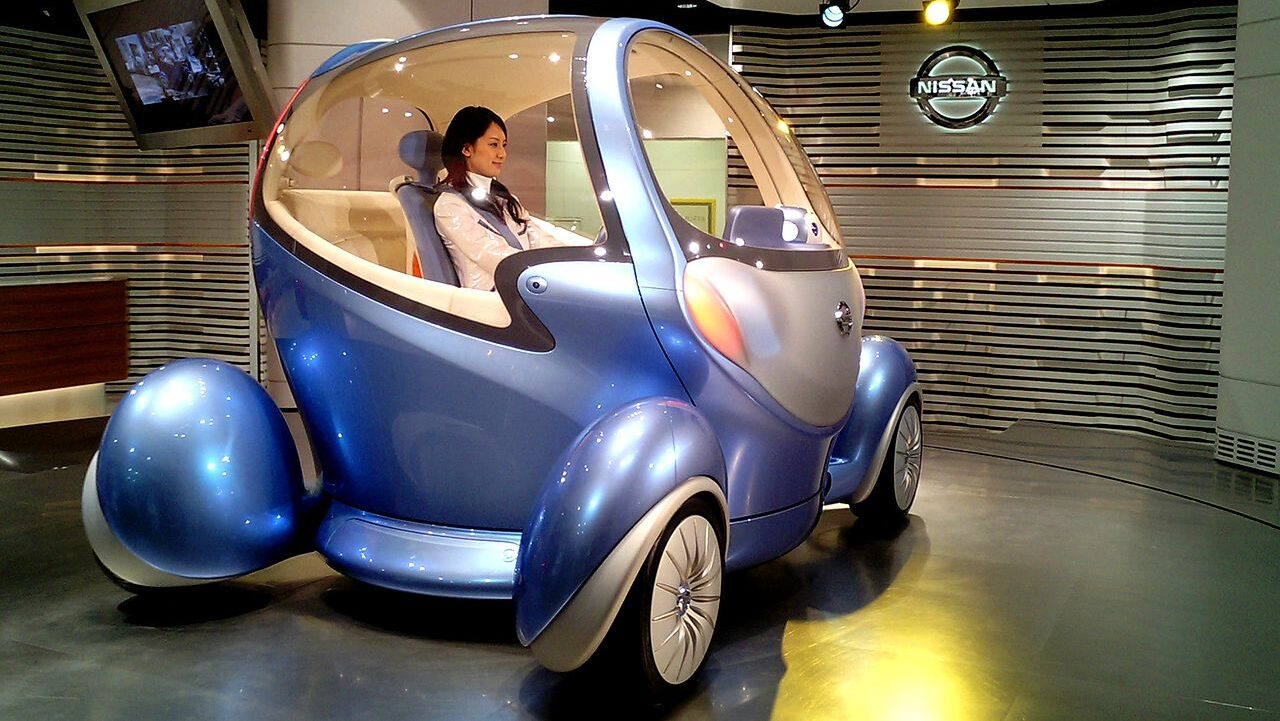
Fast-forward to 2007, and Nissan rolls up to the Tokyo Motor Show with a concept that would make a Transformer stop a fight just to squeal in delight. The Pivo 2 resembled a friendly, blushing robot egg controlled by a glossy-eyed creature, reminiscent of those found at Disney World. But the party trick was genuine engineering wizardry: the entire passenger cabin could rotate 360 degrees, and all four wheels could pivot 90 degrees independently.
Think about it: no more three-point turns in parking garages, no more backing out of tight spots while praying you don’t clip that BMW’s mirror. The cabin spun so the driver always faced forward, and the wheels could slide the car sideways into parking spaces like a crab with excellent manners.
The tech specs were equally impressive. In-wheel electric motors eliminated the need for a traditional drivetrain, freeing up interior space and enabling that choreographed wheel dance. The battery pack sat low in the floor for stability, and four-wheel steering made U-turns feel like gentle curves. Top speed was limited to about 37 mph.
The interface was pure Japanese whimsy, with friendly digital faces and intuitive controls that made parallel parking feel like a video game. Even the exterior lighting was expressive, helping communicate the car’s intentions to confused pedestrians watching it pirouette into a parking spot.
While no production car copied the full rotating cabin (insurance companies probably had heart attacks), pieces of the Pivo 2’s DNA appeared in many other vehicles. Rear-wheel steering systems, in-wheel motors, and ultra-short overhangs have all become standard features in EV design. The concept proved that electric packaging could completely reimagine how cars move through tight spaces.
Nissan Land Glider (2009)
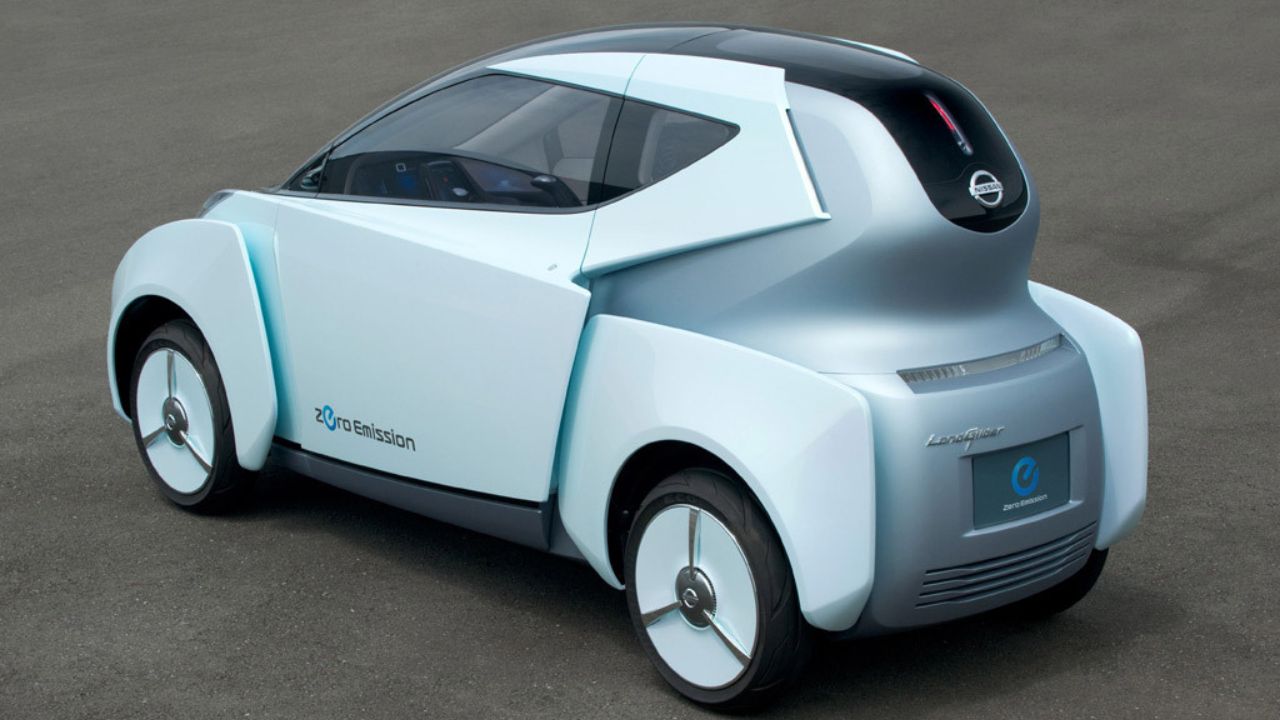
Two years later, Nissan was back with another head-scratcher: a tandem two-seater so narrow it made lane-splitting legal. The Land Glider was barely wider than your shoulders, with the passenger sitting behind the driver like a very civilized motorcycle. But here’s the kicker – it leaned into corners like a bike while maintaining four-wheel stability.
The engineering was genuinely clever. Electronic systems monitored speed, steering input, and lean angle to maintain stability on the narrow track through curves. Steer-by-wire technology coordinated everything, so drivers didn’t need to learn motorcycle skills to keep it upright. The whole system worked so seamlessly that cornering felt natural rather than terrifying.
Dimensions were motorcycle-modest: roughly 110 inches long and just 43 inches wide, with a wheelbase of about 88 inches. Two electric motors provided motivation, while the battery pack was positioned low on the floor to keep the center of gravity stable. Cameras replaced traditional mirrors to keep the profile even slimmer, and the wheels tucked tight to the body to avoid curb kisses.
The cabin felt more like a fighter jet cockpit than a traditional car interior, with controls optimized for the unique dynamics of the vehicle. The upright seating position and excellent visibility made threading through traffic feel effortless, while the narrow profile opened up parking possibilities that regular cars couldn’t even dream about.
Sure, crash regulations would’ve required extensive engineering for production, but the concept nailed something important: personal mobility doesn’t always need to be car-sized. The Land Glider demonstrated that with smart engineering, you can achieve weather protection and stability without occupying a full traffic lane.
Renault Twizy Z.E. Concept (2009)

While other manufacturers were content to build show cars, Renault had bigger plans: build something that looks like it will turn you into an avatar (using electricity, of course). The Twizy Z.E. Concept debuted at the 2009 Frankfurt show as a tiny electric quadricycle with tandem seating – and the French actually put it into production two years later with minimal changes.
The specs were refreshingly honest: 92 inches long, 45 inches wide, and weighing just 992 pounds empty. A 6.1 kWh battery pack powered a 13 kW (17 hp) motor, providing approximately 62 miles of range in the city. The top speed was electronically limited to 50 mph, which was more than enough for urban adventures. The entire package was classified as a quadricycle in Europe, which opened up licensing advantages for younger drivers.
The tandem layout wasn’t just space efficiency: it was brilliant psychology. That narrow profile led other drivers to treat the Twizy more like a motorcycle, giving it the appropriate space and consideration in traffic. The high seating position and excellent visibility made it feel safer than its diminutive size suggested, while the tight turning radius (just 11.5 feet) made parking a joy rather than a chore.
Renault kept the design refreshingly simple. Scissor doors opened to reveal a minimalist cabin with essential controls and weather protection that was more suggestion than guarantee. The visible structure around the seats provided psychological security while minimizing weight. It was transportation distilled to its essence.
The production of Twizy proved the concept’s validity by actually selling over 25,000 units that found homes across Europe. It demonstrated that right-sized transportation could be an upgrade for urban mobility, not a compromise. Sometimes smaller really is better, especially when parking costs more than your morning coffee.
GM EN-V (2010)

General Motors partnered with SAIC to unveil something that looked like a mashup between a Segway and a spaceship at the 2010 Shanghai World Expo. The EN-V (Electric Networked-Vehicle) balanced on just two wheels using gyroscopic control, while packing two passengers into a pod roughly one-sixth the size of a conventional sedan.
The engineering was legitimately impressive. Two electric hub motors provided propulsion and stability control, while sophisticated sensors and software maintained the pod’s upright position at all speeds, including a complete stop. The lithium-ion battery pack targeted urban range rather than highway endurance, with enough juice for typical city commutes. Five EN-Vs could fit in a single conventional parking space; now that’s efficiency.
But the real innovation here was connectivity. The concept integrated GPS navigation, obstacle detection, and vehicle-to-vehicle communication for semi-autonomous operation in controlled environments. The pod could theoretically drive itself in designated areas, communicate with traffic infrastructure, and coordinate with other EN-Vs to optimize traffic flow. It was Tesla Autopilot before Tesla was even a glimmer in Elon’s eye.
The cabin maximized visibility with wraparound glass and a canopy-style roof, giving occupants an almost helicopter-like view of their surroundings. Materials were chosen for minimum weight: carbon fiber body panels, lightweight plastics, and carefully positioned componentry. The entire package weighed roughly 1,100 pounds, making it more efficient than any conventional car could aspire to be.
GM showcased three different design variations on the same mechanical platform, demonstrating that the underlying technology could support various personalities – sporty, elegant, or purely functional. Later prototypes were tested on university campuses and in controlled urban environments, where the combination of size, efficiency, and automation made perfect sense.
Charging the Future

Here’s the thing about these seemingly crazy concepts: they weren’t crazy at all. Each one identified real problems with urban transportation and proposed genuine solutions. Rotating cabins eliminates backing up stress. Leaning bodies solve narrow-track stability. Tandem seating maximizes space efficiency. Two-wheel balancing minimizes parking footprint.
Modern EVs borrowed liberally from these ideas, even if they didn’t copy them directly. Today’s electric cars feature shorter overhangs, more upright seating positions, improved maneuverability systems, and packaging that would’ve been impossible with internal combustion engines. The weirdest concepts often contain the most practical insights.
The beauty of electric drive is the freedom it offers in terms of packaging. Without a big engine, transmission, and exhaust system hogging space, designers can optimize for different priorities: efficiency, maneuverability, or just fitting into spaces that conventional cars can’t access. These five concepts explored freedom fearlessly, and their lessons continue to influence how we think about urban mobility.
Sometimes the most sensible solutions look completely insane at first glance. These concepts proved that weird can be wonderful (and practical) when it’s weird for all the right reasons.