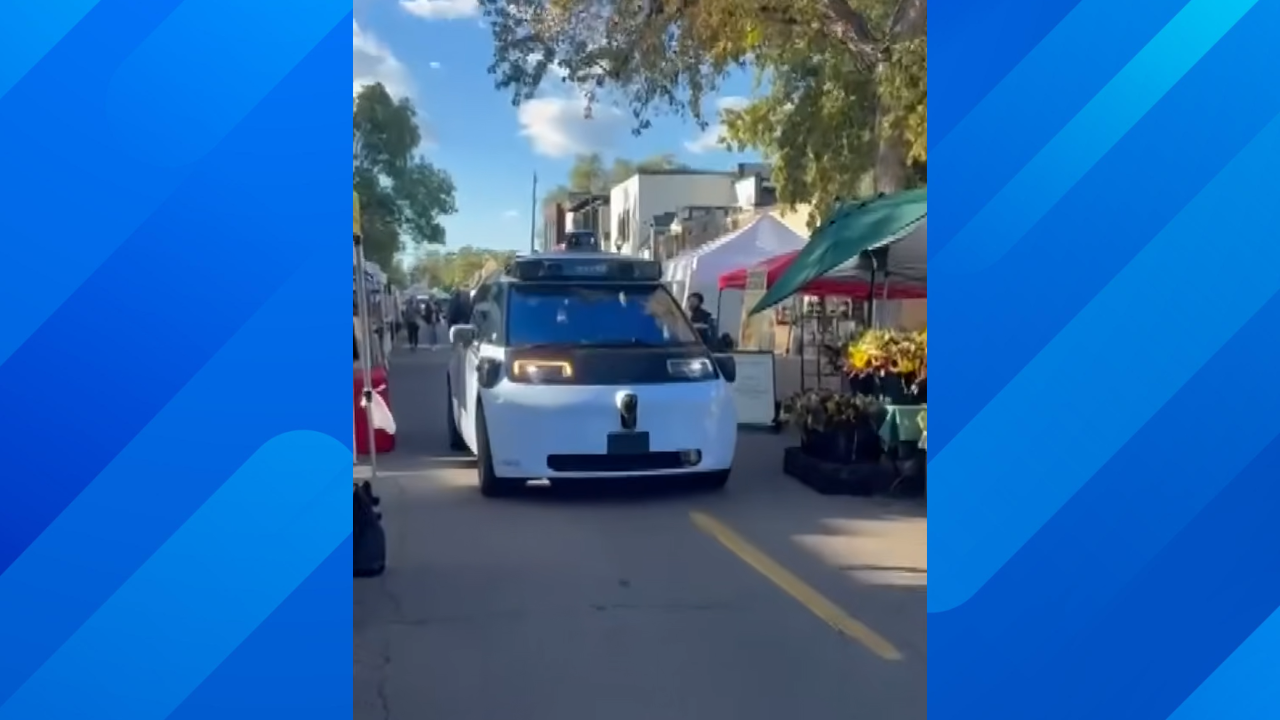
A Waymo that wandered into a Denver farmers market over the weekend did more than send vendors scrambling around a car with nobody behind the wheel. It also gave police a problem Colorado law does not appear equipped to solve.
The autonomous vehicle entered the South Pearl Street Farmers Market during setup on Sunday morning, Sept. 20, passing barricades and continuing through an area filled with vendors. Market workers eventually helped guide it back toward the street. Nobody was injured.
But when 9NEWS followed up with Denver police and the Colorado State Patrol, both agencies told the station there is currently no mechanism for issuing a traffic citation when the vehicle has no human driver.
That creates an odd split. Colorado law expressly permits automated driving systems, but it also requires that those systems be capable of complying with the state and federal laws that apply to the driving functions they perform.
The state figured out how to let the robot drive. Nearly a decade later, it still has not created the equivalent of handing the robot a ticket.
Nobody To Cite
Embedded media follows; please allow a moment to load.
The problem became visible after the Waymo entered the market shortly before it opened.
Assistant market manager Shari Wilkins told 9NEWS that people began reacting as the vehicle came through. Theodore Subbotin, a market manager for Hearth Denver, said workers then faced the unusual task of trying to usher out a car that had nobody inside to listen to them.
The episode was relatively uneventful in the end. The vehicle traveled slowly, and no injuries or damage were reported.
The legal question survived after the car left.
“If there’s no driver, there currently isn’t a mechanism within state law for issuing a citation,” a Denver Police Department spokesperson told 9NEWS.
Colorado State Patrol gave the station a similar answer and said, to its knowledge, its troopers had not yet contacted a Waymo vehicle.
Built For People
Colorado opened the door to vehicles like Waymo with Senate Bill 17-213, which became law in 2017.
The resulting Colorado statute allows a person to use an automated driving system when it is capable of complying with all applicable state and federal laws governing the driving function it performs.
It also makes an important distinction: provisions that inherently regulate a human driver generally do not apply to an automated driving system. Laws governing the physical driving of the vehicle still do.
Another section of Colorado law prevents state agencies and local governments from setting different operating standards for automated driving systems than those applied to human drivers.
Taken together, the framework answers whether autonomous systems can legally operate and what rules their driving must follow. What it does not create is a special enforcement process for the moment a fully driverless vehicle allegedly violates one of those rules.
That omission mattered a lot less in 2017 than it does now. Waymo began welcoming public riders in Denver on Sept. 1, putting fully autonomous rides on city streets just weeks before the farmers market incident.
California Wrote One
Colorado does not have to invent the concept from scratch.
California lawmakers approved a specific procedure for this problem through AB 1777. Under California Vehicle Code Section 38752, a peace officer who observes an alleged traffic violation involving an autonomous vehicle can issue a “notice of autonomous vehicle noncompliance.”
The notice records the alleged violation, time, location, and vehicle license plate. The manufacturer must then provide the notice to the California Department of Motor Vehicles.
The system became operational July 1, 2026, under new DMV regulations.
It is not simply a conventional traffic ticket addressed to a computer. California instead created an administrative trail tied to the company operating the autonomous vehicle.
That distinction matters because traffic enforcement has traditionally assumed that somebody is behind the wheel. The National Highway Traffic Safety Administration still describes traffic law enactment and enforcement as primarily a state responsibility, while the federal agency handles vehicle safety standards, defects, and recalls.
A New Roadblock
The Denver incident also arrived as federal regulators are wrestling with a related problem: how vehicles without human drivers interact with the people responsible for controlling roads.
In July, NHTSA warned autonomous-vehicle developers about what it called a pattern of driverless vehicles interfering with police and other first responders.
California’s new rules require additional communication capabilities for driverless vehicles, including ways for first responders to reach a remote human operator.
Colorado’s 2017 framework predates most of that real-world experience.
Waymo told 9NEWS that it is “dedicated to learning from this situation” as it continues improving road safety in the cities where it operates.
The South Pearl Street Farmers Market, meanwhile, is scheduled to return Sunday. Its 2026 season runs through Nov. 8.
Waymo vehicles are still driving in Denver, too.