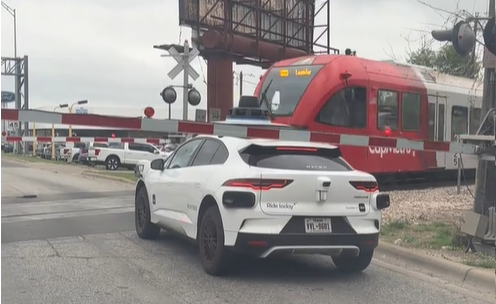
A viral video circulating online this week is fueling debate about autonomous vehicles after appearing to show a Waymo robotaxi stopped unusually close to a railroad crossing in Austin, Texas. The clip has spread widely across social media, with many viewers questioning what exactly happened in the moment captured on camera.
The video also arrives just days after another widely shared Waymo moment in Austin. Last week, footage appeared to show a Waymo robotaxi blocking first responders during an emergency scene, adding to the growing online scrutiny of how autonomous vehicles behave in unpredictable situations.
The short video shows the autonomous Jaguar I-Pace positioned beyond a lowered railroad crossing arm while a train passes through the intersection directly in front of the vehicle. Although the train does not strike the car, the visual of a driverless vehicle sitting past the crossing gate proved unsettling to many viewers.
According to KVUE’s report, Waymo said the vehicle stopped just over 8 feet from the tracks once the railroad crossing lights activated. The company told reporters that its “initial analysis indicates the vehicle behaved safely in this unique scenario.”
Waymo said the vehicle came to a controlled stop as conditions at the intersection changed while the car was approaching the crossing. The company also noted that the vehicle remained outside the train’s path despite stopping beyond the crossing arm.
While the company emphasized that the vehicle maintained a safe distance from the tracks, the moment quickly gained traction online. The image of a robotaxi sitting past a lowered crossing gate struck many viewers as exactly the kind of situation people worry about when they imagine edge cases for self-driving cars.
A Video That Spread Quickly Online
@trissykay Thank goodness nobody was in this Waymo
#waymo
♬ som original – 4BEAT47
As the clip circulated across platforms like Reddit, reactions came quickly and covered a wide range of opinions. Some commenters treated the video with humor, while others said the moment reinforced their concerns about autonomous vehicles.
Many of the first reactions focused on what the experience might feel like for someone inside the vehicle. Even though Waymo confirmed there were no passengers in the car at the time, viewers still imagined how tense the moment could have felt.
“I wonder how the passenger sitting inside must have felt,” one commenter wrote in a discussion thread about the video. Another user replied bluntly that they would have exited the vehicle if they had been sitting inside.
Some commenters immediately jumped to worst-case scenarios. Others said the situation looked far more dangerous than it actually was once the details became clearer.
“This would be such a terrible way to go out,” one user joked after watching the clip. Another commenter wrote that even if the car technically stopped safely, the moment would still shake their confidence in the system.
“Even if it stopped far enough away, I’d not trust it anymore to not panic and start moving in the wrong moment,” one commenter wrote. Reactions like that illustrate how quickly unusual moments involving autonomous vehicles can influence public perception.
Others Pointed Out the Vehicle Appears to Stop
Not everyone interpreted the clip as a failure of the system. Some commenters noted that the video appears to show the vehicle recognizing the approaching train and remaining stopped.
“This is bad, but it seems like Waymo is aware of the situation and isn’t going to proceed forward,” one commenter wrote. Others pointed out that the train clearly passes safely in front of the vehicle, suggesting the system recognized the hazard.
A few commenters also tried to piece together what might have happened before the video began recording. One theory suggested the vehicle entered the intersection before the crossing gate lowered, but stopped once the crossing lights activated and the train approached.
Because the video begins after the vehicle is already positioned past the gate, the full sequence of events leading up to the stop remains unclear. That lack of context is one reason the clip quickly turned into a debate rather than a simple explanation.
The Bigger Challenge for Self-Driving Cars
Moments like this highlight a challenge autonomous vehicle companies continue to face as the technology expands into more cities. Even when systems technically remain safe, situations that appear unusual or confusing to human observers can quickly go viral online.
Waymo has been steadily expanding its robotaxi service in cities such as Phoenix, San Francisco, Los Angeles, and Austin. The company’s vehicles now operate millions of autonomous miles as part of its commercial ride-hailing service.
As that scale grows, occasional clips showing strange or unexpected behavior are almost inevitable. Every unusual moment captured on video becomes another flashpoint in the broader debate over whether self-driving technology is ready for widespread adoption.
Supporters of autonomous vehicles argue that these moments should be viewed in the context of the enormous number of miles driven by the systems each year. Critics, however, tend to focus on situations that appear confusing or counterintuitive compared with how a human driver might behave.
The video from Austin does not show the full sequence of events leading up to the stop. What it does show is how quickly a brief moment involving autonomous technology can ignite a much larger online conversation.
For companies like Waymo, that reaction may be just as important as the technical details of what actually happened at the crossing.