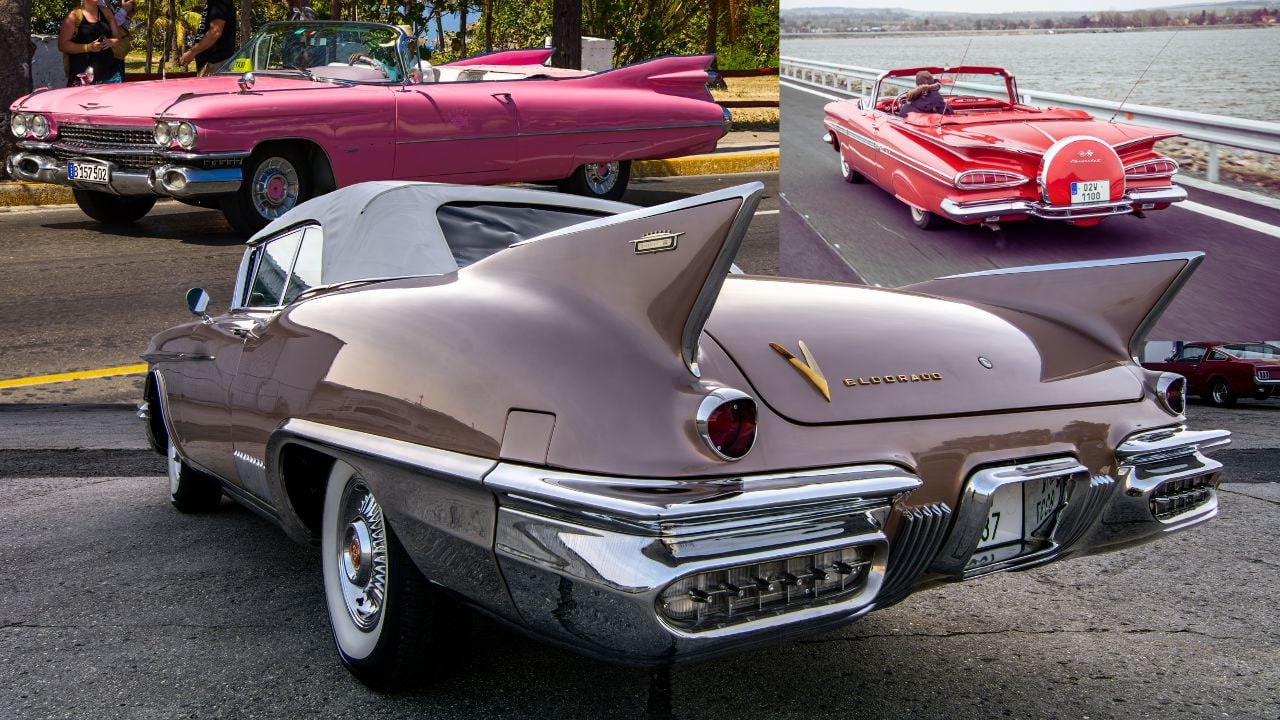
There was a time when American cars didn’t just turn heads. They made jaws drop. In the 1950s and ’60s, nothing captured that sense of motion and magic quite like a towering set of tailfins. These fins weren’t just styling cues but bold statements of progress, power, and pride.
Inspired by jets and rockets, tailfins symbolized a nation looking ahead and dreaming big. Designers like GM’s Harley Earl saw them as the future on four wheels. While the aerodynamic benefits were minimal, the impact on design, culture, and the American imagination was immense.
Today, these classic cars serve as reminders of a golden age in American automotive history, when Detroit aimed for the stars and occasionally touched them.
Methodology: What Made These Tailfin Cars Stand Out

To create this list, we focused on standout vehicles from the height of the tailfin era—models that didn’t just follow the trend, but helped define it. Here’s what we looked for:
- Tailfins That Turned Heads
These weren’t cars with subtle styling tweaks—each one proudly wore its fins as a key part of its identity and presence. - Cultural or Historical Relevance
From movie stars like Christine to engineering milestones like Pontiac’s Wide-Track stance, we favored cars that made a lasting impression beyond the showroom. - Real Performance or Luxury Credentials
Flash was necessary, but so was substance. Many of these models offered serious V8 muscle, cutting-edge features, or top-tier interior craftsmanship for their time. - True to the Era
All picks were produced between the mid-1950s and early ’60s, during the peak of America’s fascination with jet-age styling and space-race inspiration.
This list isn’t exhaustive, but it’s a celebration of the machines that captured a moment when American cars were bold, beautiful, and unafraid to dream big.
1959 Cadillac Eldorado

The 1959 Eldorado is the undisputed icon of America’s tailfin era. Its towering fins soared nearly 42 inches off the ground and stretched dramatically outward from the body, making it one of the most dramatic designs of the jet-age decade. Crafted under the direction of Cadillac design chief Chuck Jordan, the Eldorado blended flamboyance with futuristic flair, the Eldorado blended flamboyance with futuristic flair.
Its look was sealed with gleaming chrome, dual bullet-style taillights, and Cadillac’s unmistakable sense of swagger. Under the hood, a 6.4-liter V8 delivered 345 horsepower and 435 lb-ft of torque, ensuring it had the muscle to match its showmanship.
1957 Chevrolet Bel Air

Few cars scream 1950s Americana louder than the ’57 Bel Air. With its chrome-laden body, gold anodized trim, V-shaped grille emblems, and sleek tailfins, it became an icon when it hit the streets.
Chevrolet offered a range of body styles—from the 2-door sedan to the beefy Nomad Wagon—with curb weights generally ranging from about 3,200 to 3,600 pounds, depending on body style. Under the hood, top-spec models packed the advanced 4.6-liter “Super Turbo Fire” V8 with fuel injection, delivering up to 283 horsepower—a serious number for the era and a sign of the Bel Air’s sporty intentions.
1957 Ford Fairlane 500

The 1957 Fairlane 500 may not have had the tallest fins of the decade, but it brought futuristic flair to the mainstream. With jet-inspired side trim, a wide stance, and tailfins that swept upward in a clean arc, it was a massive hit for Ford—and a symbol of middle-class style.
Under the hood, buyers could choose from a range of V8s, including a 312-cubic-inch Thunderbird Special V8 producing up to 245 horsepower. The Fairlane 500 proved you didn’t need to spend Cadillac money to get a healthy dose of space-age design.
1956 Lincoln Premiere

Before Lincoln’s Continentals defined early-’60s elegance, the Premiere carried the brand’s design torch through the tailfin years. With bold rear styling, wraparound glass, and a body that looked more rocket than sedan, the Premiere helped bridge the gap between classic ‘50s flash and modern luxury.
These enormous cars were loaded with features for their time, including push-button lubrication systems, 368-cubic-inch V8s with up to 300 horsepower, and lavish interiors. The Premiere was a stylish heavyweight that provided an early glimpse of the design style Lincoln would employ in its later models.
1959 Mercury Park Lane

Mercury was often the forgotten middle child between Ford and Lincoln, but in 1959, it made a loud statement with the Park Lane. Riding on an extended 126-inch wheelbase, the Park Lane combined graceful tailfins with sweeping side sculpting and signature “rocket pod” taillights.
It wasn’t just about looks. The Park Lane was available with Mercury’s 430-cubic-inch Super Marauder V8, delivering up to 400 horsepower in triple-carb form, making it one of the most powerful luxury cruisers of the day.
1959 Dodge Custom Royal Lancer

Few cars captured the wild energy of late-’50s design better than the 1959 Dodge Custom Royal Lancer. With tailfins that shot skyward, bold two-tone paint, and jet-inspired detailing throughout, the Lancer looked like it was moving even when parked.
Available with a 361- or 383-cubic-inch V8 and up to 320 horsepower, it wasn’t just style over substance. Inside, it offered luxury touches like swivel seats and push-button gear selectors. It’s one of the flashiest Dodges ever built and a favorite among fin-era fans.
1958 Plymouth Fury

The 1958 Plymouth Fury earned pop culture immortality as the sinister star of Christine, the Stephen King novel adapted into the John Carpenter horror classic. Its bold, menacing design made it the perfect candidate to play a car possessed by something far from friendly.
Styling came courtesy of Chrysler’s “Forward Look” design language, crafted by legendary designer Virgil Exner. With its sweeping lines, low-slung stance, wraparound windshield, and sharply angled tailfins, the Fury seemed to belong more on a launchpad than a driveway. Gold-anodized trim and matching wheel covers completed the space-age flair that made this finned Mopar a standout—even before it came to life on the big screen.
1957 Chrysler 300C

The 1957 Chrysler 300C wasn’t just stylish—it was a brute in a tuxedo. With gracefully sculpted tailfins and a menacing 6.4-liter Hemi V8 under the hood, this limited-production coupe was both a design statement and a performance legend.
Packing 375 horsepower and 420 lb-ft of torque, the 300C was among the most potent cars of its day. Another one of Exner’s brilliant creations was indeed the ’57 300C. This “Forward Look” gas guzzler decorated the American tarmac, blending elegance with futuristic flair. Available as a hardtop or convertible, the 300C wasn’t just fast—it looked every bit the part.
1959 Chevrolet Impala

The 1959 Impala was a rolling spectacle of late-’50s design excess—in the best possible way. With dramatic “batwing” tailfins, cat-eye taillights, dual rear antennas, and gleaming chrome from bumper to bumper, it was impossible to mistake it for anything else on the road.
Inside, it offered a stylish, roomy cabin with two-tone upholstery and wide bench seats. Under the hood, the top-tier 5.7-liter Special Turbo-Thrust V8 delivered 315 horsepower and 356 lb-ft of torque—enough to move this cruiser with surprising authority. Buyers could choose from various body styles, including 2-door hardtops, 4-door sedans, and sleek convertibles.
1959 Dodge Coronet

The 1959 Dodge Coronet embraced the tailfin craze with gusto, wearing a pair of exaggerated fins and dual taillights that could’ve doubled as rocket boosters. It was another standout from Virgil Exner’s “Forward Look” design era—complete with sweeping lines, a bold front grille, and plenty of space-age swagger.
Power came from a lineup of V8 engines, including the 5.9-liter Super Red Ram and the high-performance 6.3-liter D-500, pushing out 320 horsepower and 425 lb-ft of torque. The Coronet also offered ahead-of-its-time features like Chrysler’s push-button TorqueFlite automatic transmission and a padded dashboard, making it as innovative as it was flashy.
1958 Buick Limited

No late-’50s Buick felt complete without a set of towering tailfins, and the 1958 Limited delivered them with flair. With an elongated body draped in chrome, dramatic rear fins, and signature taillights, the Limited was Buick’s answer to the era’s appetite for luxury and spectacle.
Its massive front grille and lavish detailing made it hard to miss, even among other flamboyant cruisers of the time. While not quite as potent as Chrysler’s Hemi-powered monsters, the Limited still packed a respectable punch with its 6.0-liter V8 producing 300 horsepower. Paired with Buick’s advanced “Flight Pitch Dynaflow” transmission, it offered smooth, effortless cruising worthy of its upscale image.
1960 Ford Thunderbird

The 1960 Thunderbird may not have had the tallest tailfins of the era, but it oozed cool in a more refined, grown-up way. Lower, wider, and sleeker than its predecessors, it shifted toward personal luxury without abandoning its jet-age roots.
Up front, the Thunderbird sported a distinctive grille and dual headlights, while the rear featured subtle tailfins and wide, horizontally oriented taillights. Under the hood, buyers had a choice between a 5.8-liter V8 with 300 horsepower or a burly 7.0-liter V8 that delivered 350 hp and a stump-pulling 490 lb-ft of torque. It was a powerful cruiser with just the right amount of attitude.
1957 DeSoto Adventurer

The 1957 DeSoto Adventurer was a bold, high-performance standout from a brand nearing its twilight. Produced from 1956 to 1960 in limited numbers, the Adventurer was DeSoto’s halo car—a luxury muscle machine wrapped in dramatic tailfins and golden trim.
As part of Chrysler Corporation, DeSoto aimed to bridge the gap between Plymouth and Chrysler, offering upscale features with distinctive flair. The Adventurer’s swan song in 1960 coincided with the brand’s discontinuation the following year, making it a rare collector’s gem and a striking reminder of DeSoto’s ambitious final chapter.
1959 Pontiac Bonneville

The 1959 Bonneville was Pontiac’s answer to the era’s demand for bold style and big performance. Offered as a coupe, sedan, convertible, or station wagon, it blended luxury with flair and wore a sweeping tailfin that perfectly matched its wide, confident stance.
This car introduced Pontiac’s “Wide-Track” design, which extended the distance between the wheels to improve handling and road presence. It wasn’t just a marketing gimmick—the result was a car that looked planted and drove better than its peers. Power came from a 6.4-liter V8 producing 300 horsepower, backed by a dual exhaust system and a suspension tuned for a surprisingly composed ride.
1959 Lincoln Continental Mark IV

A car as massive as the 1959 Lincoln Continental Mark IV needed tailfins to match—and it delivered with style and stature to spare. This luxury land yacht was known for its cavernous interior, lavish materials like leather and wood trim, and the kind of ride comfort only a car of its size could provide.
At the time, the Mark IV boasted cutting-edge features including power windows, air conditioning, power seats, and even a state-of-the-art AM radio, making it one of the most tech-laden cars of the decade. Under the hood, Lincoln’s 7.0-liter MEL V8 churned out 350 horsepower and a torque-rich 490 lb-ft, effortlessly propelling this heavyweight with smooth authority.
1957 Imperial Crown

As the flagship of Chrysler’s luxury division, the 1957 Imperial Crown exuded prestige from every angle. It announced its presence with authority and elegance with bold tailfins, distinctive “gun sight” taillights, and a massive grille flanked by quad headlights.
Under the hood, a 6.4-liter Hemi V8 delivered 325 horsepower and 430 lb-ft of torque—plenty to move this opulent cruiser in effortless style. Inside, the Crown offered a first-class experience, with rich leather upholstery, real wood accents, and thick carpeting, making it feel more like a rolling lounge than a car. It was Chrysler’s answer to Cadillac, which made that answer loud and clear.
1961 Cadillac Series 62

The 1961 Cadillac Series 62 marked the tail end—literally—of the flamboyant fin era. While still unmistakably a Cadillac, it traded towering fins for sleeker, more restrained styling, signaling a shift toward the refined luxury look that would define the decade ahead.
With a wider grille, lower stance, and smoother lines, the Series 62 reflected the industry’s pivot from rocket-inspired flash to elegant sophistication. Available in coupe, sedan, and convertible forms, it was powered by Cadillac’s 6.4-liter V8, which produced 325 horsepower and 430 lb-ft of torque—proof that even as the fins shrank, the performance didn’t.
When Tailfins Meant the Future

Tailfins may be long gone from today’s showrooms, but for many, they still represent the golden age of American car design. These bold, beautiful machines captured a moment when creativity ruled, and the sky wasn’t the limit—it was the inspiration.
In an era shaped by space dreams, booming industry, and national pride, fins were more than chrome and metal. They were optimism in motion. Even now, decades later, they continue to stir the soul and spark memories, just like a good car always should.