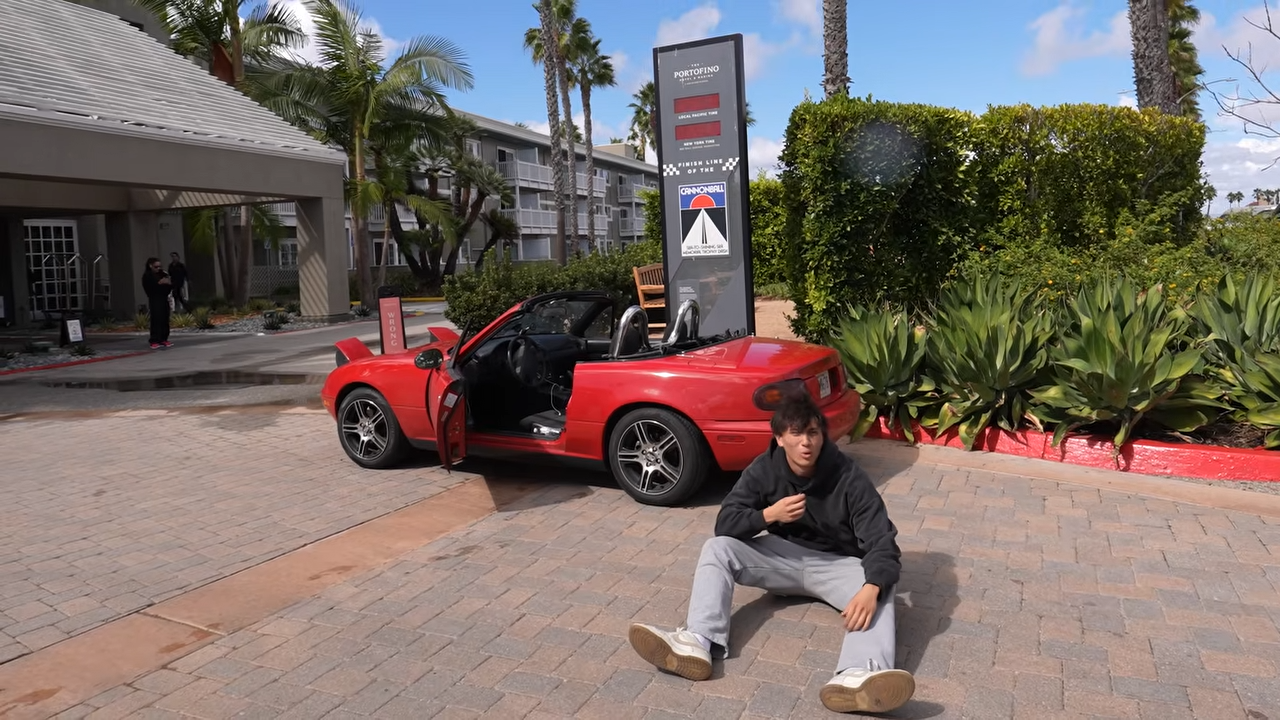
A $9,000 Mazda Miata might not seem like the best car for a cross-country speed run. That didn’t stop YouTuber Doug Vargo from trying to drive one from New York City to California in less than 38 hours and 29 minutes.
With his friend Jared sharing the driving, Vargo set out in a 1996 Miata that was nearly stock when he bought it. Their goal was to beat a time set by another Miata team in 2024.
The two friends faced nearly 2,800 miles of highway, with little room for luggage or sleep. They also had to deal with traffic, fuel stops, and whatever weather came their way.
In a video published November 14, Vargo showed how their trip unfolded. The Miata made it across the country, although the final time wasn’t quite what he had planned.
A Smaller Challenge
Embedded media follows; please allow a moment to load.
The Cannonball Run is an unofficial challenge to drive from Manhattan’s Red Ball Garage to the Portofino Hotel in Redondo Beach, California, as quickly as possible. Some teams have spent heavily on powerful cars, extra fuel tanks, and equipment to help them avoid delays.
Vargo wasn’t trying to beat the overall time of 25 hours and 39 minutes cited in his video. Instead, he wanted to improve on a Miata run completed by Jonathan Blakemore and Jason Awalt in March 2024.
According to a post from that team, their 1999 Miata covered 2,814 miles in 38 hours and 29 minutes. Vargo called his own attempt Project 3828, aiming to finish at least one minute faster.
His 1996 car received fresh oil, spark plugs, brake work, and coilovers before leaving. There was no large fuel tank or major engine upgrade. To save time, the pair planned quick stops and took turns sleeping in the passenger seat.
Across the Country
Their timer started at 12:27 a.m. in Manhattan. After getting through New York City, they made good progress through New Jersey, but traffic near Columbus, Ohio, put them about 30 minutes behind their target.
The team recovered much of that time as the roads cleared. They divided up duties at gas stations, with one person filling the tank while the other bought food or used the restroom. Some stops took only three minutes.
By the time they entered Texas, the pair were just 15 minutes behind their planned arrival there. But Vargo was struggling with the long overnight drive. He described feeling lonely on Interstate 40 while Jared slept beside him.
Eventually, Vargo pulled over and let Jared take the wheel. Their pace improved through New Mexico, where Vargo reported an average speed of 82 mph.
Heavy rain and lightning in Arizona changed their plans. At one point, they slowed to around 40 mph as the storm continued through the night. The delay cost them roughly an hour, leaving little time to recover before reaching California.
Fifty-Five Minutes Short
Despite making up time on the final stretch, the Miata reached the Portofino Hotel with 39 hours and 24 minutes on the clock. Vargo reported covering 2,762 miles, finishing 55 minutes slower than the 2024 Miata team.
While discussing the result, he noticed something about the two cars. The earlier team had used a 1999 Miata, which belongs to the second generation. His 1996 model was a first-generation car with pop-up headlights.
Vargo then claimed he had set the fastest time for a first-generation Miata. That more specific record has not been independently confirmed, but the distinction gave him something to celebrate after missing his original target.
The car also survived the trip without a reported mechanical breakdown. Vargo later announced plans to give away the Miata rather than sell it as part of his ongoing car-flipping project.
He said the return trip would be covered in another video, leaving the next chapter of the nearly 30-year-old Mazda’s journey for a future upload.