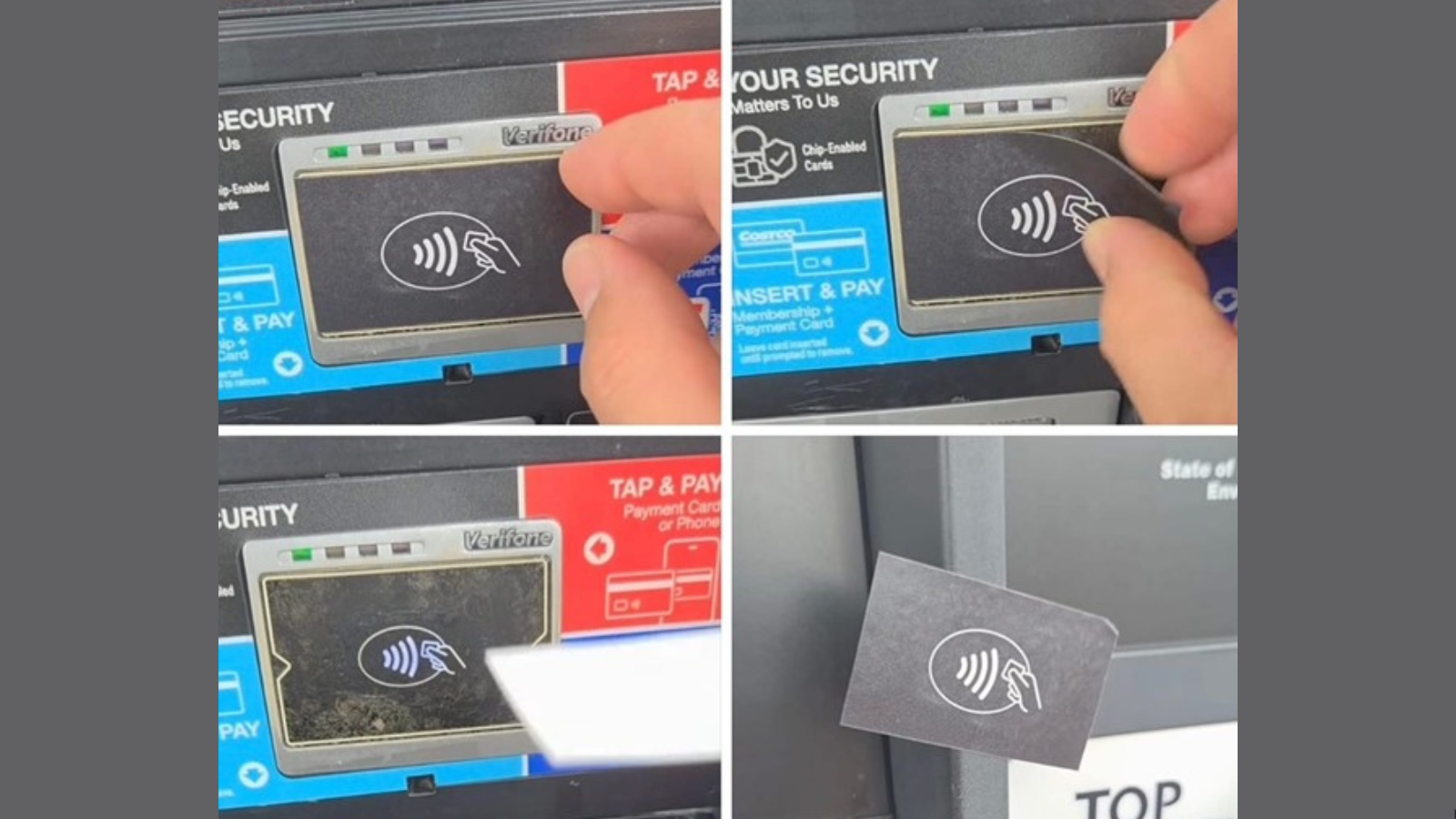
A viral warning circulating on Facebook, TikTok, and other social media platforms claims that criminals are placing fake tap-to-pay stickers on gas pumps to steal credit card information from unsuspecting drivers.
The claim generated headlines during the summer of 2025 and was investigated by multiple media outlets, law enforcement agencies, and financial crime investigators. Despite those efforts, the videos continue to circulate online and are still being shared by well-meaning users who believe they are warning others about a new scam.
In fact, one of the videos recently popped back up in my own Facebook feed after being shared by a family member, a reminder that viral misinformation often has a much longer shelf life than the corrections that follow.
The videos often show someone peeling a sticker off a payment terminal, then warn viewers that the decal itself is a sophisticated scam device. Others claim the stickers are being used to block contactless payments, forcing drivers to insert their cards into skimmers hidden inside the pump.
The claims sound alarming, especially as card skimming remains a very real problem at gas stations across the country. The problem is that financial crime investigators, law enforcement agencies, and at least one major gas station chain have all pushed back on the claims.
Instead, experts say many of the viral videos are causing drivers to worry about the wrong threat.
Viral Videos Claim Gas Pump Stickers Are Part of a Scam
The videos generally follow a similar formula.
A person approaches a gas pump, points out a tap-to-pay sticker covering the original contactless payment symbol, peels it away, and warns viewers that scammers installed it to capture payment information.
Some versions of the claim go a step further. Rather than alleging the sticker itself steals card data, they claim criminals intentionally cover tap-to-pay readers so customers cannot use contactless payments and are forced to insert or swipe their cards through a compromised reader.
On the surface, the theory sounds plausible. Criminals have become increasingly sophisticated, and gas station skimmers remain a major concern for drivers. When people see something attached to a payment terminal that appears out of place, it is easy to assume something suspicious is happening.
That assumption, however, is where investigators say the story starts to fall apart.
Financial Crime Investigators Say the Stickers Are Not a Known Scam
In July 2025, the Texas Financial Crimes Intelligence Center (FCIC), a specialized unit that investigates financial crimes, including credit card skimming operations, issued a public warning urging drivers not to fall for social media claims about tap-to-pay stickers.
According to the FCIC, there have been no legitimate reported instances of tap-to-pay stickers being used to steal payment information.
The agency said the decals shown in viral social media posts appeared to be standard industry stickers commonly used to replace worn, faded, or difficult-to-see tap-to-pay logos on payment terminals.
“While we all need to stay vigilant as criminals become more savvy, there are no legitimate instances reported where ‘tap-to-pay stickers’ have been used to steal data,” FCIC Intelligence Operations Captain Jeff Roberts said in the agency’s news release.
The FCIC added that if a driver encounters a sticker or device that appears to interfere with the operation of a tap-to-pay terminal, it should be reported to the gas station immediately.
Quiktrip Says the Stickers Were Installed by Employees
The issue gained additional attention after social media users began posting videos showing tap-to-pay stickers at QuikTrip gas stations.
Atlanta News First investigated the claims after receiving reports from concerned customers who believed the stickers were evidence of a scam.
According to the station’s reporting, QuikTrip confirmed that employees had installed the decals as replacement logos on payment terminals and that the stickers did not pose a fraud risk. State regulators similarly told the station that viral claims surrounding the stickers were false.
The station further reported that QuikTrip stores conduct routine inspections of their pumps and payment systems and employ security measures to detect unauthorized access.
In other words, the stickers generating panic online were reportedly placed there by the company itself.
If Tap-To-pay Is Not Working, Don’t Automatically Swipe Your Card
While investigators say the stickers themselves are not a known fraud device, some security experts would agree with one part of the viral warnings.
If a tap-to-pay reader appears damaged, blocked, or simply is not working properly, drivers should not ignore it.
Instead, report the issue to the gas station and consider using another pump or paying at the counter.
That’s because traditional skimmers typically target magnetic stripe transactions. When a card is inserted or swiped, a skimmer can capture information stored on the card’s magnetic stripe. Tap-to-pay transactions work differently.
According to both financial crime investigators and law enforcement agencies that have addressed the viral claims, contactless payments use encrypted transaction data and tokenization technology rather than transmitting card information as magnetic stripe transactions do.
Tap-to-pay remains one of the safest payment methods available at fuel pumps, particularly when paired with a payment app.
The takeaway is fairly simple. If a contactless payment reader appears blocked or isn’t functioning properly, don’t assume everything is fine and immediately insert your card. Report the problem, try another pump, or pay inside instead.
The Real Fraud Threat Hasn’t Changed
Part of the reason these videos continue gaining traction is that they look convincing.
A person peeling an unfamiliar sticker off a payment terminal makes it appear that something suspicious has been discovered. Viewers see a hidden decal, hear a warning about criminals, and often share the video before investigating whether the claim is true.
Unfortunately, social media rewards content that sparks strong reactions, and few things generate engagement faster than warnings about criminals stealing money.
Ironically, some of the videos may even discourage people from using one of the safest payment methods available. While drivers should absolutely remain vigilant for signs of tampering, most experts recommend using tap-to-pay whenever possible rather than swiping a magnetic stripe card.
In this case, the agencies that investigate payment fraud for a living reached a far less dramatic conclusion.
Rather than uncovering a sophisticated new scam, investigators found what appear to be ordinary replacement decals covering worn tap-to-pay logos. Meanwhile, the real threat remains the same one drivers have been dealing with for years: traditional card skimmers targeting magnetic stripe transactions.
For drivers looking to protect themselves, the advice remains straightforward. Use tap-to-pay whenever possible, monitor your accounts for suspicious transactions, inspect pumps for signs of tampering, and report anything that appears unusual. Despite what some viral social media posts claim, the safest option at the pump is often the one those videos are warning people not to use.