
Architecture tells the story of a city, its history, culture, and vision for the future. For those of us who find beauty in towering skyscrapers, ancient temples, or innovative designs, traveling becomes more than just sightseeing. It’s about immersing ourselves in the artistry and craftsmanship that shape the world around us.
From ancient Roman amphitheaters that still echo with history to futuristic skylines that seem to defy gravity, these 15 cities represent the pinnacle of architectural achievement across millennia. Buildings represent different periods and can even define the character of a city. Barcelona, for example, instantly brings to mind the whimsical designs of Antoni Gaudí, while Miami is synonymous with its vibrant Art Deco district.
1. Paris, France

Paris remains the global capital of architectural beauty, offering an unmatched journey through architectural history. Paris combines historical grandeur with innovative modern structures. Iconic landmarks like the Gothic Notre-Dame Cathedral and the modern Louvre Pyramid exhibit contrasting styles within a single city. The Eiffel Tower, an engineering marvel, epitomizes 19th-century ingenuity, while contemporary buildings like La Défense’s Grande Arche highlight Paris’s bold design evolution.
Art Nouveau builds dot the city like the Grand Palais and the Palais Garnier, Gothic architecture is evident in Notre-Dame Cathedral, Renaissance styles like the Louvre are found all over, and newer additions of Contemporary architecture can be found in the Centre Pompidou and the Foundation Louis Vuitton. The Haussmannian buildings with their uniform façades and ironwork balconies define the quintessential Parisian streetscape that has influenced urban planning worldwide.
2. Rome, Italy:

Rome is a timeless stage for grandeur and innovation. Rome captivates with unmatched historical significance and iconic architecture. Structures like the Colosseum and the Pantheon tell stories of ancient Rome, while Renaissance highlights include St. Peter’s Basilica and the Sistine Chapel.
Rome is like a layered cake filled with different layers of history and architecture. It has no equals, which makes it a must-see destination for anyone interested in architecture and history. From the marvels of Roman engineering like the Pantheon and the Colosseum to the Baroque fountains and Renaissance palaces, there is something here for everyone. The city represents over 2,000 years of continuous architectural evolution.
3. Barcelona, Spain

Barcelona vibrates with Gaudí’s dreamlike visions. Barcelona prominently features Antoni Gaudí’s revolutionary designs. The Sagrada Familia, Park Güell, and Casa Batlló infuse the cityscape with organic forms and colorful mosaics. Beyond Gaudí, Gothic structures in the Barri Gòtic and contemporary works like Torres Glòries display Barcelona’s architectural diversity.
It is the canvas for the Catalan architect Antoni Gaudí, who has crafted captivating structures throughout the city. The bizarre, Casa Batlló, the Basilica of the Sagrada Familia, and the sloped, mosaic-covered Park Güell are a testament to Gaudí’s excellence in architecture. The unfinished Sagrada Familia continues to redefine architecture with its grand facades and biomimicry principles.
4. Florence, Italy

As the birthplace of the Renaissance, Florence is a city that oozes beauty and art. It’s a beautiful city with a unique charm. Here, you can admire the Renaissance architecture that made the city what it is today, and you can’t help but walk away feeling awed.
Widely credited as the birthplace of the Renaissance, Florence has many elegant cathedrals, palaces, and museums to see. From the breathtaking Florence Cathedral (Duomo), Palazzo Vecchio, Uffizi Gallery, Strozzi Palace, Ponte Vecchio, and The Brancacci Chapel, Florence is the perfect destination for architectural marvels. The powerful Medici family’s patronage created an architectural legacy that continues to inspire visitors centuries later.
5. Tokyo, Japan

Tokyo is a laboratory of futuristic forms and traditions. In stark contrast with its spectacular contemporary buildings of glass and steel, are Tokyo’s traditional wooden buildings with sliding doors (fusuma and shoji), and graceful rooflines, a testament to the city’s ability to preserve tradition while embracing modernism. The city’s iconic landmarks include the Tokyo Skytree, the Tokyo Tower, and the Meiji Shrine.
Tokyo is a head rush of metropolitanism and modernism; glitz and glam, which is no better reflected than in its architecture – a lively mix of neon and concrete. You need only look at the Metropolitan Government Office to get a sense of the futuristic design aesthetic that dominates.
6. Chicago, USA
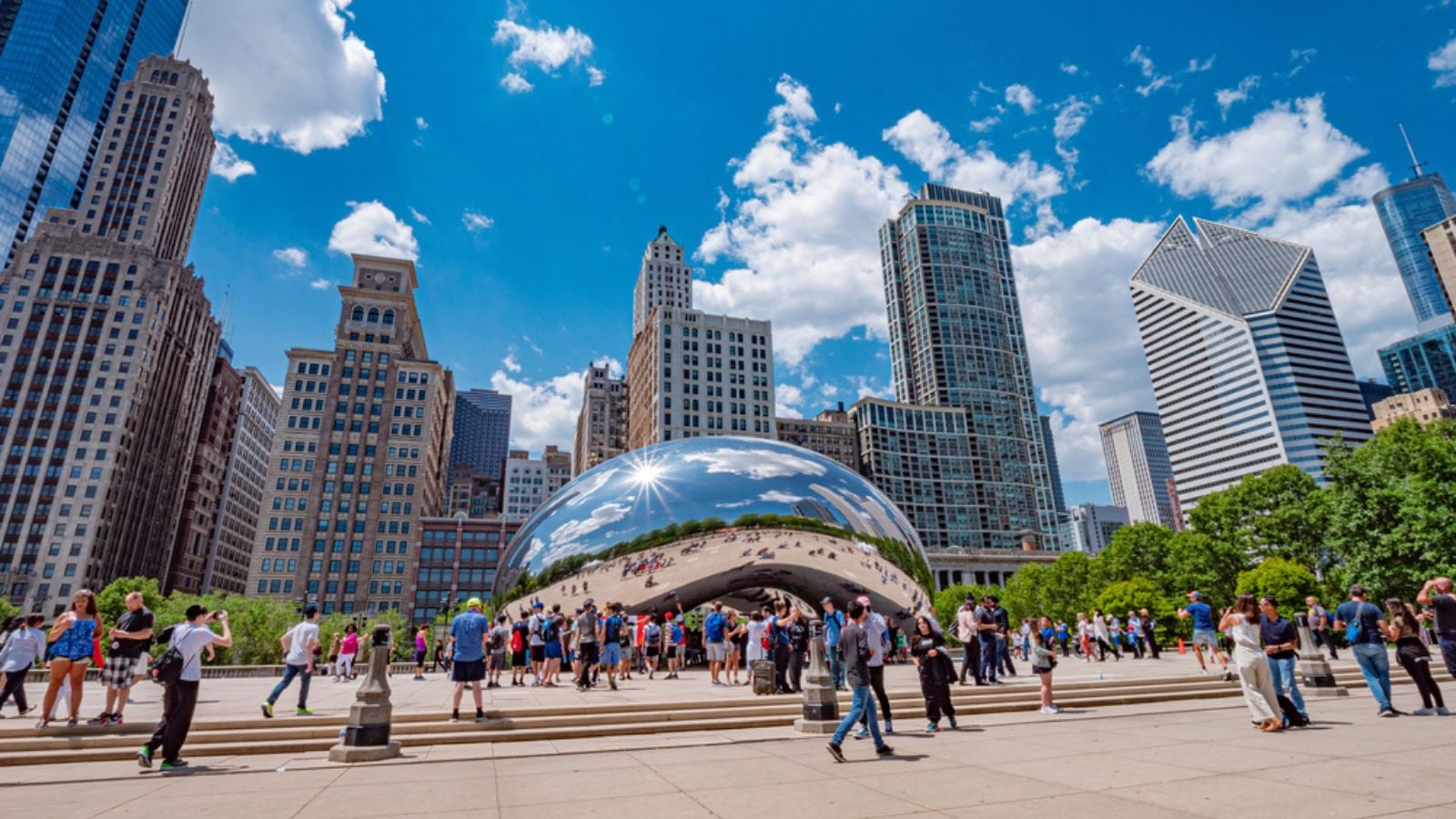
Chicago pioneered modern skyscraper design. The Willis Tower and John Hancock Center showcase its vertical innovation, while Frank Lloyd Wright’s Prairie School introduces thoughtful residential architecture. The city’s urban planning masterpiece, Millennium Park, incorporates public art and modern design at its finest.
The Great Chicago Fire in 1871 destroyed most of the city’s downtown and paved the way for the construction of the world’s first skyscraper, the 10-storey Home Insurance Building. Since then, Chicago has earned a reputation for architectural experimentation with arresting high-rise creations and the work of pioneering modernists, such as Frank Lloyd Wright, littering the city.
7. Vienna, Austria

Vienna’s imperial legacy is evident in its grand palaces, opulent churches, and elegant boulevards. From the lavish Schönbrunn Palace to the majestic St. Stephen’s Cathedral and the modernist Hundertwasserhaus, Vienna’s architectural diversity reflects its rich cultural heritage.
Vienna is a treasure trove for Art Nouveau, Baroque, and contemporary architecture. Vienna is where Baroque, Gothic and Modernist architecture harmoniously coexist. As the cultural heart of Europe for decades, Vienna was built with all that Habsburg family money and evidence of that power is everywhere.
8. Dubai, UAE

Dubai redefines architectural ambition with its futuristic skyline. The Burj Khalifa, the world’s tallest building, stands alongside innovative structures like the sail-shaped Burj Al Arab and the twisting Cayan Tower.
Notable architects like Rem Koolhaas and the late Zaha Hadid have worked feverishly to define Dubai’s skyline, which includes the tallest building on the planet: the dizzying, 2,717-foot-tall Burj Khalifa. New construction is so prevalent in Dubai that reports claim the city houses between 15 and 25 percent of all the world’s cranes.
9. Venice, Italy

Venice floats like a dream of marble and mosaics. Venice may be famous for its canals but its stunning Venetian Gothic and Renaissance architecture are worth a mention. Venetian Gothic style architecture can be identified by its delicate blend of Gothic elements and Byzantine influences.
Just like Rome and Florence, Venice experienced a flourishing Renaissance period. A great start for an architecture tour is the Piazza San Marco, where the impressive Byzantine-style Basilica and the Doge’s Palace stand facing St. Mark’s Campanile. The city’s unique setting on water created architectural innovations that influenced maritime cities worldwide.
10. Istanbul, Turkey

Positioned at the terminus of the Silk Road, Istanbul has been a hub of trade, power and culture for millennia. Straddling two continents, the city is home to a kaleidoscope of styles. From Byzantine to Ottoman, the influences are apparent across the city’s many monuments, palaces and towers.
Known for its Ottoman architecture, with its intricate designs and colorful tiles, Istanbul’s architectural highlights include the Hagia Sophia, the Blue Mosque, and the Topkapi Palace. The city represents one of the world’s most successful fusions of diverse architectural traditions.
11. St. Petersburg, Russia

St. Petersburg’s grandeur shines in palaces, canals, and onion domes. The architectural history of St. Petersburg is one of the most abundant and fascinating to learn more about. The city’s hallmark Baroque and Neoclassical styles are colorful, eclectic, and bold.
The late Baroque, Rococo style became a favorite among the female rulers in St. Petersburg, and the city’s architecture reflects both European Baroque and Neoclassical styles. The opulent Winter Palace, Saint Isaac’s Cathedral, Yelagin Palace, the Imperial Academy of Arts, and Mikhailovsky Palace are all exceptional examples of this mixture of styles.
12. London, England

London’s skyline tells the story of centuries of power and progress. London is huge and like many European cities it’s been through centuries of history. The architecture throughout this enormous city is extremely varied, and you can admire plenty of new styles at every corner.
London, the capital of England, boasts of landmarks such as the Big Ben and Westminster Abbey, which showcase the evolution of architectural styles over the centuries. From Tudor and Georgian to Victorian and ultra-modern, London represents nearly every major architectural movement in Western history.
13. Prague, Czech Republic

With its fairy-tale skyline dominated by Prague Castle and the spires of St. Vitus Cathedral, Prague is a city straight out of a storybook. The Charles Bridge, Astronomical Clock, and colorful baroque buildings of the Old Town create an enchanting atmosphere that transports visitors back in time.
Prague’s remarkably preserved medieval center showcases Gothic architecture at its finest, while Baroque additions create a harmonious blend of architectural periods that few cities can match.
14. Singapore

Known as “Garden City,” Singapore places priority on sustainability. Gardens by the Bay, a nature park and energy-efficient conservatory, is undoubtedly one of the highlights. It includes striking domed greenhouses and 18 Supertrees.
Cutting-edge architects have created an ultra-modern cityscape in Singapore, whose skyline is instantly recognisable. The city’s commitment to green architecture and sustainable design makes it a model for future urban development.
15. Athens, Greece

Athens is the foundation of Western architectural heritage. When in Athens, you’re not just exploring a city; you’re stepping into a time machine. As the home to one of history’s most prominent empires, Athens offers nothing more than alluring.
Much of Greek architecture represents the people who built it. Monuments to the gods, commemorations of victorious battles, and egotistical representations of important leaders are all mainstays of the unique building styles of the Ionic, Doric, and Corinthian architectural styles. The Parthenon and other Acropolis monuments established principles that continue to influence architecture today.