
Steel met sunlight in ways that stirred something deep, and roads stretched out like runways built for noise. Rivalries grew in the heat rising from the pavement, and the Mustang always arrived with its name written in smoke. Introduced on April 17, 1964 (as a 1965 model-year car), the Mustang created the pony-car segment, affordable, stylish, and sporty cars that looked fast even when parked. What followed was a parade of challengers, each hoping to knock the galloping horse from its throne.
Let’s take a closer look at the cars that are often compared to the Mustang (whether they deserve it or not) and what makes them winners or losers when the lights turn green.
How Rivalries Were Chosen

Stories guided the selections, not just specs or sales numbers. These cars represent the most significant challenges to pony car supremacy, each emerging during distinct periods of automotive evolution.
Names that echoed across decades earned their place through cultural impact and sales success; these weren’t just pretty faces, they were cars that forced the Mustang to get better or get left behind.
Real quick: The winners are just my opinion. Sometimes it’s just fun to have results, you know? In reality, all of these cars are worthy of admiration for one reason or another. They may not be Mustangs, but they have the fighting spirit and power to make their own mark.
Camaro vs. Mustang

Long stretches of American pavement echoed with the growl of two unmistakable names, as the Camaro arrived three years late to the party but brought fresh RS/SS styling and a wider stance that made Mustangs look almost dainty by comparison. General Motors had watched Ford hit one million Mustangs within about two years of launch and decided enough was enough.
The numbers tell the tale: while Mustang pioneered the segment with over 20,000 orders on the first day, Camaro struck back with 220,917 units in its debut year. People admired profiles that hugged the road with Coke-bottle curves, and every model year brought new weapons, Z/28 track packages, SS big-blocks, and enough stripe combinations to make a NASCAR pit crew jealous. Camaro pushed visual drama through deeply recessed grilles and hidden headlights, while Mustang answered with fastback elegance and that unmistakable galloping horse badge.
The rivalry reached a fever pitch during the Trans Am racing series, where both cars battled for supremacy on road courses nationwide. Mark Donohue’s Camaro and Parnelli Jones’ Mustang became household names, their wins translating directly to Monday morning sales.
Winner: Mustang takes the crown for continuous production since 1964, while Camaro has had multiple dormancy/hiatus periods (notably after 2002, returning for 2010) and cultural icon status, though Camaro deserves credit for keeping the horse honest when it got a little too comfortable.
Challenger vs. Mustang

Big-block era styling filled garage doors with personality as the Challenger stepped into the spotlight five years after the Mustang party started, arriving with upright shoulders and a wide-mouth grille that could swallow small imports whole. Chrysler’s philosophy was simple: if you can’t be first, be loudest.
Built on the same E-body platform as the Plymouth ‘Cuda, the Challenger offered something Mustang couldn’t match, pure, unapologetic size. At 191.3 inches long, it was noticeably larger than most contemporary Mustangs while packing engines the original pony car could only dream about. The 426 Hemi and 440 Six Pack made Mustang’s 428 Cobra Jet look like a warm-up act, though Ford owners quietly reminded everyone that gas mileage mattered too (sometimes).
The Challenger’s party ended abruptly in 1974 when insurance companies and gas crises killed the fun, leaving the Mustang to carry the pony car torch alone for decades. When the Challenger returned in 2008, it came back swinging with retro styling so accurate it made the Mustang’s retro attempt look like a rough draft.
Winner: The Challenger wins the looks contest and the straight-line drama award, but the Mustang claims victory through simple survival and consistent evolution.
Firebird vs. Mustang

The Trans Am styling lit up roads with screaming chicken decals and functional hood scoops, while the Firebird packed twin-nostril air intakes and rising fender lines that made every parking lot entrance feel like a movie scene. Pontiac took the Camaro’s bones and dressed them in pure theatrical flair, creating something that was equal parts race car and rock concert.
The Firebird formula worked because Pontiac understood something Ford sometimes forgot: drama sells. While the Mustang played it relatively conservative, Firebird owners got shaker hoods that moved with the engine, WS6 handling packages that could embarrass European sports cars, and enough cosmetic options to make each car feel custom-built. The Trans Am became Burt Reynolds’ co-star in “Smokey and the Bandit,” selling more tickets than most Hollywood actors.
Pontiac’s engineering prowess showed up on the stopwatch. In period testing, high-performance Firebirds were capable of high-13 to low-14-second quarter-mile times right off the showroom floor, while many contemporary Mustangs needed serious modifications to keep pace. The available WS6 handling package transformed the Firebird into a genuine road-course threat, proving it could do far more than just shine in a straight line.
Winner: The Firebird takes the style points and the “most likely to get pulled over” award, but the Mustang wins the longevity contest, Pontiac folded while the horse kept galloping.
Javelin vs. Mustang

AMC brought the Javelin into view with flair and angular stance that proved small companies could still throw haymakers in Detroit’s heavyweight division. With a wheelbase nearly identical to the Mustang’s, the Javelin matched the formula while adding distinctly different sheet metal that looked like it was carved by someone who actually understood wind tunnels.
The Javelin’s secret weapon wasn’t just looks, it was AMC’s willingness to try harder than the big boys. While Ford built hundreds of thousands of Mustangs, AMC hand-picked its best for racing, creating the AMX two-seater, a closely related performance model that could embarrass Corvettes at road courses nationwide. Trans Am racing saw the Javelin piloted by Mark Donohue (before he switched to Camaro) and Roger Penske’s team, proving that cubic dollars mattered less than cubic inches when applied correctly.
AMC’s pricing strategy was brilliant: undercut the Mustang by hundreds of dollars while offering similar performance and arguably better build quality. The 390 AMX could hit 60 mph in 6.6 seconds, matching the Mustang 428’s times while costing significantly less. Interior appointments often exceeded Ford’s efforts, with better materials and more thoughtful ergonomics.
Winner: The Javelin wins the underdog award and the “best value” trophy, but the Mustang’s production numbers and dealer network meant AMC was always playing catch-up in a game where volume mattered.
Cougar XR-7 vs. Mustang GT

Mercury gave the Cougar XR-7 long hoods and vertical grille bars that whispered luxury while the Mustang GT sat nearby flexing its performance credentials like a younger brother trying too hard at Thanksgiving dinner. This wasn’t just a rivalry, it was family dysfunction with V8 soundtracks.
Ford’s strategy seemed almost comical: take the Mustang platform, stretch the wheelbase by about three inches, add 200 pounds, premium interior materials, and sequential taillights, then ask customers to pay $400 more for the privilege. Somehow, it worked. The Cougar carved out its own niche as the gentleman’s pony car, offering radar-measuring sequential taillights and hidden headlights that made the Mustang look almost pedestrian.
The XR-7 variant pushed luxury even further with leather-appointed interiors, woodgrain accents, and analog clocks that actually worked most of the time. European Grand Touring influence showed in details like the center console design and gauge cluster layout, making Cougar feel more sophisticated than its platform-mate.
Racing success came through different channels: the Cougar earned notoriety in Trans-Am (Bud Moore campaigned Cougars in 1967), and the Cougar nameplate later appeared in NASCAR during its larger-bodied years.
Winner: The Mustang wins through sheer stubbornness and broader appeal, though the Cougar deserves credit for proving that sometimes a more civilized approach works better than pure aggression.
Torino Cobra vs. Mustang Boss 429
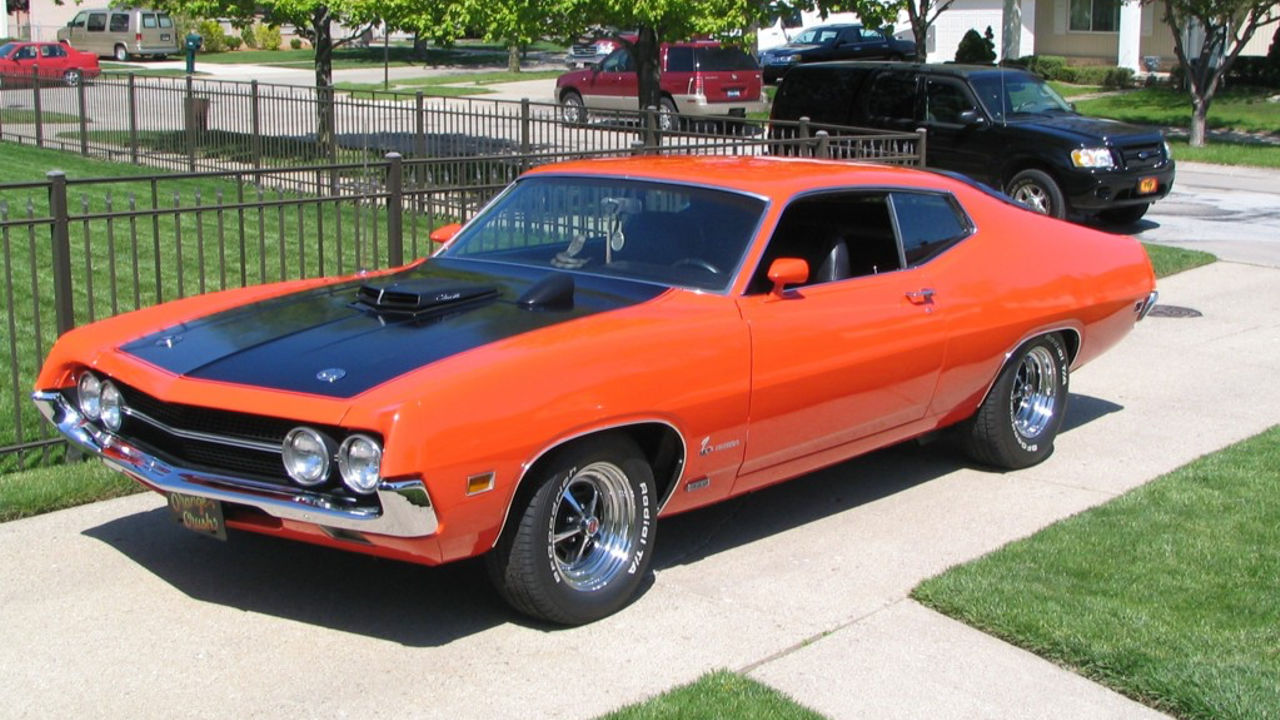
Ford created its own civil war when the Torino Cobra roared into driveways with NASCAR-bred aerodynamics and enough sheet metal to panel a small aircraft, while the Mustang Boss 429 tried to stuff the biggest engine possible into the smallest acceptable package. This was like watching two heavyweight boxers from the same gym try to knock each other senseless.
The Torino Cobra made no apologies for its size, at 206.2 inches long and weighing roughly 3,900–4,100+ pounds, depending on body style and options, it was built for NASCAR superspeedways where aerodynamics mattered more than parking lot maneuverability. The standard 429 Cobra Jet produced 370 hp, while the Boss 429 crammed a different, NASCAR-homologation 429 with hemi-style heads into a car 200 pounds lighter and 19 inches shorter.
Numbers revealed the contradiction: The Torino Cobra could hit 105 mph in the quarter-mile but needed a football field to stop, while the Boss 429 launched harder but topped out lower due to aerodynamic limitations. Track testing showed the Torino’s superiority on high-speed ovals, while the Boss dominated road courses and drag strips.
The marketplace delivered the verdict quickly, only 1,359 Boss 429s were built over two years, while the Torino Cobra sold in much higher numbers to customers who preferred their performance with more comfort and trunk space.
Winner: The Torino Cobra wins the practical performance award, but the Boss 429 claims legendary status and collector car immortality, sometimes losing feels like winning 30 years later.
Celica GT vs. Mustang II

The gas crisis rewrote the rules and humbled the mighty, as the Celica GT arrived from Japan with fastback curves that looked purposeful while the Mustang II followed through with compact dimensions that made longtime fans wonder if Ford had forgotten how to spell “performance.” The 1970s taught everyone that being a pony car meant more than just looking like one.
When insurance companies declared war on horsepower and OPEC held America’s fuel supply hostage, both cars faced the same challenge: maintain sporting pretensions while actually getting reasonable gas mileage. Toyota’s approach was methodical: build a lightweight coupe with precise handling and reliable four-cylinder power. Ford’s strategy seemed more desperate: shrink the Mustang down to Pinto proportions and hope nobody noticed the performance had disappeared entirely.
The numbers told a sobering story. The Celica GT’s 2.2-liter four-cylinder made 96 horsepower and could return mid-to-high-20s mpg on the highway in favorable conditions, while the Mustang II’s optional 302 V8 was rated at roughly 122–139 horsepower, depending on year, and drank fuel like a thirsty linebacker. Toyota’s rear-wheel-drive platform delivered genuine sports-car handling, while Ford’s modified Pinto-based architecture felt better suited to grocery runs than canyon carving.
Road tests revealed the fundamental difference in philosophy: The Celica rewarded drivers with precise steering, balanced weight distribution, and build quality that bordered on Germanic, while the Mustang II offered familiar V8 rumble in a package that had forgotten why people loved the original. Car and Driver’s comparison was brutal, they praised the Toyota’s “honest competence” while lamenting Ford’s “cynical badge engineering.”
The marketplace delivered its verdict in the end. Celica sales climbed steadily while the Mustang II became the pony car everyone tried to forget. Toyota had studied what made sports coupes desirable and delivered exactly that, while Ford seemed to have studied only their accountant’s recommendations.
Winner: The Celica GT takes the trophy for understanding the assignment, delivering actual sporting performance when it mattered most. The Mustang II wins only the “most likely to make fans demand a do-over” award.
RX-7 vs. Mustang SVO

Japan crashed the pony car party with rotary power and handling dynamics that made traditional V8s look like steam engines, while the Mustang SVO attempted to answer with turbo-four sophistication and suspension geometry borrowed from European road racing. This was a culture clash at 7,000 RPM.
The second-generation RX-7’s 13B was rated around 146 hp but weighed 200 pounds less than Ford’s turbo four, creating a power-to-weight ratio that embarrassed much more powerful cars. Mazda’s 50/50 weight distribution made every on-ramp feel like a racetrack, while SVO’s sophisticated independent front suspension and a solid rear axle with advanced link geometry tried to bring German road-holding to American iron.
Track testing revealed the fundamental difference: The RX-7 rewarded smooth drivers with incredible cornering speeds and engine revs that climbed like a motorcycle, while the SVO delivered traditional American torque with modern European handling. Road & Track’s comparison showed RX-7 lapping faster despite lower straight-line speeds, proving that horsepower wasn’t everything.
The turbo four vs. rotary debate split enthusiasts: Ford’s 2.3-liter produced more low-end torque and sounded more conventional, while Mazda’s rotary delivered seamless power delivery and a soundtrack that belonged in a Formula car. Reliability would eventually favor Ford, though early RX-7s were surprisingly robust.
Winner: The RX-7 takes the handling crown and the “most likely to be driven to its redline daily” award, but the SVO wins the practicality contest and parts availability championship that matters decades later.
Mustang Mayhem Continues

The Mustang’s greatest achievement wasn’t beating these rivals, it was inspiring them to exist in the first place. Every challenger forced Ford to build better pony cars, creating an arms race that gave enthusiasts some of the greatest automotive years in American history. Some battles were won by cubic inches, others by cubic dollars, but all were fought on the sacred ground of quarter-mile strips and winding back roads where legends earned their stripes.
Modern Mustangs still catch side glances from Camaros, while classic Javelins spark conversations at car shows where stories matter more than specifications.