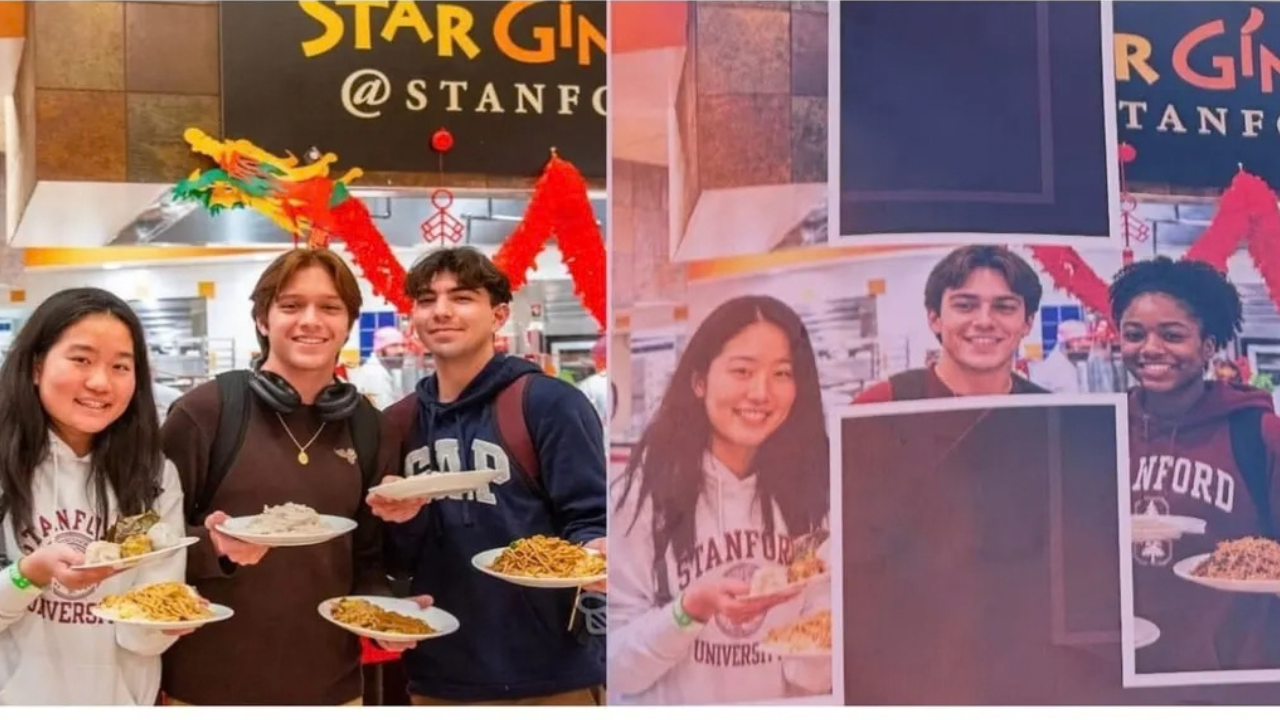
Stanford University removed promotional banners from campus after acknowledging that artificial intelligence had been used to replace a Latino male student in a real photograph with a Black woman.
The original photo showed Stanford student Billy Ramirez and two classmates holding plates of food during a 2024 Lunar New Year dinner. But when the image appeared on banners advertising Stanford dining services this fall, Ramirez was no longer in it.
In his place was a woman who had not been in the original photograph. The appearances of the other two students had also been altered, including changes that made their faces appear thinner.
Stanford later confirmed that its Residential & Dining Enterprises department had used generative AI on the image and said the alterations violated university rules.
The episode went from a student social-media discovery to national news within days, with Ramirez saying what initially struck him as absurd became more troubling once he considered what had actually been changed.
Someone Was Missing
Embedded media follows; please allow a moment to load.
Ramirez told the Stanford Review that a friend sent him a comparison of the banner and the original photograph while he was traveling back to campus.
He first laughed.
Then he realized the edits had not simply cleaned up the picture or changed its background. They had removed him entirely and replaced him with someone of a different race and gender.
“Seeing my identity changed and being left out of the picture made me feel, in a way, silenced and erased,” Ramirez told the Review.
Ramirez later told CNN that his concern was less about the person generated in his place than about having his own Latino identity removed.
He said he takes pride in being Mexican.
More Than One Edit
Ramirez was not the only person whose appearance changed.
The Stanford Daily reported that Stanford’s Residential & Dining Enterprises used AI to modify all three students in the photograph.
The two students who remained in the image were made to appear thinner, while their facial features and clothing were also altered. One student’s clothes were changed into Stanford-branded apparel.
Those students subsequently issued their own statement and said they were embarrassed by alterations to their ethnic facial features. The Daily verified that the two students pictured alongside Ramirez were behind the statement.
They have since filed a Title VI report alleging discrimination and have been communicating with Stanford Vice Provost for Undergraduate Education Jay Hamilton, according to the Daily.
The students requested anonymity amid what they described as ongoing harassment.
Stanford Responds
Stanford did not dispute that AI had been used.
University public relations director Charlene Gage told the Daily that Stanford had reviewed the matter and confirmed that the image was altered in violation of university policy.
“Both the alteration and lack of disclosure in this case violate that policy,” Gage said.
Stanford removed the banners and said it was providing additional staff training and working to ensure materials receive proper review.
That response tracks with Stanford’s published AI guidelines for marketing and communications.
The university’s guidance says communicators should not publish AI-generated material that falsely depicts Stanford people, events, research, facilities or achievements. It also requires appropriate authorization before creating realistic AI-generated depictions of identifiable people.
Stanford’s broader visual-communications guidance goes further on manipulated diversity imagery, warning against editing photographs in ways that create a misleading impression about who is actually represented.
A Different Concern
The incident also left Ramirez pushing back on the idea that Stanford needed to manufacture a more diverse photograph in the first place.
He told CNN the episode should instead prompt the university to examine actual representation on campus.
Stanford freshman Kavinder Patel made a similar point in an ABC News interview, saying the university already draws students from scores of countries.
“They have diversity and they shouldn’t need to fabricate it,” Patel said.
Ramirez, meanwhile, has found himself at the center of far more attention than he expected when a photographer took the original dining-hall picture two years ago.
After national outlets began contacting him, he told the Daily that he was exhausted by the response.
“I don’t want my legacy at Stanford to be ‘the AI guy,’” he said.