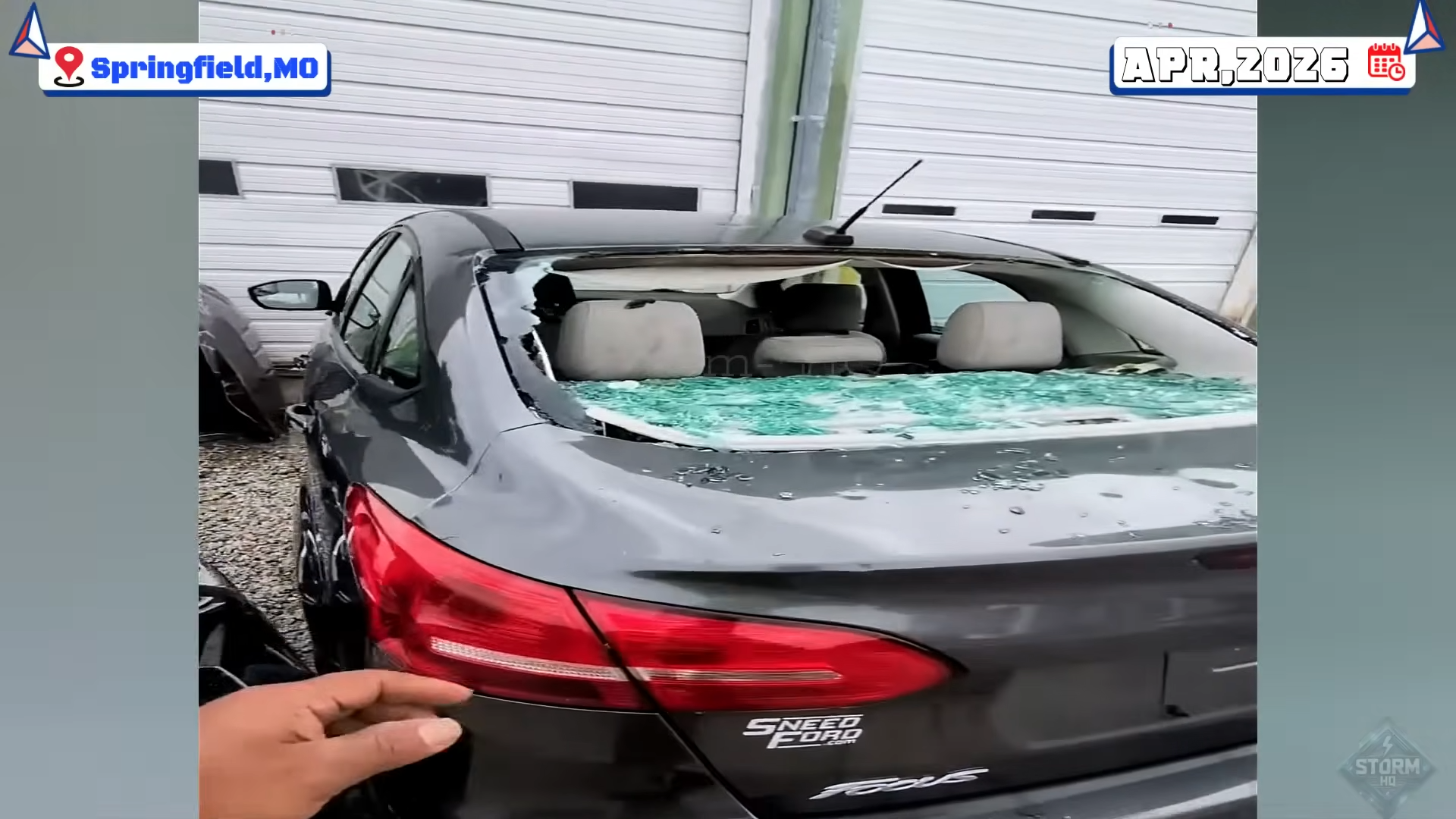
Springfield drivers woke up Wednesday to a harsh reality: their cars took a beating, and getting them fixed is going to take a lot longer than anyone wants to hear. Tuesday’s hail storm tore through the city around midday, and the damage it left behind is being described by insurance companies as nothing short of catastrophic, in the most official sense of that word.
Hammer’s Autoworks on West Chestnut Expressway became ground zero for the chaos. The shop logged more than 1,000 phone calls in the 24 hours following the storm, and that number was still climbing into Wednesday morning. The parking lot, which was already full of vehicles waiting on routine repairs, ended up looking like a windshield graveyard, with broken glass scattered across the property and cars that arrived for minor fixes now considered total losses.
What makes this situation especially rough is that the storm did not spare the shop itself. Vehicles that customers had already dropped off for unrelated work sustained major hail damage while sitting on the lot. That is not exactly the phone call anyone wants to get from their mechanic.
The sheer scale of the event has set off a chain reaction across the insurance industry, deployed specialized response teams, and left Springfield residents wondering when, exactly, they will be able to get their cars back on the road in one piece. The short answer, according to people who know this business well, is: not anytime soon.
What Made This Storm So Destructive

Tuesday’s storm was not your average springtime sprinkle. It moved through Springfield shortly before noon and brought with it some of the largest hailstones Aaron Bruton, vice president of Hammer’s Autoworks, says he has ever seen, and he has spent most of his life in the area. Between late morning and early evening, his shop alone fielded somewhere between 300 and 500 phone calls, with similar volume continuing the next day.
The combination of hail size and geographic spread is what pushed this event into a different category entirely. The storm did not just clip one neighborhood. It cut across a major metro area, which means the damage is spread across multiple counties and tens of thousands of vehicles.
Insurance Companies Are Classifying This as a Catastrophe, and That Actually Matters
When insurance companies use the word “catastrophic,” they are not just being dramatic. It is a formal designation that triggers a specific response. According to Andrea Korte, owner of AD Korte Insurance, the storm has officially been classified as a “cat loss,” which stands for catastrophic claim. That classification means damage is widespread enough across multiple counties to warrant bringing in dedicated catastrophe teams.
These are not your typical adjusters reviewing claims from a desk in another state. They are on-the-ground teams deployed directly into affected areas to speed up the claims process for local residents. State Farm has confirmed its catastrophe teams are expected to arrive in Springfield by Thursday to begin helping customers work through the backlog.
For anyone dealing with a damaged vehicle, this is actually good news. More boots on the ground means faster claim reviews and, ideally, quicker decisions on whether your car is being repaired or totaled.
Repairs Could Take Up to a Full Year
Here is the part nobody wants to hear but everybody needs to know: this is not a two-week turnaround situation. Bruton was direct about the timeline, saying shops in Springfield could realistically be processing repairs from this single storm for up to a year. That is not a typo.
When a storm hits an entire metro area at once, every shop in the region is dealing with the same surge of damaged vehicles at the same time. There are only so many technicians, so many parts, and so many bays to work in. Priority will naturally go to vehicles that are unsafe to drive, particularly those with shattered glass or structural damage.
If your car is drivable and the hail left dents but did not knock out any windows, expect to wait. Both mechanics and insurance agents are asking customers to be patient and to resist the urge to call every shop in town repeatedly, since that only adds to the phone volume everyone is already drowning in.
What You Should Do Right Now If Your Car Was Damaged
The first and most important step, according to both auto repair professionals and insurance agents in Springfield, is to file a damage claim. That gets the clock started. Without a filed claim, you are not in line for anything.
From there, document everything. Take photos of your vehicle from multiple angles before anything is moved or repaired. Note the date, time, and location where the vehicle was parked during the storm. If your car was at a repair shop when the storm hit, ask the facility for written documentation of what additional damage occurred on their property.
If you have comprehensive coverage on your policy, hail damage is typically covered under that. If you are unsure what your policy includes, call your agent directly rather than trying to sort it out through the claims portal alone.
What This Storm Can Teach Us About Being Prepared
Events like this one are a good reminder that vehicle coverage often gets overlooked until something goes sideways. Comprehensive auto insurance, which is the type that covers weather-related damage, is not automatically included with every policy. Many drivers carry only liability coverage, which would leave them paying for hail repairs entirely out of pocket.
If you live in a region that sees regular severe weather, it is worth reviewing your coverage annually. It is also worth knowing your deductible before disaster strikes, since a $1,500 deductible on a $1,800 repair estimate changes the math significantly.
Beyond insurance, having a plan for where to park during severe weather can make a real difference. Covered parking, garages, and even thick moving blankets have been known to reduce hail damage. It sounds low-tech, but so does walking out to a shattered windshield.
Springfield’s recovery from this storm is going to be a long one. The good news is that the systems designed for exactly this kind of event are being activated. The not-so-great news is that patience is not optional right now.