
A San Antonio police officer has been fired after internal records revealed a string of dangerous driving incidents that included speeds reaching 118 mph, repeated traffic violations, and failures tied to body camera procedures. The case, first reported by KSAT Investigates, has drawn fresh scrutiny to accountability within the San Antonio Police Department.
According to discipline records reviewed by KSAT, Officer Taylor C. Sanchez was indefinitely suspended twice following multiple incidents that unfolded in September 2025. Department documents state his conduct was severe enough to make his continued employment “detrimental to effective law enforcement.”
The allegations against Sanchez paint a troubling picture of a patrol officer repeatedly ignoring department policy while operating a marked police vehicle. Records show the violations were not isolated to a single mistake or one chaotic shift.
Investigators documented numerous instances in which Sanchez allegedly exceeded authorized speeds, disregarded traffic signals, and failed to properly maintain body camera evidence. The earliest suspension date tied to the incidents was issued in February 2026.
Patrol Speeds Reached Triple Digits
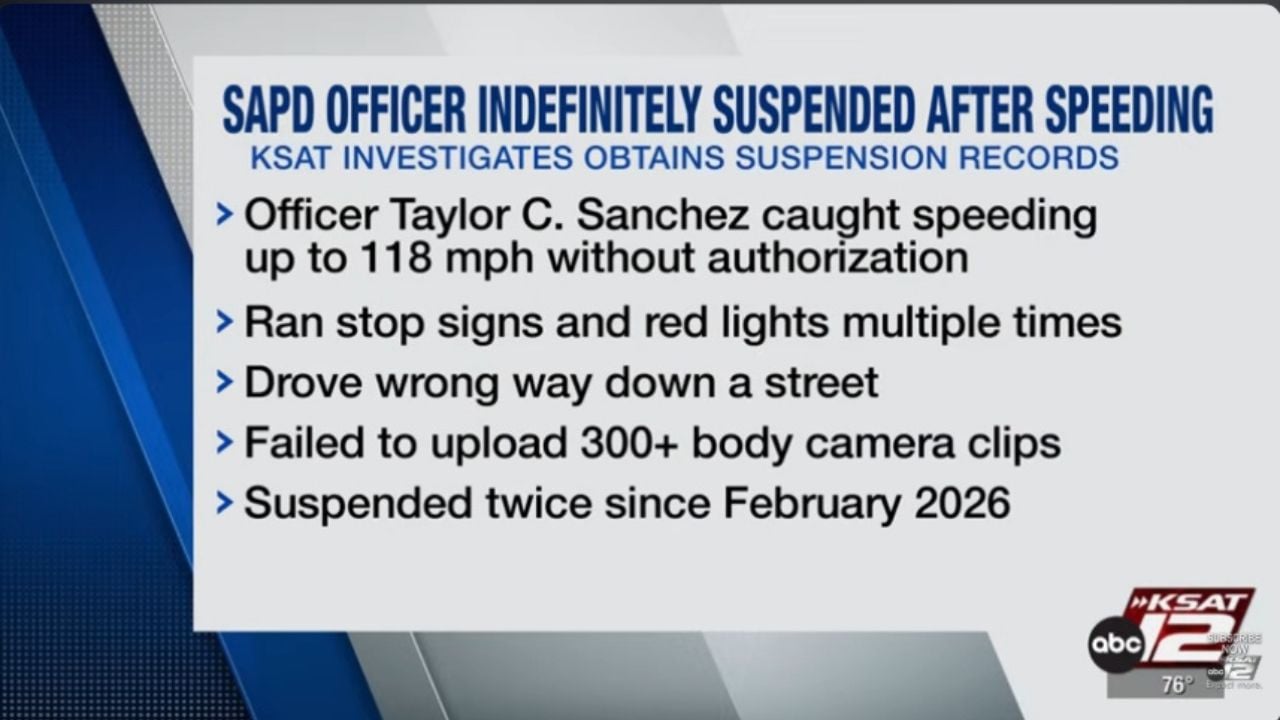
KSAT Investigates reported that Sanchez was caught driving far above the speed limit at least five times during a single shift, along with additional violations in the days afterward. Internal records state that during one response call, Sanchez drove 98 mph in a 65-mph zone despite lacking authorization to travel at that speed.
Another incident proved even more alarming. Suspension paperwork shows Sanchez exceeded 100 mph while responding to a separate call and eventually reached 118 mph in a 65-mph area.
Police agencies often allow officers to exceed posted limits under specific emergency circumstances, but such actions typically require justification and compliance with department pursuit policies. According to the records reviewed by KSAT, Sanchez was not cleared to drive at those extreme speeds.
The disciplinary files also accuse Sanchez of repeatedly disregarding basic traffic laws while on duty. Investigators documented incidents where he allegedly failed to stop at red lights and stop signs multiple times.
Records further indicate he drove the wrong way down a street during one incident. The paperwork does not suggest that a formal vehicle pursuit was underway during the violations.
Internal Investigation Built Case Against Officer
The San Antonio Police Department launched an internal review after the alleged conduct surfaced through department monitoring and investigative procedures. The resulting records outlined what officials described as repeated violations of departmental expectations for safe driving and evidence handling.
In many departments, patrol vehicle activity can be reconstructed through GPS tracking systems, vehicle telemetry data, dispatch logs, and officer reporting records. Those systems appear to have played a role in documenting Sanchez’s driving behavior.
The disciplinary findings ultimately concluded that the officer’s conduct posed a risk not only to public safety but also to the department’s credibility. Officials wrote in the suspension paperwork that Sanchez’s actions harmed effective law enforcement operations.
An indefinite suspension within Texas law enforcement effectively functions as a termination unless successfully appealed through civil service procedures or arbitration. The records reviewed by KSAT show Sanchez received two separate indefinite suspensions connected to the September 2025 incidents.
Body Camera Failures Added to Discipline
The case against Sanchez expanded beyond speeding allegations later that month when investigators discovered serious body camera compliance issues. According to department records, Sanchez failed to upload more than 300 clips from his body-worn camera across seven separate shifts.
Body camera systems are considered critical evidence tools for modern policing. Footage can be used to document arrests, preserve evidence, review officer conduct, and protect both officers and civilians during complaints or investigations.
Failure to upload recordings can create major problems for criminal cases and departmental transparency. In some jurisdictions, missing footage has led prosecutors to dismiss charges or defense attorneys to challenge police credibility in court.
The suspension paperwork reviewed by KSAT did not specify whether the missing clips affected any criminal investigations. However, the volume of unuploaded recordings appears to have intensified concerns within the department about Sanchez’s reliability and adherence to policy.
Fallout Raises Questions About Oversight
The case has sparked renewed discussion about how police departments monitor officer driving behavior and enforce accountability standards. High-speed operation of patrol vehicles remains one of the most dangerous aspects of law enforcement work, particularly in densely populated urban areas like San Antonio.
Traffic collisions involving police vehicles have become an increasing focus for departments nationwide as agencies attempt to balance emergency response demands with public safety risks. Many departments now rely on stricter pursuit rules, GPS monitoring, and automatic vehicle tracking systems to identify unsafe driving patterns.
KSAT Investigates’ report offered a rare public glimpse into the disciplinary records tied to those enforcement systems. The station’s findings revealed not just a single speeding incident, but an extended pattern of alleged violations that ultimately ended Sanchez’s career with SAPD.
For the San Antonio Police Department, the disciplinary action signals an effort to show that officers who violate policy can face severe consequences. For residents, the records raise difficult questions about how long the conduct continued before intervention occurred and whether stronger oversight could have prevented the situation from escalating.