

The United States is rapidly expanding its military footprint in the Middle East as tensions around Iran and vital global shipping routes intensify.
According to reporting from Axios, the Pentagon has ordered the deployment of thousands of Marines aboard the amphibious assault ship USS Tripoli (LHA-7), signaling a significant escalation in the region’s already volatile security environment.
Defense officials say the move will send roughly 2,200 Marines from a Marine Expeditionary Unit toward the Middle East as part of an Amphibious Ready Group.
These rapid response forces typically include several naval vessels, aircraft, and combat-ready Marines capable of conducting missions ranging from evacuations and maritime security operations to full-scale combat if required.
The USS Tripoli
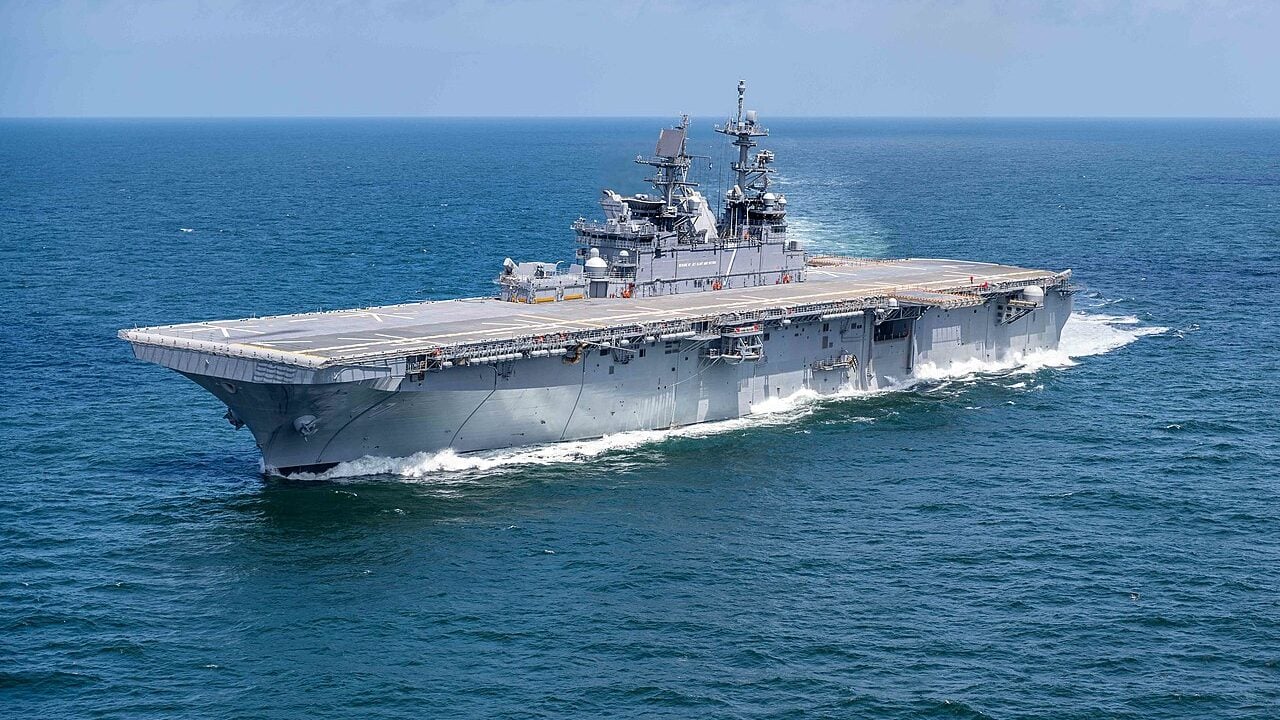
The centerpiece of the deployment is the USS Tripoli, one of the U.S. Navy’s most advanced amphibious assault ships. Commissioned in 2020 and currently forward deployed in Japan, the 844-foot warship is designed to function as a floating aviation hub capable of launching short takeoff aircraft, helicopters, and tiltrotor transports.
Ships like the Tripoli often operate with fifth-generation fighter aircraft such as the short takeoff and vertical landing F-35B, giving them capabilities similar to a light aircraft carrier. That aviation capacity allows Marine Expeditionary Units embarked on the vessel to quickly project power ashore or support operations across a wide region.
Strategic Context: The Strait of Hormuz

The deployment comes as the United States and Iran remain locked in a tense standoff around the Strait of Hormuz, one of the world’s most strategically important maritime chokepoints. A large portion of the planet’s oil shipments moves through the narrow waterway each day.
Recent disruptions and military incidents in the area have raised concerns about global energy markets and maritime security.
U.S. officials say the Marine deployment is intended to reinforce American deterrence and ensure freedom of navigation in the region. Military planners also want the added flexibility that amphibious forces provide.
Unlike traditional naval task forces that focus mainly on sea control, amphibious groups carry ground troops that can rapidly conduct raids, secure ports or infrastructure, and assist allied forces.
The Marine Expeditionary Unit joining the deployment is built for exactly that type of crisis response. These units combine infantry, aviation, logistics, and armored capabilities into a compact force designed to deploy on short notice. A typical Marine Expeditionary Unit can sustain independent operations for weeks while operating from ships at sea.
Expanding US Presence

The Tripoli and its Marines will join an already expanding U.S. military presence across the Middle East. Aircraft carriers, air defense systems, and additional naval assets have also been positioned in or near the region in recent weeks as Washington seeks to manage rising tensions and protect commercial shipping routes.
According to Axios, the decision reflects growing concern within the Pentagon that maritime instability around Iran could spiral into a broader regional confrontation if not contained.
The amphibious deployment provides American commanders with additional options without committing large numbers of ground forces to permanent bases in the region.
Military analysts say amphibious groups are particularly useful in uncertain crises because they can operate offshore while still maintaining the ability to strike, assist allies, or evacuate civilians if conditions deteriorate.
A Signal of Readiness
For now, the arrival of the USS Tripoli and its Marines is intended as a signal of readiness rather than a declaration of imminent conflict. Still, the deployment underscores how quickly global security dynamics can shift, especially in a region where shipping lanes, energy markets, and geopolitical rivalries intersect.
As Axios reports, the Pentagon’s latest move highlights the continued importance of flexible naval forces in modern military strategy, especially when events in one narrow stretch of water can ripple across the entire global economy.