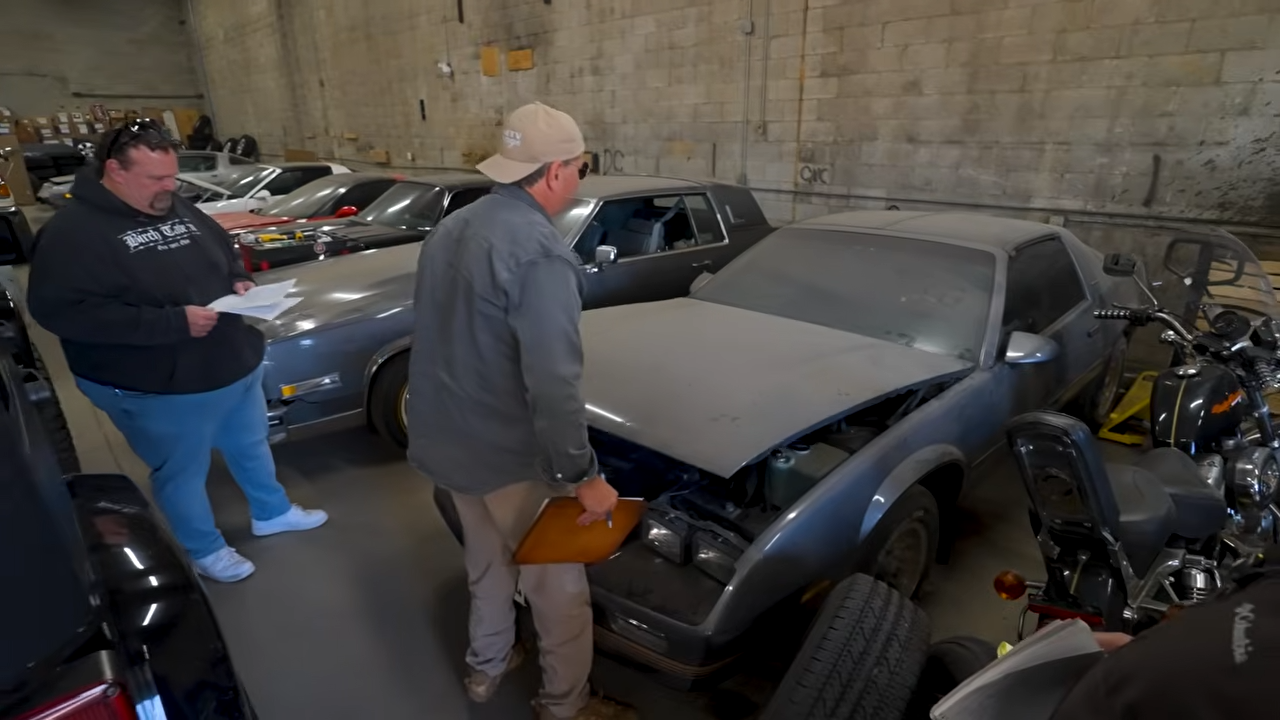
A warehouse in Columbus, Ohio, held something that could make just about any 1980s muscle car enthusiast jealous. An longtime car dealer had spent decades setting aside the interesting vehicles he encountered, building a personal collection of Pontiac Trans Ams, Chevrolet Camaros, Buick Grand Nationals, and other American performance cars.
Texas car buyer John Clay Wolfe wasn’t originally planning to visit the collection. While traveling through Virginia, he remembered a conversation with the owner from two months earlier and arranged an unexpected stop in Ohio on his way home.
The owner had spent roughly 40 years in the wholesale car business, buying and selling vehicles while keeping certain favorites for himself. Now he was considering parting with much of the collection, giving Wolfe an opportunity to buy cars that rarely appear together in one place.
What followed was a rapid series of negotiations, with prices jumping from a few thousand dollars to more than $40,000. Some cars changed hands almost immediately, while others exposed a familiar problem for collectors: knowing what a vehicle is worth doesn’t necessarily make it easy to sell.
Some Serious Negotiations
Embedded media follows; please allow a moment to load.
In the video documenting the visit, Wolfe explains that buying from another experienced wholesaler requires a different approach than shopping for a personal vehicle. Both men understand the market, and neither wants to waste time.
One early deal involved a Mercedes priced at $53,000. Wolfe accepted without much hesitation, setting the pace for the negotiations that followed.
An older Pontiac Trans Am proved more complicated. Its T-top glass had shattered while the vehicle sat in storage, and its engine compartment raised questions about its condition. Although the odometer showed fewer than 6,000 miles, Wolfe’s inspection team wasn’t entirely convinced the car looked that fresh.
The seller described its history with a family in northern Ohio and suggested original ownership documents could help establish the mileage. Wolfe still had to consider the vehicle’s condition before deciding what he could afford to pay.
A 200-Mile Camaro
One of the biggest surprises was a 1985 Chevrolet Camaro IROC-Z showing approximately 200 miles.
The seller explained that the Camaro had an unusual ownership history involving a family collection and an attorney who reportedly received the vehicle as payment. Its extraordinarily low indicated mileage immediately caught Wolfe’s attention.
The asking price eventually reached $45,000. Wolfe initially hoped to buy it for $40,000, but the negotiations moved higher.
He ultimately agreed to pay the full $45,000, admitting that he might have spent too much.
Wolfe explained that he believes interest in performance cars from this era is growing. Even so, he acknowledged the possibility of losing money on the Camaro, hoping that profits from other purchases would balance the risk.
Not Every Car Sold
Other vehicles presented a different challenge: expensive repairs.
A Buick Grand National needed paintwork, interior attention, and replacement exterior components. Wolfe estimated that preparing it for resale could consume approximately $15,000.
With the seller unwilling to accept less than $30,000, the numbers didn’t work for Wolfe. He walked away rather than gamble on a narrow profit margin.
A 2000 Ford SVT Lightning was another story. Despite paint problems, rust concerns, and body damage, the $7,500 price was tempting enough for Wolfe to make the purchase.
He also agreed to pay $18,000 for a red 1981 Camaro Z28 that needed substantial paintwork. Its unusual factory red-and-silver color combination helped persuade him, even though the repairs could cost several thousand dollars.
An even more desirable purchase was a 1989 Pontiac Turbo Trans Am, which used a turbocharged Buick-derived V6. After negotiating over its value and potential resale price, Wolfe secured it for $30,000.
Hard To Let Go
The collection wasn’t simply unsold dealership inventory. The owner had deliberately accumulated these cars because he liked them, particularly the American performance models of his younger years.
Wolfe recognized that emotional attachment as the negotiations continued. Although the seller understood wholesale pricing, deciding whether to release individual cars sometimes took considerably longer than establishing their market value.
That hesitation was especially apparent around the low-mileage IROC-Z and several Pontiac Trans Ams.
Wolfe’s broader business strategy was to purchase enough vehicles that strong resale results could compensate for weaker ones. Transport, mechanical repairs, cosmetic improvements, and auction expenses all had to be considered before making an offer.
By the end of the visit, Wolfe had assembled what he described as a full load of vehicles headed back to Texas.
He announced plans to offer the cars at a December 23, 2026, collector-car sale at Manheim Dallas, where he expected to assemble approximately 100 no-reserve vehicles. Wolfe also explained that buyers without dealer licenses would need to arrange participation through a licensed dealer.