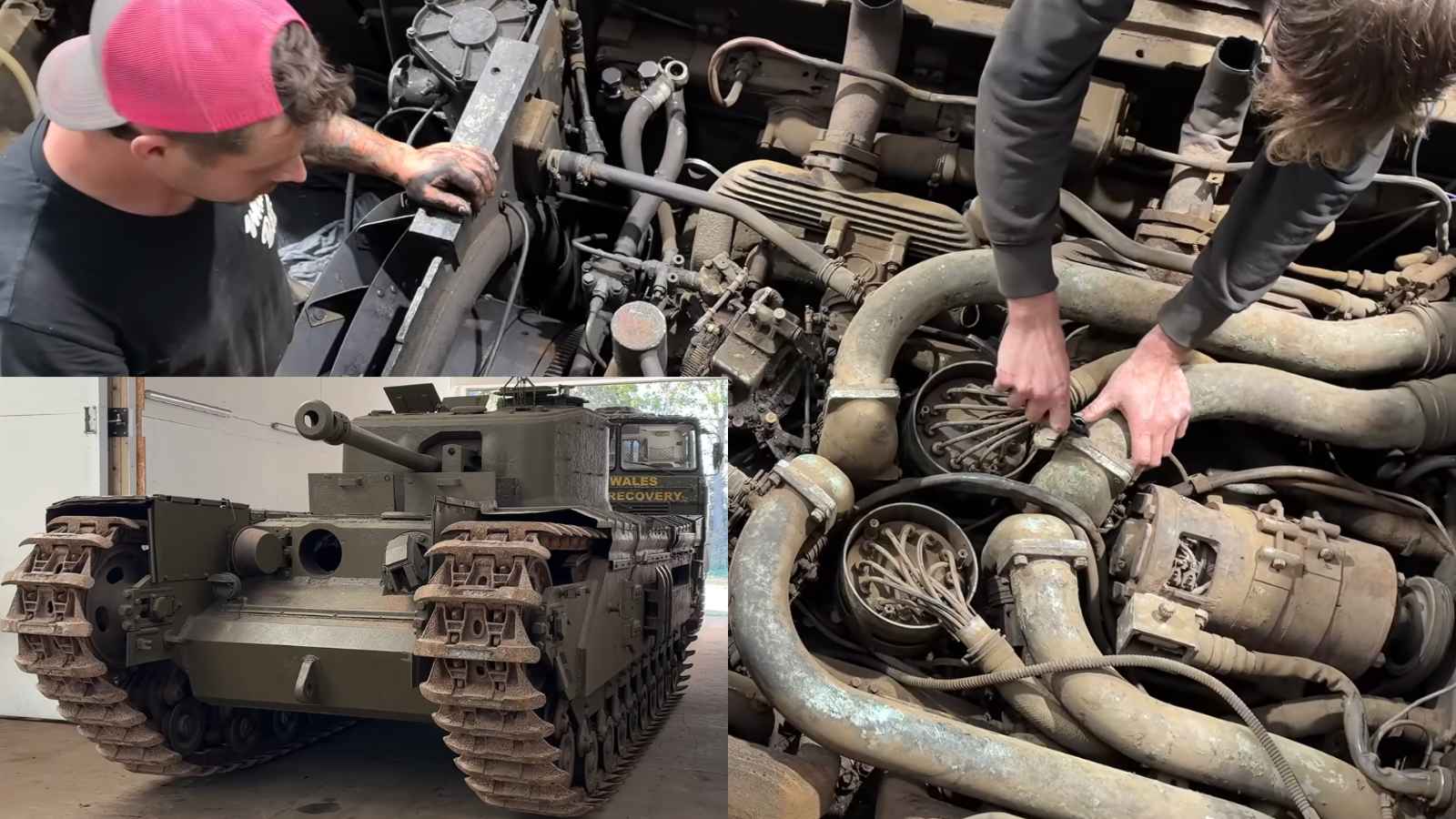
A rare World War II tank survived the scrapyard, but getting it back on the move has become a much bigger job than anyone expected. After bringing the old machine’s engine back to life, a British restoration crew discovered it could barely steer.
The tank is a Churchill Crocodile, a powerful British vehicle built to carry a flamethrower into battle. Now part of England’s Cobbaton Combat Collection, it has a long history, including years spent abandoned among other unwanted military vehicles.
YouTube mechanic Mr Hewes and his team volunteered to repair the tank free of charge for a friend. They expected an oil leak and faulty steering, but the problems ran much deeper.
By the time they finished pulling things apart, they had removed the engine, gearbox, radiators, and fuel tanks. What began as a repair had turned into a major restoration, with some surprising clues about the tank’s past.
One Big Problem
Getting an old tank’s engine running is one thing. Making sure it can move safely is another, as the crew learned after their earlier success with the Churchill.
Its massive 12-cylinder engine was leaking oil, and the steering wouldn’t work. At first, the team suspected oil was blowing onto the steering brakes, preventing them from gripping properly.
That theory sounded reasonable until they removed the gearbox and inspected the brakes. Instead of finding parts soaked in oil, they found badly worn surfaces and signs of rust.
Several small parts appeared to have seized after years of water exposure. Some brake parts were so badly glazed they could no longer do their jobs properly.
The crew planned to have the brake surfaces replaced with modern, asbestos-free material. Other parts would be cleaned and repaired before the tank could steer again.
A Scrapyard Survivor
The damage made more sense once the team considered where this Churchill had spent part of its life.
According to Mr Hewes, collector Preston Isaac rescued the tank from Pound Scrapyard around the 1950s. It had been lying partly on its side, with other tanks stacked on top.
Old photographs from the restoration reveal how far the vehicle has come. Before becoming a prized part of the collection, it was another piece of military equipment left to rust after the war.
Water appears to have collected inside the tank during those years outdoors. As the crew took it apart, they discovered rusted bolts, damaged fuel tanks, and areas that suggested water had been trapped inside for a long time.
The Churchill Crocodile itself is a remarkable survivor. According to Tank Encyclopedia, about 800 were produced. These tanks carried a 75 mm gun alongside a flamethrower system fed by a special armored trailer.
The Cobbaton Combat Collection in North Devon preserves vehicles and military equipment from several periods, with World War II forming a major part of its displays.
More Than Expected
Removing the engine finally gave the mechanics access to the oil leak. After all that work, they discovered a loose fitting on a main oil line.
It was a relatively small fault hidden in a terrible spot. With the engine installed, reaching it would have been extremely difficult.
The discovery brought some relief, but it didn’t mean the engine could go straight back in. Old hoses, worn belts, and aging wiring also needed attention.
Elsewhere, the radiators were removed for inspection, while several fuel tanks showed serious rust damage. Some looked repairable, but others would need considerable work.
Despite the growing list of repairs, the crew kept their sense of humor. At one point, they even modified a socket rather than drive several miles to find a tool that would fit.
By the end of the Mr Hewes restoration video, the engine bay was nearly empty. With the major parts removed, the team could finally clean the space and assess what could be saved.
The remaining work included repairing the steering system, inspecting the fuel tanks, and preparing the engine and other parts for reassembly.