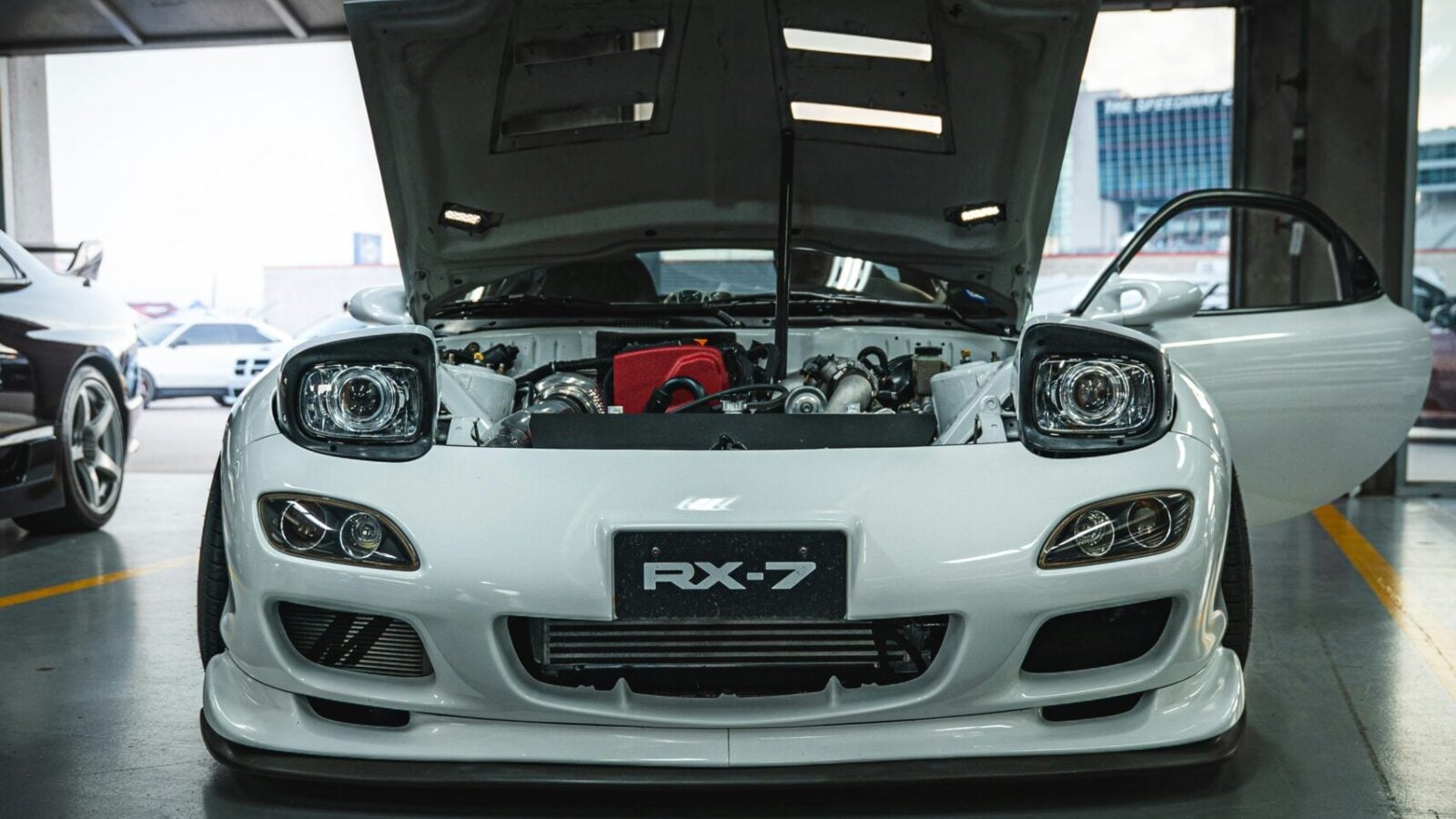
Mazda and the rotary engine have a relationship that refuses to end. Years after the RX-8 disappeared from showrooms, the automaker is still spending engineering resources figuring out how the unusual engine could survive increasingly strict emissions regulations.
A recently published U.S. patent offers another clue about that work. Mazda has devised an exhaust gas recirculation system specifically suited to a rotary engine, potentially addressing one of the technology’s longstanding weaknesses while also incorporating turbocharging.
That’s especially interesting after Mazda repeatedly teased enthusiasts with rotary-powered concepts. The Iconic SP and Vision X-Coupe have shown that the company hasn’t forgotten what made cars such as the RX-7 special.
None of this confirms another rotary sports car is headed for production. Patents frequently protect engineering ideas that never reach dealerships, but Mazda clearly hasn’t stopped trying to make the Wankel work in a modern emissions environment.
Why Modern Emissions Rules Are A Problem
Rotary engines operate very differently from conventional piston engines, and those differences have historically made emissions and fuel consumption challenging. Mazda managed those shortcomings for decades, but today’s regulations leave considerably less room for compromise.
One common emissions-control technology is exhaust gas recirculation, or EGR. It redirects a controlled quantity of exhaust gas back into the engine’s intake, helping reduce combustion temperatures and therefore the formation of nitrogen oxides.
Mazda’s previous rotary engines generally didn’t require a conventional EGR arrangement because characteristics of their design could provide a similar effect. According to the patent, however, achieving the required EGR rates with a modern rotary presents challenges that Mazda’s proposed system attempts to solve.
Mazda Wants To Split The Exhaust Flow
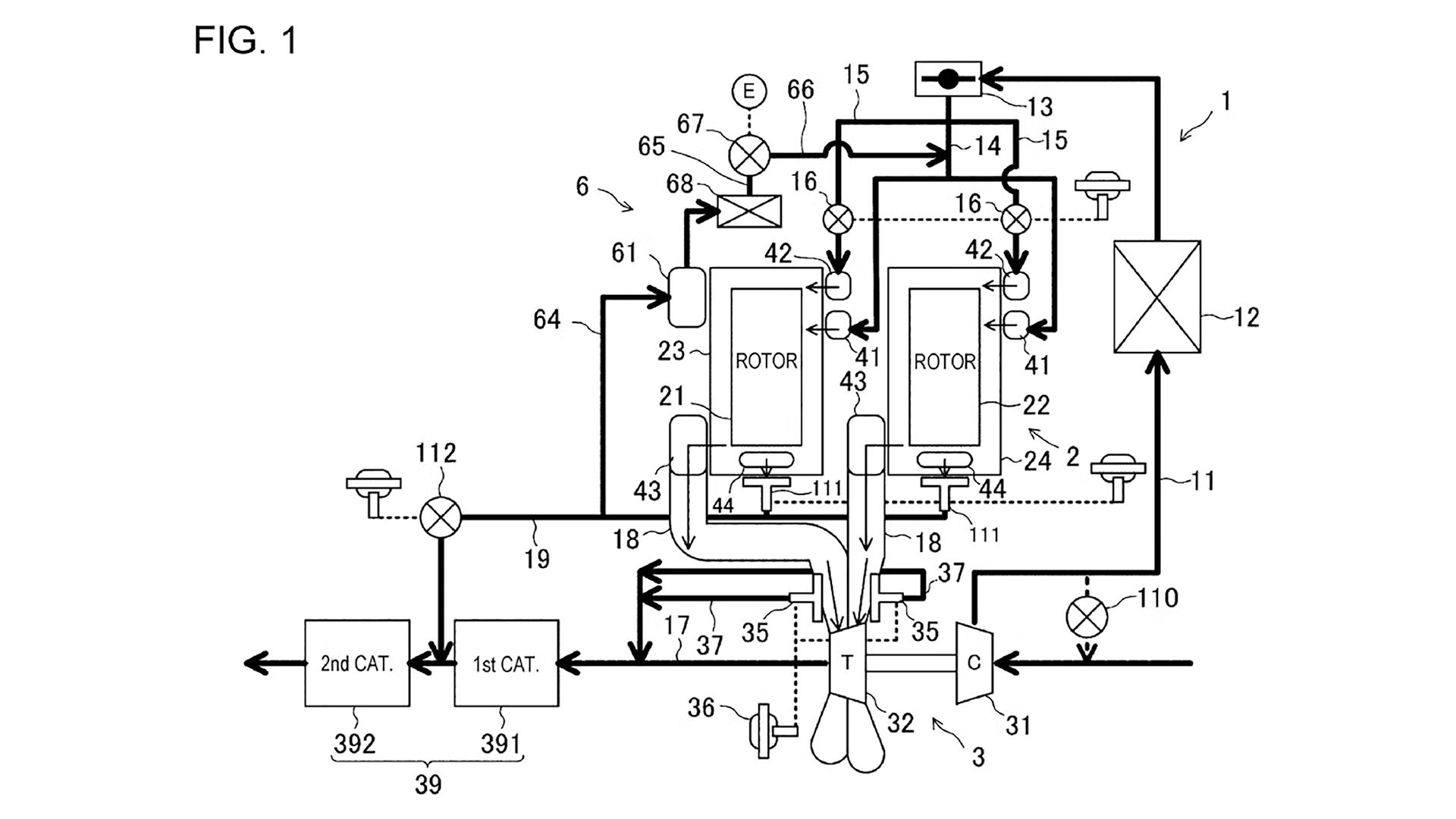
The clever part concerns how exhaust gases leave the rotary housing. Mazda’s design utilizes separate side and peripheral exhaust ports, then gives the gases coming from those ports different jobs.
The hotter, higher-volume exhaust leaving the side port would be directed toward a turbocharger. That’s the part enthusiasts will immediately notice, because the patent isn’t simply describing a low-output rotary intended solely to act as an EV range extender.
Exhaust from the peripheral port takes another route. Because those gases are cooler, Mazda proposes directing them through passages integrated into the engine before sending them through an EGR cooler connected to the engine’s cooling system.
Packaging the passages internally could eliminate some bulky external EGR plumbing. Starting with the cooler peripheral-port exhaust could also allow Mazda to use a smaller EGR cooler while still achieving the desired temperature reduction.
When EGR isn’t required, such as during higher-output operation, the patent describes routing that exhaust toward a secondary catalytic converter instead.
More Power Without Ignoring Emissions
The arrangement effectively attempts to satisfy two very different objectives. The primary exhaust flow can feed a turbocharger for additional performance, while the secondary path provides cooled exhaust gas for emissions control.
That’s significant because some of the characteristics enthusiasts love about rotary engines have always arrived with compromises. High fuel consumption, oil consumption, and emissions have repeatedly made the Wankel difficult to justify as regulations have tightened.
Mazda hasn’t abandoned the rotary entirely in recent years, having used one as a range extender in the MX-30 R-EV. A dedicated performance application, however, would be a much bigger deal for enthusiasts.
Don’t Call It A New RX-7 Just Yet
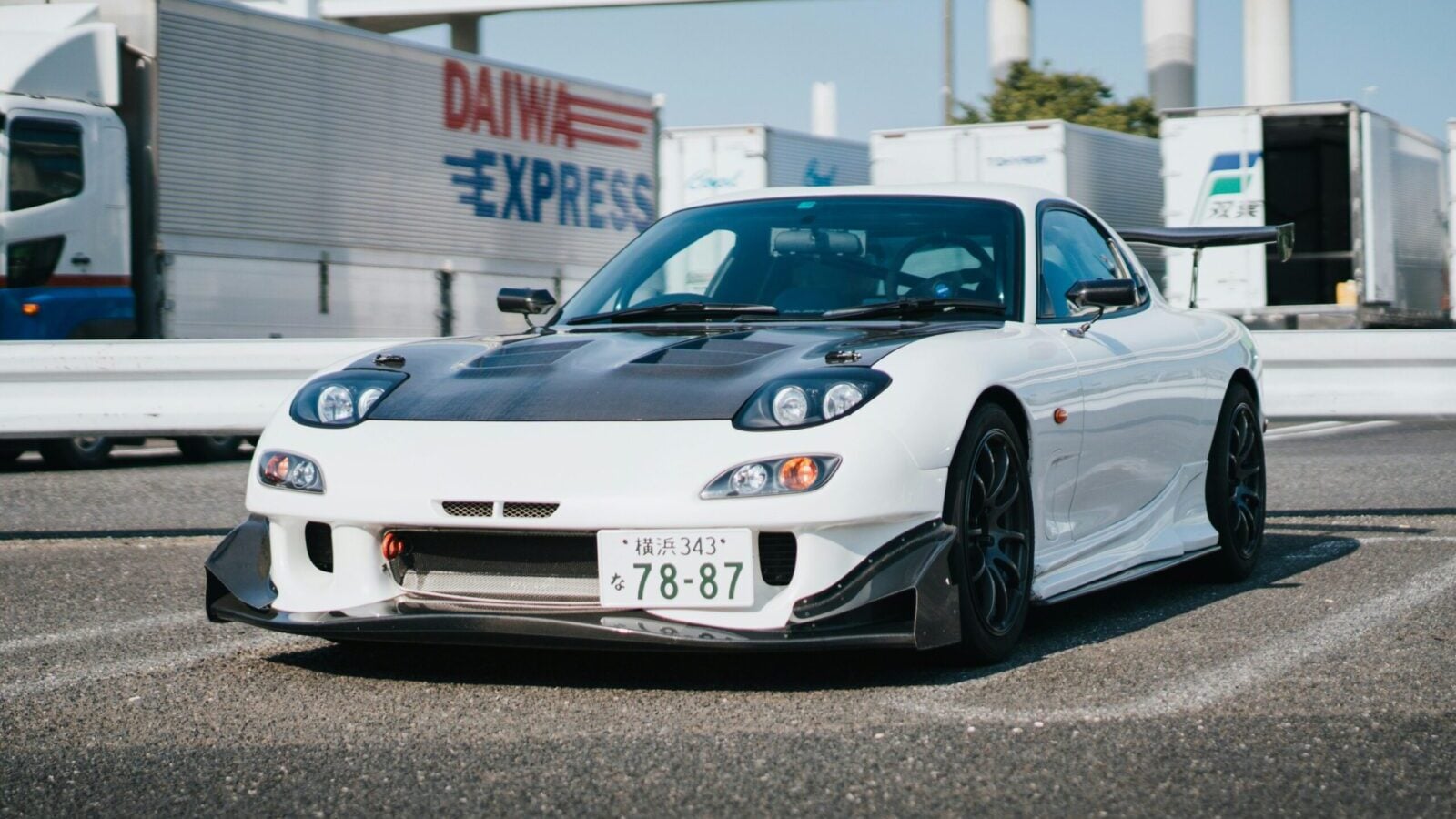
It’s tempting to connect this patent directly to the Iconic SP or another future Mazda sports car, but there’s currently no confirmation that this particular system will enter production, much less that it’s destined for a new RX model. There are, however, enough pieces appearing at roughly the same time to keep the speculation interesting.
Patents like this demonstrate that Mazda engineers continue working on solutions to the rotary’s real-world shortcomings, and the carmaker is also working on concepts and virtual motorsport projects such as the RX-Vision GT3 for the Gran Turismo video game.
The timing is also noteworthy, as May 2027 will mark 60 years since Mazda launched the Cosmo Sport, its first rotary-powered production vehicle. Again, an anniversary doesn’t prove a new sports car is coming, of course, but it would provide Mazda with an appropriate stage if it did have something planned.
Taken individually, patents, concepts, and Gran Turismo projects don’t confirm much, but when combined with Mazda’s continuing engineering work on turbocharging and emissions control, these factors make the prospect of another performance-oriented rotary considerably harder to dismiss. Maybe 2027 is the year the Wankel will return?