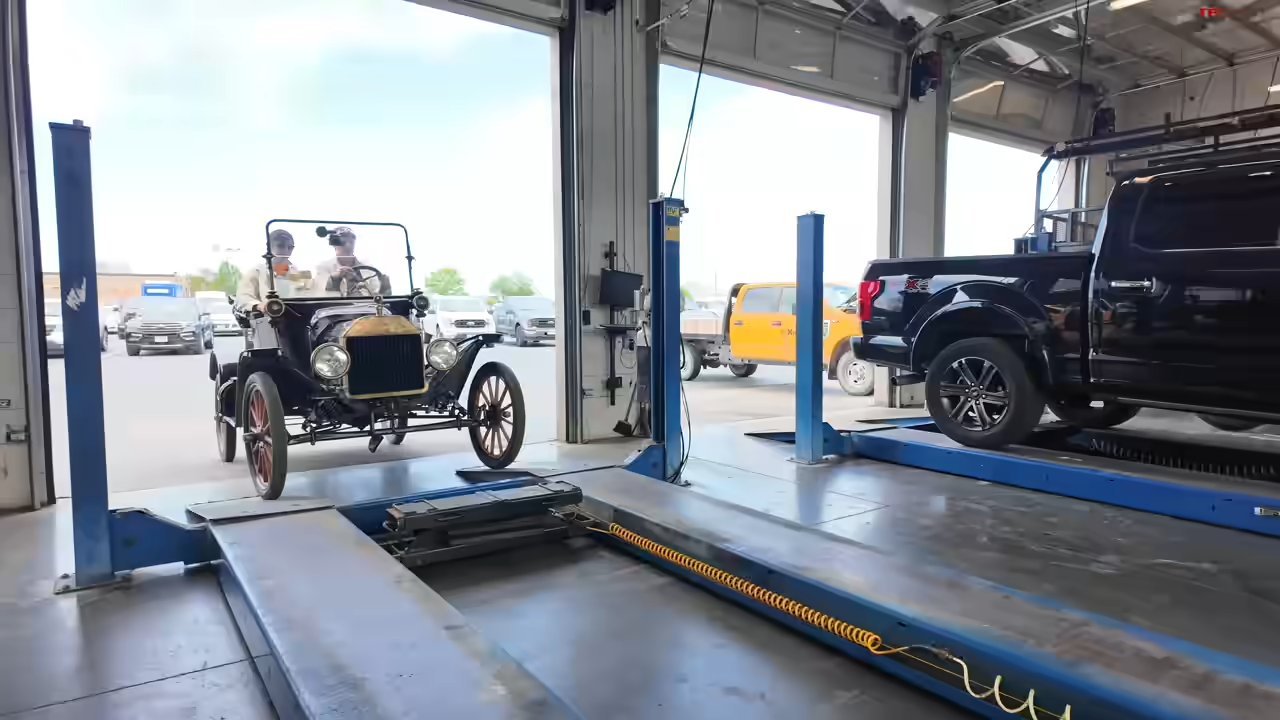
A routine oil change usually takes less than an hour, but what happens when the vehicle pulling into a modern Ford dealership was built before most American roads were paved?
The team behind TFLclassics decided to find out by bringing a 1915 Ford Model T to Brighton Ford in Colorado. The car was already 109 years old when they filmed the visit in 2024, and the service department agreed to take a look despite its unusual age. While it’s a bit of an older video, it caught my eye as a really hilarious look at how vehicles have changed!
The Model T had wooden wheels, a hand-crank starter, and a braking system unlike anything found on a modern car. Even more surprising, the engine and transmission shared the same oil, making a simple oil change very different from what today’s technicians normally handle.
Before the mechanics could get their hands on the antique Ford, however, its owners faced a bigger problem. They had to get the car to a dealership roughly 45 minutes away, and their planned route included highways where traffic traveled more than twice as fast as the Model T.
A Dangerous Drive
Embedded media follows; please allow a moment to load.
Tommy and Kase initially planned to drive the Model T all the way to Brighton Ford. They had recently worked on the engine and cooling system after severe overheating problems, and the trip offered a chance to see whether the repairs had helped.
On smaller roads, the car seemed relatively happy traveling around 30 mph. Its radiator held water, and the engine ran better than expected. The situation changed when they approached a highway with a 65-mph speed limit.
Climbing a hill, the Model T struggled to maintain 21 mph at full throttle. Meanwhile, modern traffic continued moving at highway speeds.
The car also had no hazard lights, and its primitive brakes made it hard to stop. At one point, the windshield began falling forward while they were driving.
“This is a bad idea,” one of the men said as they considered whether continuing was worth the risk.
They eventually abandoned the drive and used a truck and trailer to transport the Model T the rest of the way. The decision meant they could reach the dealership without forcing the antique car to keep up with modern highway traffic.
Mechanics Meet the Model T
When the Model T finally arrived at Brighton Ford, technicians got a closer look at a vehicle unlike anything normally passing through their service department.
One technician, Ray, said the oldest vehicles he had previously worked on dated to the early 1960s. The 1915 Ford was roughly half a century older.
The owners explained that the Model T used a four-cylinder engine with a displacement of approximately 2.9 liters. Unlike modern vehicles, it had no conventional oil pump, distributor, or water pump.
Instead, the engine relied on splash lubrication, while its cooling system used thermosiphon circulation. The owners had actually removed an aftermarket water pump while attempting to address their overheating problems.
Ray was also invited to start the engine using its hand crank. After receiving instructions about the ignition timing and proper starting procedure, he managed to get the old Ford running.
“It starts better than most of the cars I work on,” he joked.
An Unusual Oil Change
Once the vehicle was positioned in the service bay, the technicians turned their attention to the oil.
One of the Model T’s unusual features is that its engine and transmission share the same lubricant. That means changing the oil services both systems, not just the engine.
The owners and technicians also had to figure out how to drain the old oil. Modern service tools weren’t necessarily designed for the car’s fittings, and the team initially got confused about the drain plug size.
They ultimately used the Model T’s lower drain valve to remove the old lubricant.
Despite the vehicle’s age, the technician explained that modern motor oil could still be used. The dealership selected 5W-30 oil from its available supplies.
The team initially discussed a capacity of roughly 3.5 quarts, but the car ultimately accepted about 2.8 quarts during the service.
The owners also found the car was running low on oil. They estimated that only about a quart and a half had drained out before they added fresh lubricant.
Would It Pass Inspection?
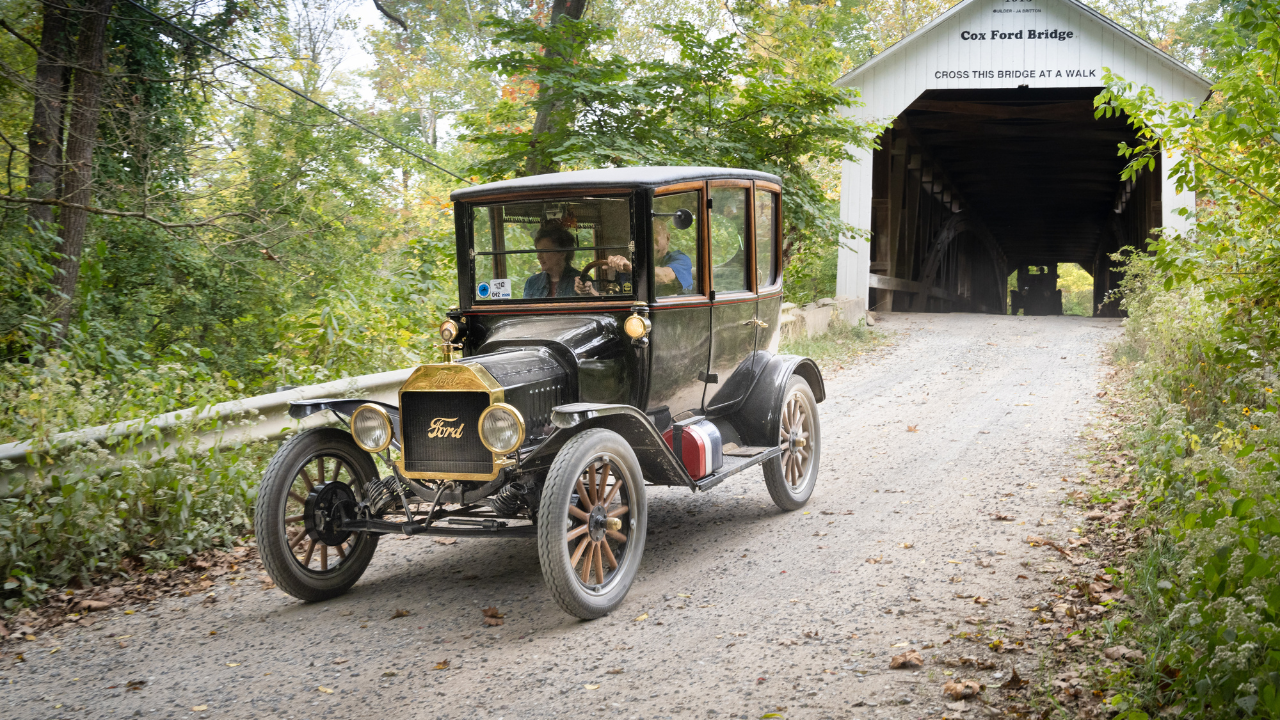
The Ford mechanics didn’t stop at the oil change.
When asked whether the Model T would pass a modern safety inspection, Ray immediately pointed to its front tires as a concern.
He explained that his approach to vehicle safety was to consider whether he would feel comfortable letting his wife drive the vehicle.
Asked whether he would let her drive the Model T, he gave a qualified answer.
“Around the block, yes. On the highway, no.”
The owners had already experienced the car’s limitations during their attempted highway trip.
Its service brakes relied on a band inside the transmission rather than the hydraulic braking systems found in modern vehicles. The Model T also had a separate mechanical parking brake, but the owners wanted additional braking improvements before taking it on more demanding trips.
The tires were another priority. The car’s narrow wooden wheels and inner tubes made replacing them more complicated than an ordinary tire change.
A Mechanic Takes the Wheel
After completing the oil change, the owners invited Ray to drive the Model T around the dealership.
The lesson began with an explanation of its unusual controls.
The right pedal operated the brake, the middle pedal controlled reverse, and the left pedal served as both the clutch and gear selector. A lever on the steering column controlled the throttle.
Ray quickly discovered that driving the antique Ford required forgetting much of what he knew about modern cars.
With some guidance, he managed to get the Model T moving through the parking lot, shift into its higher gear, and bring it safely to a stop.
It was his first time driving one, and the experience left him impressed with the vehicle’s design.
When the owners asked whether the dealership would accept another Model T for service, the staff appeared open to the idea.
There was just one complication: the service department couldn’t find the century-old model in its modern billing system.
The staff joked that they would have to figure out how to charge for the work themselves.
More Work Ahead
The visit demonstrated that a modern Ford dealership could still perform basic maintenance on a car built more than a century earlier, even if the service process required some improvisation.
The owners had no plans to turn their Model T into a museum exhibit. They wanted to keep driving it and documenting what ownership was like.
At the time of filming, they discussed replacing its tires, improving the brakes, fixing the windshield, and potentially taking the car up Pikes Peak.
They also revealed that the Model T had not undergone a full restoration since the 1950s.
Despite its age, the car continued attracting attention wherever it went. Its owners said they had paid about $12,000 for it, and they pointed out that later Model T examples could be purchased for considerably less.
Following the dealership visit, the Model T was running, its radiator was no longer boiling over as it had before, and its engine and transmission had fresh oil.
The tires and brakes still needed attention, but the owners had accomplished what they set out to do: getting a 1915 Ford serviced at a modern Ford dealership.