
Building a supercar from scratch is already an outrageous challenge. Building one almost entirely out of wood sounds like an idea most people would abandon after the first sketch.
Joe Harmon did not abandon it. The former North Carolina State University graduate student spent roughly seven years creating Splinter, a fully functional wooden supercar powered by a 7.0-liter V8.
The car recently appeared on Hagerty’s Barn Find Hunter, where host Tom Cotter was clearly stunned by the craftsmanship. That reaction makes sense because Splinter is not just a sculpture or static design exercise.
It runs, drives, weighs around 2,600 pounds, and produces approximately 650 horsepower. For something made largely from wood, those numbers are genuinely astonishing.
A Graduate Project That Became An Obsession

Harmon began sketching Splinter around 2006 while studying industrial design at NC State. He saw graduate school as a rare opportunity to build the kind of car he had dreamed about since childhood.
The project quickly grew far beyond a school assignment. After graduating, Harmon continued working nights and weekends for several more years until the car was completed around 2015.
In total, he estimates the build required about 20,000 hours of labor. That includes not only the car itself, but also the molds, jigs, fixtures, tooling, and experimental parts needed to make the impossible idea work.
Wood Was More Than A Styling Gimmick
Splinter’s body, chassis, wheels, and even many suspension components are made from wood. Harmon used metal only where it was structurally necessary, such as suspension hard points and key mechanical interfaces.
The goal was not to wrap a normal steel car in decorative wood. Instead, Harmon treated wood as a serious engineering material and designed around its strength-to-weight properties.
He says wood can be extremely strong for its weight when used properly. That helps explain how the car ended up weighing roughly 2,600 pounds, lighter than many modern performance cars.
A 650-HP V8 Sits Under The Wooden Skin
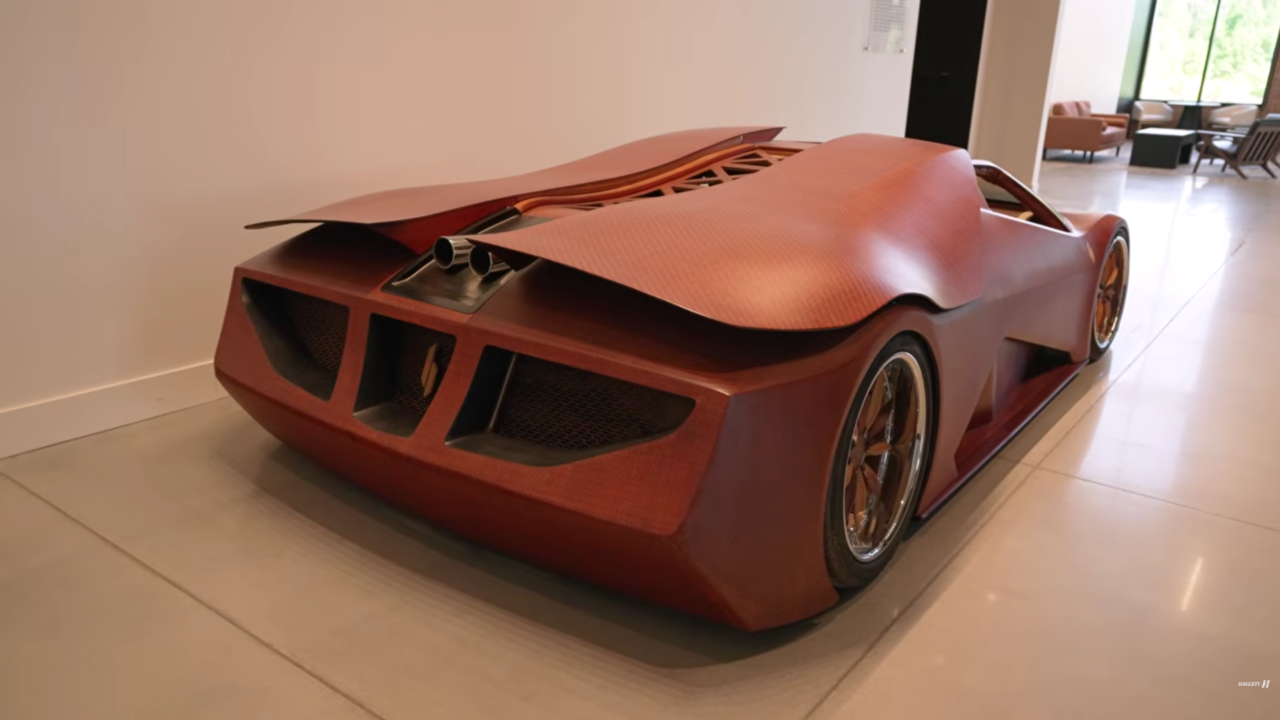
Despite the unusual construction, Splinter uses very serious performance hardware. Power comes from an LS7-based 7.0-liter V8 with internal upgrades, individual throttle bodies, custom intake work, and 180-degree cross-flow headers.
The engine makes approximately 650 horsepower and is paired with a six-speed manual transmission. Harmon adapted a C5 Corvette-style rear transaxle layout to suit the car’s custom mid-engine configuration.
The shifter mechanism had to be routed in an unusual way because of the drivetrain layout. Like many parts of the car, it required custom engineering rather than off-the-shelf solutions.
The Body Is Actually Woven Wood

One of Splinter’s most remarkable features is its woven wooden bodywork. At first glance, the surface resembles exposed carbon fiber, but the weave is made from thin strips of wood veneer.
Harmon and his team built their own looms because no normal process existed for weaving wood into usable body panels. The material was then laid into molds and formed using a vacuum-assisted resin process similar to composite manufacturing.
That method allowed the wooden panels to achieve compound curves that ordinary sheets of veneer could not manage. Harmon even designed the weave direction to flow symmetrically across the body instead of relying on overlapped sections.
Even The Wheels Are Partly Wooden
The wheels were one of the earliest major challenges. Each wheel contains hundreds of wooden pieces, with oak veneer forming much of the center section.
The rims use aluminum inner and outer shells, but the centers are primarily wood clamped together with metal plates and bolts. Harmon said the wheels took so much effort that he questioned whether the rest of the car would ever be finished.
Across the entire build, Splinter uses roughly 20 different types of wood. Cherry appears heavily in the body, walnut is used for decorative elements, and stronger woods such as maple, hickory, birch, ash, and oak appear throughout the structure.
A True One-Off Supercar
Splinter has only covered a small number of miles, but it is a functioning vehicle rather than a display model. It even received a VIN so it could travel internationally for an exhibition in Germany.
Harmon says the tooling for the car is now gone because he never wanted to build another identical example. That makes Splinter a true one-off, not the first prototype of a future production run.
It may not be practical, easy to enter, or likely to rack up road-trip mileage. Still, as a demonstration of creativity, engineering, and persistence, this 650-hp wooden supercar is one of the most astonishing homebuilt vehicles ever created.